Aller au contenu principal
En direct Manifestation « contre le racisme anti-blancs » à Angers : en dépit de l’interdiction, les néofascistes déroulent leur haine
0 nouveau 1 angles 8,911 dossiers
Mardi 24 novembre 2026 0
Traduit par NobuAI Les articles non francophones sont affichés en français quand une traduction NobuAI est disponible. Traductions NobuAI disponibles.
African and Caribbean nations call for formal apology for transatlantic slavery
Article · Lu chez BBC · il y a 5 mois

Les pays d’Afrique et des Caraïbes demandent des excuses officielles pour l’esclavage transatlantique

Traduit par NobuAI Article original en EN affiché en français.
Source BBC GB · EN
Centre État
Crédibilité de la source 90/100
Aperçu Résumé multi-sources à venir si d'autres couvertures rejoignent cette histoire.

Les dirigeants ont demandé des excuses aux pays qui ont bénéficié de la traite négrière, ainsi qu'un allégement de la dette et une compensation financière.

Texte intégral

Lire l'article complet dans GrimbaNews

731 mots
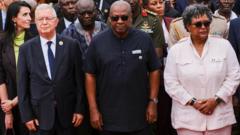
African and Caribbean nations call for formal apology for transatlantic slavery1 day agoYvette TanReutersGhana's President John Dramani Mahama, Barbados' Prime Minister Mia Amor Mottley and other dignitaries attended a wreath-laying event at the Christiansborg Castle, a former slave post in Ghana

African and Caribbean countries have called for a formal apology and reparations from countries that benefited from the transatlantic slave trade.

The demands come at the end of a three-day conference in Ghana which looked to advance the push for reparatory justice.

It follows a landmark UN resolution in March which recognised transatlantic slavery as the "gravest crime against humanity", urging UN member states to contribute to a reparations fund.

Around 12-15 million African men, women and children were captured and trafficked to the Americas to work as slaves from the 15-19th Centuries

A 19-point reparations plan has been endorsed as part of the "Next Steps" conference in the Ghanaian capital, Accra.

It calls for comprehensive debt relief, the restitution of looted cultural property, and the establishment of a global reparations fund, though no specific amount was stated. It also addresses the disproportionate impact of slavery on African women and girls.

The conference leaders also called on countries formerly involved in the slave trade to offer their "full, formal and unconditional apologies".

Ghana's President John Dramani Mahama told delegates: "History does not ask us to inherit guilt, but it asks us to inherit responsibility."

French President Emmanuel Macron also gave a virtual note at the conference, where he recognised that enslaved people were "dehumanised and treated as goods".

However, he cautioned against reducing reparations for slavery to financial compensation alone, saying they should not be seen as a "cheque written to bring the story to a close".

The UN General Assembly vote took place in March, with 123 votes in favour, and three votes - the United States, Israel and Argentina - against declaring the transatlantic slave trade a crime against humanity.

52 countries, including the United Kingdom and European Union member states abstained.

Unlike UN Security Council resolutions, those from the General Assembly are not legally binding.

The UK has long rejected calls to pay reparations, saying today's institutions cannot be held responsible for past wrongs.

"No single set of atrocities should be regarded as more or less significant than another," UK ambassador to the UN James Kariuki said at the time.

The US ambassador to the UN echoed this, saying his country did not "recognise a legal right to reparations for historical wrongs that were not illegal under international law at the time they occurred".

He added that the UN resolution was unclear as to "whom the recipients of 'reparatory justice' would be".

No country has ever paid reparations to the descendants of enslaved Africans or affected African, Caribbean and Latin American nations.

Most of the reparations paid by governments came in the form of compensation to slave owners in the 19th Century, rather than to those who had been enslaved.

That includes the UK - in the 1830s, following the abolition of slavery, the country paid owners the equivalent of more than $21bn (£16bn) in today's money.

UN votes to recognise enslavement of Africans as 'gravest crime against humanity'

'The gravest crime against humanity': What does the UN vote on slavery mean?

Atlantic slave tradeAfricaGhanaUnited NationsRelated

UN votes to recognise enslavement of Africans as 'gravest crime against humanity'

Workshops help trace African and Caribbean roots

What new artwork next to Colston window will look like

More from the BBC22 hrs ago

Oh, brother! The sibling rivals lining up for different World Cup teams

Sibling rivals are lining up for different teams at the World Cup, with seven pairs of brothers in total at this tournament.

22 hrs ago1 day ago

US to stop funding HIV programmes in South Africa

More than eight million South Africans are living with HIV – the highest number of any country in the world.

1 day ago2 days ago

UK law enforcement destroyed my reputation and integrity, ex-Nigerian oil minister tells BBC

Diezani Alison-Madueke was cleared of taking bribes from wealthy oil executives after six-month trial.

2 days ago2 days ago

Africa's greatest World Cup kits - pick your favourite

Your chance to rank 10 of the most colourful and iconic kits African teams have worn at the World Cup.

2 days ago2 days ago

Six-year-old Ebola patient taken from DR Congo hospital found and 'doing well'

Health facilities have come under attack during the current outbreak as a result of misinformation and fear.

2 days ago

Source originale : BBC ↗

Partager cette histoire

Envoyez le dossier, pas seulement un titre isolé.

Twitter Bluesky
Partager :
System Admin

Laisser un commentaire

Votre adresse e-mail ne sera pas publiée. Les champs obligatoires sont marqués *

Your experience on this site will be improved by allowing cookies.