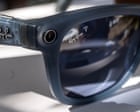
The Albanese government is considering a “world-leading” ban on smart glasses in its offices and service centres as councils around Australia push the technology out of public spaces over privacy fears.
The government has avoided a sweeping ban on the import of the camera-equipped technology and encouraged individual workplaces to set their own rules.
The public service minister, Katy Gallagher, said on Thursday she had asked the Australian public service for advice on whether the glasses should be prohibited.
“We need clear and consistent guidance for public servants,” Gallagher said.
“Smart glasses can raise legitimate privacy and security concerns, particularly because of their ability to record and capture information.”
Commonwealth-run workplaces range from bureaucrats’ offices to Centrelink service centres and CSIRO laboratories.
Smartglasses should automatically blur people’s faces while filming, Australia’s online safety regulator saysRead moreSchools and hospitals run by state governments would be left to set their own rules over the technology, which have grown increasingly popular but raised public outcry.
A University of Sydney study of smart glasses-filmed videos posted on Instagram found 60% of a sample could be classified as potential harassment.
The Albanese government said it was seeking to set a world-leading standard. So far, no national government has banned the glasses’ use across their agencies.
Courts in England and Wales in the UK and New York state in the US have banned the technology, while the US Immigration and Customs Enforcement (ICE) agency reportedly classified them as body-worn cameras and barred them from the “federal workspace”.
A local council in Sydney on Tuesday became the latest to issue a targeted bans on the use of the technology. Canterbury-Bankstown’s mayor, Bilal El-Hayek, decried what he called “pervert glasses” as the council barred the wearable tech from public pools.
In August, Brisbane city council became the first to ban the glasses from pools and Melbourne’s Yarra city council has banned them from playgrounds, childcare centres and gyms.
The City of Sydney and the Blacktown city councils have prohibited pool patrons from using smart glasses to record.
Speaking to Channel Seven earlier this month, the federal attorney general, Michelle Rowland, praised councils’ decisions and said she would consult businesses on their approach.
“Businesses know that good privacy is good business,” Rowland said.
“But … we want to make sure we get the balance right and we don’t unfairly discriminate against people who are using this technology to better participate in society.”
Vision Australia and some people living with disabilities have praised the technology as a support for people who are blind or have low vision. Rowland said the government was not pursuing a ban but had not “ruled anything out”.
Could Meta’s ‘pervert glasses’ be banned across the UK? - The LatestGallagher said she wanted the Australian public service to set the national standard as a “model employer”.
“Technology is changing rapidly and as a major employer the Commonwealth needs to make sure our workplace policies keep pace,” Gallagher said.
Pending restrictions on smart glasses would be the federal government’s latest workplace technology reform after it issued guidance on the use of AI in the public service last week.
The guidelines indicate employees would not need to be consulted on every new tool but should be consulted for major initiatives or changes to how they carry out work.
Major businesses will contribute to new national guidelines on AI in workplaces, with Commonwealth Bank, Microsoft, AGL, Telstra, Kmart, Blackmores Group and Ramsay Health Care to attend a roundtable on Friday.
Amanda Rishworth, the employment minister, said the government wanted to use the roundtable to take on the lessons of businesses already using AI.
“Workers and businesses need the capability to adopt new technologies with confidence that appropriate safeguards are in place,” Rishworth said.
Additional reporting from Caitlin Cassidy
