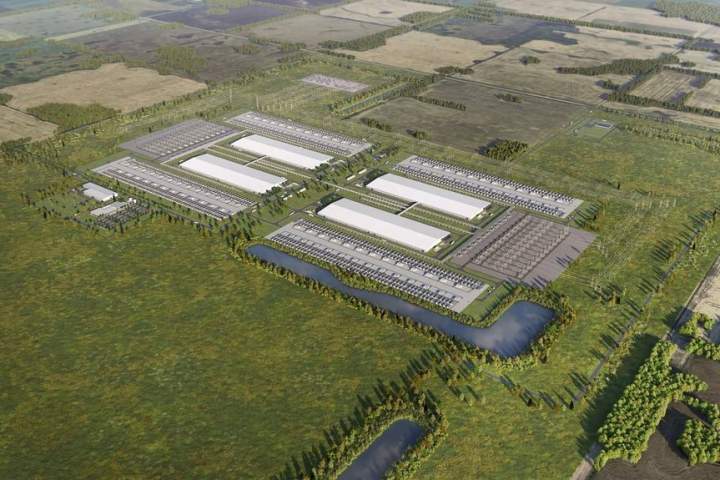
Alberta is looking at setting new rules around major data centres and where they can be built, as the provincial government continues to encourage tech investment in the Prairie province.
Bill 42: Energy, Environment and Utilities Statutes Amendment Act was tabled Wednesday in the Alberta legislature, at a time when 70 data centre proposals are currently being considered for development.
“We don’t need every data centre to get built in Alberta, we don’t need every proposal to move forward in Alberta — we need the right ones,” Technology Minister Nate Glubish said on Wednesday when sharing details of the legislation.
For data centres of 10 megawatts or larger, the bill would impose a 600-metre buffer zone, or setback, from homes, irrigated land and what the province calls high-quality farm areas.
“We, essentially, were trying to find a balance between ‘What does responsible development look like? and ‘How do we protect communities and homeowners?’ and that’s how we settled on the 600 metres,” Glubish said.
Municipalities would also be allowed to set their own larger setbacks.
The bill would also allow the province to set standards for data centre water use, but they wouldn’t apply to gas-fired power plants used to run the massive computing complexes.
It would also recognize designated industrial zones, brownfield sites and existing power generation sites to encourage development in areas already suited for major industrial projects.
The Alberta Utilities Commission (AUC) would be the primary provincial regulator responsible for reviewing and approving data centres of 10 megawatts and larger.
2:02 Report finds Meta data centre could result in an additional $460 in electricity costs- Report finds Meta data centre could result in an additional $460 in electricity costs
- Sturgeon County data centre construction draws concerns from residents
- Meta to build $13B data centre in Alberta
- Meta to build $13 billion data centre in Alberta, largest outside the U.S.
- Danielle Smith announces deal with Meta to build new AI data centre in Alberta
- Alberta inviting more data centre development
The government says the rules wouldn’t apply to projects that have already secured development permits and are well underway, including tech giant Meta’s planned $13-billion artificial intelligence data centre campus near Edmonton.
Opponents feel buffer zones need to be several kilometres away from homes, not just a few hundred metres.
Get breaking National news
Get breaking Canada news delivered to your inbox as it happens so you won't miss a trending story. By providing your email address, you have read and agree to Global News' Terms and Conditions and Privacy Policy.Bek MacIntosh of Olds, Alta. founded Little Town Big Data, a non-profit to educate and provide resources to communities that oppose major data centre infrastructure nearby.
View image in full screen Data centre opponent Bek MacIntosh reviews documents at her home in Olds, Alta. on Friday, April 24, 2026. Jeff McIntosh/ The Canadian PressShe wanted to see a residential buffer zone of at least two to five kilometres.
“When you’re talking power generation, when it comes with the inherent risks — while I know we have a fantastic track record in oil and gas and safety and how we produce things, the reality is there are causes and harms that happen every single day.
“That would be incredibly devastating to any nearby community.”
Share this on X Click to share quote on X: "That would be incredibly devastating to any nearby community."
She also wants to see more rural land protected.
“Not just prime farmland — we’ve got a lot of really important agricultural land that needs to be preserved, because these developments have a shorter lifespan and the reclamation of them would mean a permanent destruction of soil,” MacIntosh said.
- Richmond unanimously rejects supervised consumption sites
- Ford admits his French needs work after shaky Montreal speech
- Ford puts onus on Ottawa ahead of Stellantis Brampton plant talks
- Canada to review where Chinese EVs are allowed to drive: transport minister
Back in the summer, Glubish was met with anger, profanity and concerns from hundreds of Albertans at a series of town halls over artificial intelligence data centres.
Speakers expressed concern that local resources — such as water, land and electricity — might be sucked dry. Some said trust in the provincial government has been lost on the file.
At that time, he said AI technology is going to be built globally, no matter what happens in Alberta. He said the province should take advantage of the investment, jobs and private investment in power generation.
1:52 Alberta minister faces fury at Sturgeon County town hall on AI data centresOn Wednesday, Glubish said the bill shows the government has listened and that the rules will protect communities while providing the industry with the certainty needed to build in Alberta.
In August, a site proposed near Olds, north of Calgary, was deemed too close to the town for a natural gas plant that would have powered a massive AI data centre. The proximity to the community killed the project and Glubish said the new legislation ensures similar sites won’t be considered again.
“Don’t waste your time and don’t waste Albertans time on areas that don’t make sense,” Glubish said. “We’ve provided that clarity.”
Polling back in July showed most people are concerned about the potential impacts of data centres.
The Leger poll shows 44 per cent of Canadians would support AI data centre development in their own province, while 42 per cent would oppose it.
The province’s announcement comes a day after Calgary city council voted in favour of taking steps to develop new regulations and oversight for large-scale data centres in the municipality.
With files from Lisa Johnson and Jack Farrell, The Canadian Press and Adam MacVicar, Global News
Add Global News as a Preferred Source on Google to see more of our stories in your search results.
Journalistic standards Report an error © 2026 Global News, a division of Corus Entertainment Inc.