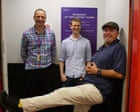
Australian scientists have used gravity as a means of communication, in a proof-of-concept experiment involving a snail-paced 1950s elevator, a brick wall and a men’s bathroom.
Physicists at the University of Queensland have used gravity to transmit a “practically unblockable” message about 70cm through a brick wall, by sending an elevator up and down between two floors and measuring changes in the gravitational field as a result of the movement.
From gold rush to cosmic questions: a South Dakota mine and the search for the secrets of the universeRead moreThe research, published in the journal Science Advances, involved a sensitive detection device known as a gravimeter, which was set up on the floor of a men’s bathroom adjacent to the lift.
The gravimeter was able to detect the position of the elevator’s 1.8-tonne counterweight as it moved between two levels – representing 0 and 1 in binary code – which enabled the scientists to send a message.
A gravimeter, set up in a men’s bathroom, was used to detect the position of an elevator counterweight, enabling scientists to transmit a message. Photograph: Andrew Groszek/University of QueenslandThe researchers chose to transmit the word “gravity”, or 1000111 1110010 1100001 1110110 1101001 1110100 1111001 in binary code. At a transmission rate of one bit (digit) per minute, the single word took nearly an hour to send.
The scientists say that while gravitational communication is currently far from usable given its extremely slow speed, an advantage is that it is a “practically unblockable wireless communication scheme”.
“Unlike the electromagnetic signals used in modern wireless communication, a gravitational signal cannot simply be screened out by placing ordinary material in its path,” said co-author Dr Charles Woffinden, of UQ’s school of mathematics and physics, in a statement. “Anyone who has lost phone reception in a tunnel or struggled with wifi through a solid wall will understand the appeal.”
Sign up for the Breaking News Australia emailStudy co-author Prof Matthew Davis told Guardian Australia: “At the moment, it’s very hard to imagine how it could be practically useful.” But he added that the experiment was “theoretically interesting enough that it was worth doing”.
To put into perspective how slow the message transmission was, Davis said that Nasa’s Voyager 1 spacecraft, which after 49 years of travel had just reached a distance of one light-day away, could “communicate with Earth at a faster data rate than our communication concept”.
According to Davis, the new method of communicating could theoretically occur at ranges of up to 500 metres and at a rate 15 times faster, if more sensitive quantum gravity sensors were used.
skip past newsletter promotionFree newsletter |When neededSign up to Breaking News Australia
Get the most important news as it breaks
after newsletter promotion
‘It’s literally slower than watching Australia drift north’: the laboratory experiment that will outlive us allRead moreThe idea for the elevator study arose from a project to develop a contactless weighbridge – which would use quantum sensors to detect changes in the strength of gravity due to a passing truck, allowing scientists to determine the mass of a large vehicle.
Classical gravimeters can be thought of as a mass on a spring. “If you stretch the spring, the mass bounces up and down at a certain rate, which is determined by the spring and the gravitational field,” Davis said. “If the gravitational field changes ever so slightly, the rate at which it bounces back and forth changes.”
“Quantum sensors are still under development,” Davis said.
“Sometimes doing physics leads in unexpected ways and it’s a bit of fun … you get to do quirky things on the side,” he added. “It’s one of the great joys of science to have stuff like this happen.”
Other near-unblockable methods of communication – involving neutrinos or gravitational waves – have been proposed, “but these approaches are somewhat hindered by the difficulty in generating a measurable signal”, the scientists note.
The physicists conducted the research in UQ’s Parnell physics building, which is also home to the world’s longest-running science experiment – the pitch drop experiment, which began in 1927.