Archaeologists solve 1,800-year-old Roman fresco puzzle in London
London researchers have reconstructed a large Roman wall plaster collection, revealing 1,800-year-old frescoes that decorated a high-status building. (Source: MOLA)
NEWYou can now listen to Fox News articles!Florida students are uncovering remnants of the past in a place many associate with the future: Cape Canaveral Space Force Station.
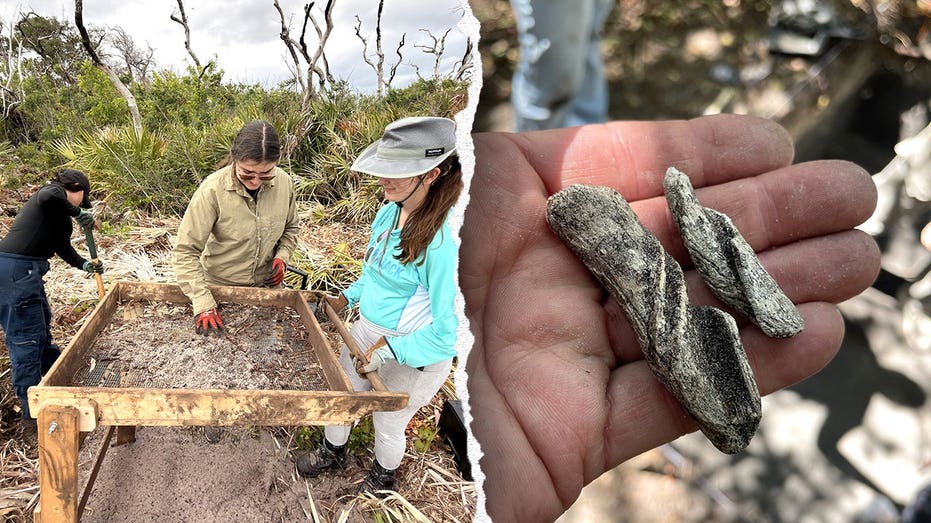
University of Central Florida students and faculty are currently excavating the DeSoto site at Cape Canaveral, along the coast of the Atlantic Ocean.
The site dates back to the Malabar II Period, which lasted from roughly 900 to 1565 A.D. It consists of black earth midden deposits — meaning it sits atop layers of ancient refuse.
Middens "contain the garbage that people left behind after undertaking their daily tasks," said Sarah "Stacy" Barber, an anthropology professor at the University of Central Florida.
Barber told Fox News Digital that "obtaining and preparing food" was an important daily activity for the people who lived there.
University of Central Florida researchers are excavating an ancient midden site at Cape Canaveral, uncovering evidence of Indigenous life dating back centuries along Florida's Atlantic coast. (Neil Duncan)
"They didn’t farm, although research by Neil Duncan has shown that at least some people in the region had access to ground corn, which was being farmed by the Indigenous people of North Florida," she said.
Instead of farming, Native Americans in the area largely relied on local resources, though some people in the region had access to imported foods such as corn and beans.
ARCHAEOLOGISTS UNCOVER CENTURIES-OLD SHIPWRECK BENEATH HISTORIC CITY: 'UNIQUE SOURCE OF KNOWLEDGE'
They also dined on seafood, including shark, fish, clams and other local species — remains of which have turned up in the midden.
"We know from our finds this year at DeSoto that turtles, shark, black drum, and coquina clams were on the menu."
"We have found the refuse of many dozens of meals," she said. "We know from our finds this year at DeSoto that turtles, shark, black drum, and coquina clams were on the menu."
Barber added, "So, ancient people fished the lagoon and the beachfront. Once we can add in the plant remains, which take longer to process in a lab, we’ll know whether these animals were supplemented with plant foods like acorns and greenbriar."
ARCHAEOLOGISTS STUMPED BY STRANGE ALIEN-LIKE FIGURINE DATING BACK 7,000 YEARS: 'RAISES QUESTIONS'
The professor said there is even evidence of seasonings — suggesting ancient people "spiced up their food just like we do."
"We have made a number of really interesting finds this year," she said.
Excavations at the DeSoto site have uncovered food remains and artifacts that shed light on daily life during the Malabar II Period between 900 and 1565 A.D. (Neil Duncan)
Those finds include the "complete vertebral column of a shark," which the Native Americans would have eaten, as well as "something that is either a fossil or a whale bone near the shark."
The anthropologist said the unidentified object "has really stumped us."
CLICK HERE TO SIGN UP FOR OUR LIFESTYLE NEWSLETTER
"We look forward to figuring out what that is," she said.
Archaeologists have also found hundreds of pottery sherds, as well as "the remnants of at least one hearth where food was likely cooked."
"It was probably a comfortable, beachfront lifestyle."
Barber added that samples still need to be sent to an outside lab for radiocarbon dating.
At the site, archaeologists also found tools such as conch shell hammers and shark tooth knives used to prepare food.
CLICK HERE FOR MORE LIFESTYLE STORIES
Researchers say the remains show that Indigenous people made deliberate choices about what they ate, with shark remains found at the site but little evidence that dolphins were hunted.
Finds suggest the Native Americans relied largely on local resources for centuries, while also having contact with other tribes.
Excavations suggest that Indigenous communities lived in relatively dense populations while relying entirely on locally sourced food for generations. (Christina Threlkeld, Neil Duncan)
"The Indigenous people of Cape Canaveral lived in relatively dense communities and relied 100% on locally obtained food," Barber said.
"They did it for thousands of years, and they didn’t put the kind of stress on the local environment that we have in far less time."
TEST YOURSELF WITH OUR LATEST LIFESTYLE QUIZ
Rather than living hand-to-mouth, Barber said the community was well-connected and far from isolated.
"Our sites show an abundance and diversity of food, time to produce pottery when needed, and the opportunity to either travel or interact with people in distant regions," she said.
"There are few places in the world highlighting the role of the past in the present than somewhere like Cape Canaveral," said Barber. (John Raoux/AP Photo)
"It was probably a comfortable, beachfront lifestyle."
Above all, Barber said the excavations show how the past and present can exist side by side.
CLICK HERE TO DOWNLOAD THE FOX NEWS APP
"There are few places in the world highlighting the role of the past in the present than somewhere like Cape Canaveral, where the future of space flight literally sits atop and among Native American landscapes," she said.
Andrea Margolis is a lifestyle writer for Fox News Digital and Fox Business. Readers can follow her on X at @andreamargs or send story tips to andrea.margolis@fox.com.
