UK and EU have provisionally agreed to allow 100,000 EU citizens to come to the UK every year under a new mobility scheme.
LIVE Updated 2m agoJakub KrupaFri 20 Nov 2026 03.40 ESTFirst published on Fri 20 Nov 2026 03.12 ESTShareKey events- 2m agoPM Burnham leads business roundtable ahead of EU-UK summit in Brussels
- 14m agoUK and EU plan first talks on sending refused asylum seekers to third countries
- 22m agoRow over voting rights dispels myths that UK comes to negotiations from position of strength - snap analysis
- 28m agoTalks went down to the wire this morning
- 29m agoMorning opening: Second post-Brexit EU-UK summit gets under way in Brussels
Row over voting rights dispels myths that UK comes to negotiations from position of strength - snap analysis
Lisa O’CarrollSenior correspondent
France’s insistence that the UK could not have voting rights at any stage during the shaping of legislation on food standards and public health risks relating to food and agri products is a line in the sand for Andy Burnham.
Journalists arrive as preparations are made for the EU-UK Summit at the European Council building in Brussels. Photograph: Virginia Mayo/APThe last night tensions at the ambassadors meeting will be a sharp lesson for anyone in the UK who clings to the idea that negotiating with the EU comes from a position of strength: the UK is not a member of the EU and despite the warm feelings to the Labour government in European capitals, benefits of the club are not extended to non members.
It also underlines the feeling expressed by several large member states this week that the way forward after this summit is not more iterative reset summits or mini-deals.
EU ‘to close door’ to talks on long-term UK ties until Burnham has decided on BrexitRead moreYes, there will be negotiations on allowing the UK into the energy single market as this is in the joint interests of both sides in the wake of the Ukraine war. But no talks on pharma or chemicals, according to some capitals.
As one diplomat said:
“It puts down a marker warning the UK that cherry picking bits of the single market mean you are a rule taker.”
“It makes the choice for Britain starker and more binary” and shows that “the alternatives are basically muddling along with a version of the status quo or rejoining,” they said.
ShareKey events- 2m agoPM Burnham leads business roundtable ahead of EU-UK summit in Brussels
- 14m agoUK and EU plan first talks on sending refused asylum seekers to third countries
- 22m agoRow over voting rights dispels myths that UK comes to negotiations from position of strength - snap analysis
- 28m agoTalks went down to the wire this morning
- 29m agoMorning opening: Second post-Brexit EU-UK summit gets under way in Brussels
PM Burnham leads business roundtable ahead of EU-UK summit in Brussels
Prime minister Burnham is up early, leading a roundtable with business leaders at the British ambassador’s residence in Brussels.
Britain's prime minister Andy Burnham and Britain's chancellor of the exchequer John Healy attend a roundtable with business leaders during Burnham's visit for the EU-UK summit, at the official residence of the British ambassador to Belgium, in Brussels. Photograph: Hannah McKay/ReutersHe will no doubt be keen to stress the tangible benefits of today’s deals to businesses, helping them trade with the EU.
Share14m ago03.28 ESTUK and EU plan first talks on sending refused asylum seekers to third countries
Rajeev Syal and Lisa O’Carroll
The UK and the EU plan to establish formal talks for the first time about sending rejected asylum seekers to third-country hubs, according to a leaked document.
A migrant leaves an abandoned warehouse, where some migrants are taking shelter during the winter months, in Marck, near Calais, northern France. Photograph: Sameer Al-Doumy/AFP/Getty ImagesA draft of a joint statement expected to be signed by Andy Burnham and Ursula von der Leyen at a summit on Friday morning states that both sides will establish “a structured dialogue” to discuss “returns to third countries”.
Until now, the Home Office has been seeking bilateral agreements with third countries allowing the removal of migrants, but with no obvious success.
Last week, five EU countries – Austria, Denmark, Germany, Greece and the Netherlands – announced an agreement in principle with Rwanda to establish a migrant “return hub” there in 2027.
Burnham hinted at possible cooperation with EU countries last week when he told reporters that the UK had not had direct discussions with European governments involved in return hubs but “we will watch that [the five-country deal] with interest, learning from what went on in the past”. He said: “The public want us to do whatever we can to deal with illegal immigration.”
The UK has been fighting for deeper cooperation with the EU on migration, with the new deal on a “strategic dialogue” secured in the last two weeks by negotiators in Brussels.
It is a key part of the UK-EU reset pact, which also covers a youth mobility scheme, tariffs on Chinese imports, food and drink exports to the EU and a wider restatement of commitment on defence and security.
Informed sources confirmed this was the first time the UK and the EU had agreed to “open a dialogue on returns” after the launch of the bloc’s Channel action plan in June this year.
Whitehall sources said the UK was now open to the possibility of sending rejected claimants to Rwanda – a recent pivot from the position under Keir Starmer’s government, which rejected the move.
According to a draft of the joint agreement, negotiations over third-country hubs will be part of increased cooperation to tackle irregular migration.
UK and EU plan first talks on sending refused asylum seekers to third countriesRead moreShare22m ago03.20 ESTRow over voting rights dispels myths that UK comes to negotiations from position of strength - snap analysis
Lisa O’CarrollSenior correspondent
France’s insistence that the UK could not have voting rights at any stage during the shaping of legislation on food standards and public health risks relating to food and agri products is a line in the sand for Andy Burnham.
Journalists arrive as preparations are made for the EU-UK Summit at the European Council building in Brussels. Photograph: Virginia Mayo/APThe last night tensions at the ambassadors meeting will be a sharp lesson for anyone in the UK who clings to the idea that negotiating with the EU comes from a position of strength: the UK is not a member of the EU and despite the warm feelings to the Labour government in European capitals, benefits of the club are not extended to non members.
It also underlines the feeling expressed by several large member states this week that the way forward after this summit is not more iterative reset summits or mini-deals.
EU ‘to close door’ to talks on long-term UK ties until Burnham has decided on BrexitRead moreYes, there will be negotiations on allowing the UK into the energy single market as this is in the joint interests of both sides in the wake of the Ukraine war. But no talks on pharma or chemicals, according to some capitals.
As one diplomat said:
“It puts down a marker warning the UK that cherry picking bits of the single market mean you are a rule taker.”
“It makes the choice for Britain starker and more binary” and shows that “the alternatives are basically muddling along with a version of the status quo or rejoining,” they said.
Share27m ago03.15 ESTJennifer Rankinin Brussels
UK prime minister Andy Burnham will be welcomed with a rendition of God Save the King and the Ode to Joy when he attends the opening ceremony around 10.30am local time.
Musicians rehearse the British national anthem and the European anthem ahead of the EU-UK summit in Brussels, Belgium. Photograph: Olivier Hoslet/EPAShare28m ago03.13 ESTTalks went down to the wire this morning
Lisa O’CarrollSenior correspondent
Talks to seal today’s reset in relations between the UK and the EU went write down to the wire this morning.
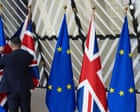
A member of protocol arranges the Union flag and EU flag as preparations are made for the EU-UK Summit at the European Council building in Brussels. Photograph: Virginia Mayo/APIn what is known as a “silence procedure”, the EU issued a late night compromise text to all member states after a meeting of crunch hours long meeting of ambassadors in Brussels last night.
Under the procedure if no member states breaks the silence the text is considered “adopted” and would then be made available for signing by the UK – bar any last minute hitches on its side.
This morning diplomats said “no one had broken the silence”.
The headline agreements are:
Food and drink deal, setting up sanitary and phyto sanitary common area
An electricity carbon emissions deal
Cap of 100,000 EU citizens under 31 years old to come to the UK under a new youth mobility scheme
The issue of tuition fees kicked down the road - a supplementary agreement has been reached to sort this out within the next six months
This allows the UK to hold up the youth deal if the EU does not give it what it needs in the Made in Europe legislation which is expected to reach its final negotiations stages by Easter too.
No voting rights for the UK when the EU comes to writing new laws about food standards; this was never a realistic option as the UK is not a member of the EU, but the French led the resistance as the UK pushed for it equally as hard, instead the UK will be consullted at key stages
Industry groups say that must mean UK regulators are in the room at the early stages. Food regulation is very technical, the say and this is where the real decisions are taken.
The two sides will also open talks on UK entering the energy single market.
Morning opening: Second post-Brexit EU-UK summit gets under way in Brussels
Jakub KrupaThe EU and UK will hold a long-awaited summit in Brussels on Friday – the second since Brexit – to hammer out the UK’s longer-term relationship with the bloc.
A member of protocol arranges the Union flag and EU flag as preparations are made for the EU-UK Summit at the European Council building in Brussels. Photograph: Virginia Mayo/APIt will be attended by the prime minister, Andy Burnham, the head of the European Commission, Ursula von der Leyen, and the president of the European Council, António Costa.
As our Brussels correspondent, Jennifer Rankin, explained:
What is at stake at the EU-UK summit in Brussels?Read more“The two sides hope to announce three deals, which were initiated under Starmer’s government.
First, a food and drink agreement that will remove a lot of Brexit red tape on animal and plant products, making it easier to trade meats, cheese, wine and flowers. To secure the deal, which is not expected to take effect until 2028, the UK will align with EU standards, meaning the government, for example, must abandon a planned ban on foie gras imports.
A second agreement will link the British emissions trading system with its bigger EU cousin, restoring a link severed by Brexit. It is a significant step for industry because EU and UK businesses will be exempt from each other’s charges on high-carbon imports such as steel, cement and electricity. This agreement also requires alignment with relevant EU rules.
The third deal has proved the most contentious: a youth mobility scheme that will give those aged 18-31 the right to live, work, travel and study on both sides of the Channel for up to three years. The scheme may not be up and running until 2030 – which is bad news for anyone in their late 20s.”
The leaders are expected to arrive 9.30am GMT (10.30am Brussels time), with “the leaders’ meeting” between Burnham, von der Leyen and Costa to follow.
A plenary session with UK ministers and EU commissioners is expected at 10.45am GMT (11.45am Brussels), and if all goes well we should then see the leaders tell us what they agreed around half past midday (1.30pm Brussels time).
I will bring you every single detail of the day here today. You won’t miss a thing.
It’s Friday, 20 November 2026, it’s Jakub Krupa here, and this is Europe Live.
Good morning.
ShareExplore more on these topicsShareReuse this content