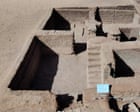
Well-preserved fourth-century quarters reveal details of daily life, urban development and economic activities
Nadeem BadshahSat 4 Jul 2026 16.32 EDTLast modified on Sun 5 Jul 2026 11.07 EDTSharePrefer the Guardian on GoogleArchaeologists in Egypt have uncovered a well-preserved Byzantine-era city in the western desert.
The fourth-century quarters had residential and religious structures, including a basilica-style church in the Dakhla oasis. Archaeologists also found coins, pottery fragments and tools.
Separately, 18 ancient tombs were discovered at Marina el-Alamein, near Alexandria, which includes rock-cut and limestone tombs, pottery and a granite sarcophagus.
The tourism and antiquities ministry said the first discovery reveals details of daily life, urban development and economic activities when Egypt was part of the Byzantine empire.
Doorways through the archaeological site in Dakhla. Photograph: Ministry of Tourism and AntiquitiesThe unearthed quarters included north-south thoroughfares intersected by east-west streets, forming open squares and public spaces, said Hisham el-Leithy, secretary general of the supreme council of antiquities.
A basilica dating back to the mid-fourth century stands at the settlement’s head, overlooking its main streets, along with remains of two watchtowers to safeguard the outskirts, according to Mahmoud Massoud, who chairs the archaeological mission.
The oasis, located in Egypt’s western province of New Valley, is on Unesco’s tentative list, a step away from being added to the agency’s world heritage list.
A heavily fortified structure with thick defensive walls, and many houses consisting of reception halls and vaulted roofs, were found in the area, Massoud added.
Archaeologists also uncovered bread ovens, kitchens, stone grinding tools and bronze coins. Photograph: Ministry of Tourism and AntiquitiesAmong them were the house of Tisous, a church deacon, which dates to the second half of the fourth century. Archaeologists believe it served as a house church before the construction of the city’s basilica.
Archaeologists also uncovered bread ovens, kitchens, grinding tools and bronze coins bearing portraits of Byzantine emperors, Latin inscriptions and Christian symbols.
A group of gold coins unearthed dated to the reign of Roman emperor Constantius II, who ruled between 337 and 361, the ministry statement said.
Diaa Zahran, head of the Islamic, Coptic and Jewish antiquities department, said they found a collection of about 200 pottery fragments which would have been used as writing material. The fragments, known as ostraca, have inscriptions detailing commercial transactions, correspondence and other details of daily life, according to Zahran.
The seven surface limestone-built tombs discovered in the Marina el-Alamein site west of Alexandria. Photograph: Ministery of Tourism and Antiquities/APArchaeologists also found ancient tombs in the Marina el-Alamein archaeological site, which is about 62 miles (100km) west of the Mediterranean city of Alexandria.
The findings included 11 rock-cut tombs with an average depth of eight metres, and seven surface limestone-built tombs, the ministry said. It has brought the total tombs found at the site to 48.
In the site, archaeologists found pottery vessels, amphorae, lamps, plates, altars and limestone basins.
An artifact discovered at Marina el-Alamein. Photograph: Ministery of Tourism and Antiquities/APThe mission chief, Eman Abdel-Khaliq, said they found a 2.5-metre-long granite sarcophagus, with skeleton remains that were being studied. Close to the sarcophagus, they found the remains of a plaster sphinx statue, she said.
Four gold pieces were placed inside the mouths of some of the deceased, known as “the golden tongue”, which had been a practice associated with funerary beliefs of that era, Abdel-Khaliq said.
Marina el-Alamein is an archaeological site close to the city of Alamein on Egypt’s northern coast, unearthed in 1986. Archaeologists believe the site was the ancient Greco-Roman port city of Leukaspis on the Mediterranean, which was built in the second century and thrived until the fourth century.
This article was amended on 5 July 2026. The house of Tisous dates to the fourth century, not the 14th century as an earlier version said due to an error introduced during editing.
Explore more on these topicsShareReuse this contentHundreds of coffins to be restored in Egyptian conservation project
17 Jan 2017Scientists find buried branch of the Nile that may have carried pyramids’ stones
16 May 2024Solstice-aligned 5,000-year-old monument ‘once in a lifetime find’, say archaeologists
17 Jun 2026Egypt scraps plan to restore cladding on one of three great pyramids of Giza
16 Feb 2024Ancient DNA provides evidence of earliest known plague outbreak
17 Jun 2026Egypt unearths 7,000-year-old lost city
23 Nov 2016…… commentsArchaeologists discover wreck of Danish warship sunk by Nelson 225 years ago
2 Apr 2026Ancient Egyptian mummy discovered 'in very good condition'
13 Nov 2016Refacing of Egyptian pyramid with granite sparks outrage online – video
29 Jan 2024Skeleton of Three Musketeers hero d’Artagnan may have been found
25 Mar 2026