If you get Global News from Instagram or Facebook - that will be changing. Find out how you can still connect with us.
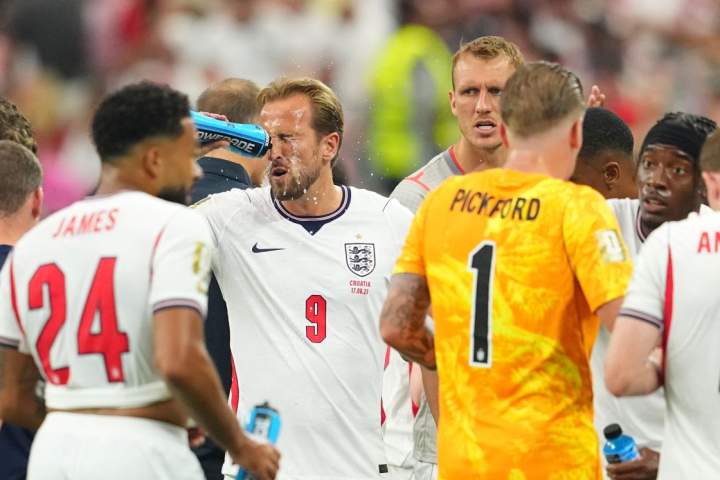
View image in full screen England's Harry Kane (9) cools off during a hydration break of the World Cup Group L soccer match between England and Croatia in Arlington, Texas, near Dallas, Wednesday, June 17, 2026. (AP Photo/Julio Cortez)The World Cup looks different this year not only because it’s being played across three countries, but thanks to a new addition sparking a heated debate: hydration breaks.
FIFA introduced the three-minute pauses in each 45-minute half, effectively creating four unofficial quarters.
Soccer’s governing body says the measure is necessary to protect players from heat and humidity, with climate change creating more extreme conditions for athletes.
But some coaches and players are questioning whether the move is really about player safety or profits.
“I think it’s probably making some more money for FIFA, a hydration break turned into a commercial break,” said Canadian defender Alistair Johnston at a news conference Tuesday in Vancouver.
1:53 Canadian World Cup fever kicking into high gear across New BrunswickThe stoppages have allowed some of the world’s most recognizable brands to squeeze in more advertising, making Canada, Mexico and the United States’ first World Cup feel distinctly more commercial.
That shift has triggered complaints from players, coaches and fans, along with boos from the stands. Some critics see the hydration breaks as another cash grab in a tournament already facing backlash for sky-high ticket prices.
Get weekly health news
Receive the latest medical news and health information delivered to you every Sunday. By providing your email address, you have read and agree to Global News' Terms and Conditions and Privacy Policy.“I think they’re probably right to be cynical,” said Toby Mündel, a kinesiology professor at Brock University.
“It’s better that FIFA has done something than absolutely nothing,” Mündel added. “Although they’ve done something, you also have to question why.”
2:01 Meet the FIFA World Cup Canadian superfans backing the home sideFIFA faced growing pressure to make the tournament safer for athletes, who are often playing during some of the hottest months of the year.
“Most sports are getting faster, stronger and so when you have hot conditions during a soccer game, what it means is that it pushes a player’s physical and mental abilities to the limit,” said Mündel, who is also Canada Research Chair in Extreme Human Environments.
But skeptics point out that much of the tournament is being played in domed, air-conditioned venues such as BC Place, while some outdoor matches have taken place in relatively mild conditions. Ghana and Panama faced off in Toronto this week with temperatures hovering around 19 C.
Ghana coach Carlos Queiroz has called for a review of the policy.
“[We have to know] if this decision was really made to protect the health and performance of the players, or if it was made to protect marketing and other issues,” Queiroz said at a news conference.- Suspected illegal campfire blamed for Kalamoir Park wildfire as safety concerns remain
- Provincial AI strategy could protect residents, scale Sask. workforce: advocates
- Museum at former residential school in Portage la Prairie to expand
- Family prepares to bury 5 children killed in devastating Ontario crash
“To have a hydration break in that context is completely unwarranted, in my opinion,” Daniel Keir, a kinesiology professor at Western University, told Global News.
FIFA says it’s rolling out hydration breaks universally to ensure consistency across matches. But the change has frustrated soccer purists for another reason: interrupting flow.
“It breaks up the game. It can change momentum and gives teams the opportunity to adjust tactics,” Keir said.
“The coaches can gather all the players, provide instructions, can move people around like pieces on a chessboard.”
1:53 Soccer for newbies: What to know about 2026 World CupMündel says it’s hard to say whether it’s been an advantage or disadvantage for World Cup competitors, adding it depends on the game.
The Brock University professor says there are ways other than hydration breaks to reduce heat-related risks, like scheduling matches earlier in the morning or later in the evening, outside the hottest parts of the day.
But that could also be a hard sell.
“That has logistical and financial implications because of television audiences,” he said.
Add Global News as a Preferred Source on Google to see more of our stories in your search results.
Journalistic standards Report an error © 2026 Global News, a division of Corus Entertainment Inc.