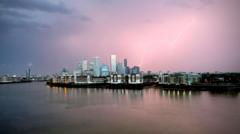
Ligntning flashes over Wapping in London in the early hours of Tuesday morning.
BySimon King , Lead Weather Presenter and Henry Moore- Published23 June 2026, 09:28 BST
Around 29,000 lightning strikes lit up the sky overnight, the Met Office has said, as thunderstorms caused flash flooding and travel disruption across parts of England.
The storms rolled into the south west on Monday evening and moved towards the south east during the night, with people reporting being woken up in the early hours by loud crashes of thunder and flashes of lightning.
London Fire Brigade said it responded to 400 calls overnight, including two house fires believed to be caused by lightning strikes, while a house in Bristol was set ablaze during a storm earlier in the evening.
It comes as England braces for temperatures of up to 40C, with the Met Office issuing a rare red alert set to come into force on Wednesday.
The Met Office confirmed that there were 29,000 flashes of lightning on Monday night and early on Tuesday morning in southern England.
That included lightning that went from cloud to cloud as well as the more "striking" cloud-to-ground fork lighting.
The number of lighting strikes is not particularly uncommon for storms developing after a hot and humid day, but the frequency and intensity of the lighting was spectacular.
While thunderstorms were forecast to track east across southern England last night, there is always going to be some uncertainty about the exact location of where - and how intense - they might be.
As well as lightning, very heavy rain in some areas lead to flash flooding.
The intense thunderstorms developed due to a couple of factors.
The first is that it was very warm if not hot across southern England on Monday afternoon and temperatures soared into the high 20s and low 30s.
This heat transfers into the atmosphere, giving it a lot of energy. That energy is then primed for a trigger to covert it into big cumulonimbus - thunder - clouds.
The trigger was an atmospheric disturbance higher in the atmosphere - which essentially allowed all that stored energy to be released, resulting in the intense thunderstorms.
Image source, Gardener Patrick / Weather WatchersImage caption,The storms travelled across the south of England from Monday evening into the early hours of Tuesday
Image source, Marzy / Weather WatchersImage caption,The overnight storm caused flash-flooding, such as here in Hammersmith, London
How to keep your home cool in hot weather
- Published23 hours ago
What are the heat exhaustion and heatstroke symptoms?
- Published23 hours ago
- Published23 hours ago
Can you keep your kids off school or refuse to work during a heatwave?
- Published37 minutes ago
The London skyline was dominated by flashes of lightning in the early hours of Tuesday morning
Image source, Peter Barrett / Weather WatchersImage caption,Lightning bolts lit up the night sky in Hornchurch, Greater London
Image source, Roger / Weather WatchersImage caption,In Bristol, one home was set on fire during the storm
Image source, PJE / Weather WatchersImage caption,Lightning strikes near a row of houses in Bath, Somerset
Image source, Josie / Weather WatchersImage caption,Forks of lightning could be seen above Bath on Monday evening
Image source, MagTel / Weather WatchersImage caption,And in Waltham Cross, Hertfordshire