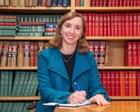
Helen Paterson’s work on advancing how police and courts understand memory is recognised in prestigious Eureka prizes
Get our breaking news email, free app or daily news podcast
Memory is an imperfect thing: research shows that recollections of single events – a purse being snatched, say – differ to those about repeated or ongoing events, such as incidents of domestic and family violence.
“What our research shows is that compared to a single-event witness, a repeated-event witness tends to report more gist-like details, the overall details of what typically would happen, and the things that remain constant between the episodes,” said Helen Paterson, an associate professor in forensic psychology at the University of Sydney.
Two women and two girls dead in four days. Australian experts yet again call for actionRead more“Sometimes they confuse one episode with another,” she said. Paterson’s work has important implications for victim-survivors of domestic and family violence and how their testimony is received.
“If they’re saying this in trial, it’s defence 101 to say … they’ve made this inconsistency, therefore their whole memory is unreliable,” she said. “But we do know what they do report tends to be highly accurate in that it did happen to them. It’s just they might mix up the episode in which it happened.”
Paterson’s work has also found that repeated-event witnesses are perceived to be “less honest, less cognitively competent, and less overall credible than the single-event witnesses – which is pretty concerning that the more repeatedly you are victimised, the less credible you appear to others”.
Sign up for the Breaking News Australia emailIn recognition of her work in advancing how police and courts understand victim-survivor testimony in such cases, Paterson was awarded a prestigious Eureka prize on Thursday night.
Established in 1990, the Australian Museum Eureka prizes recognise the work of Australian scientists and science communicators.
Paterson was recognised for excellence in forensic science – one of 19 categories – at an event at Sydney town hall.
She hopes the award will help elevate the voices of victim-survivors. “Often we don’t give them the support and encouragement, and we don’t believe them and see them as credible as we should.”
Assoc Prof Jane Tiller was recognised at the Eureka prizes for driving national legislative change that bans life insurers from discriminating against people due to genetic test results. Photograph: Michelle McFarlane/Australian MuseumAlso among the winners was Assoc Prof Jane Tiller of Monash University, recognised for driving national legislative change that bans life insurers from discriminating against people due to genetic test results.
Passed into law in April, the ban will come into effect on 8 October. The legal change will enable scientists to use genomics more effectively to prevent conditions such as cancer and heart disease, Tiller said.
“The biggest reason that people don’t want this testing is because of fear of insurance discrimination,” she said. The legal change was a “critical barrier that we needed to remove”.
“We want to … start finding young people who we know have very high risks of diseases that we can prevent, and give them the screening, the surveillance, the health tools available to them to prevent or treat those diseases early.”
Prof Georgina Long, who alongside the late Prof Richard Scolyer was named Australian of the Year in 2024, won the Eureka prize for scientific research, for her pioneering melanoma work. Four other Australians of the Year have previously received Eureka prizes: Prof Tim Flannery, Prof Ian Frazer, Prof Michelle Simmons, and the late Prof Alan Mackay-Sim.
Also among Thursday night’s winners were Australia’s marine heatwaves forecasting tool, developed by the CSIRO and Bureau of Meteorology; the Women’s Microbiome Innovation Group, a Melbourne-based research collaboration that discovered that bacterial vaginosis is sexually transmitted between partners; and Prof Yansong Shen at the University of New South Wales, who developed a scalable low-cost process to recover valuable metals and silicon from used solar panels.
Kim McKay, Australian Museum director and chief executive, said: “This year’s winners are tackling some of our greatest challenges: protecting our environment, advancing healthcare, informing public policy and inspiring the next generation of scientists.
“World-changing discoveries do not happen overnight. They are built on years of dedication, collaboration and sustained investment.”
In Australia, domestic and family violence counselling is available from Full Stop Australia on 1800 385 578. Other international helplines may be found via www.befrienders.org.
Explore more on these topicsShareReuse this contentCyborg cockroaches with tiny syringes designed to join search and rescue teams in major disasters
27 Aug 2026Male redback spiders invite cannibalism through a ‘self-sacrificial somersault’ during sex – but why?
12 Aug 2026NT minister claims Earth’s magnetic poles could flip if territory doesn’t use more groundwater
23 Jul 2026Great Barrier Reef microbiome mapped as researchers discover 500 bacterial species previously unknown to science
22 Jul 2026Greater gliders not as great at gliding as thought – but still look like magic carpets, experts say
15 Jul 2026This huge, hairy-legged Australian arachnid may be the fastest spider in the world
11 Jul 2026Do bees have inner lives? Slow-motion video reveals bumblebee behaviour similar to ‘liking’ or ‘disliking’
6 Jul 2026NSW’s deadly one-in-100-years floods could have been slashed by two metres using dams, CSIRO finds
30 Jun 2026Scientists in Australia find ‘smoking gun’ evidence of world’s oldest meteorite strike
23 Jun 2026Full StoryEl Niño is imminent. How worried should Australians be? – Full Story podcast
9 Jun 2026