National trust of Victoria award celebrates much-loved arboreal icons while calling for protection of green spaces
Get our breaking news email, free app or daily news podcast
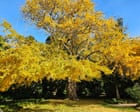
For more than 160 years, a humble ginkgo tree raised from seed in Geelong’s botanic gardens has been the backdrop to “countless local love stories”. Standing beneath it is the most popular spot to get married at the park, its branches forming the backdrop of many wedding photos.
Now, in addition to being the largest ginkgo biloba in the state – and possibly Australia – at a whopping 20 metres tall, it has a new claim to fame. The much-adored Geelong icon has been crowned Victoria’s tree of the year.
The National Trust of Australia (Victoria), which runs the awards, announced on Tuesday that Geelong’s ginkgo beat eight other finalists to the 2026 title, receiving 27% of 4,435 public votes cast. Second place went to the smooth bark apple myrtle in Prahran, while Apollo Bay’s myrtle beech was voted third.
Sign up for the Breaking News Australia emailTo be eligible, trees have to be listed on the National Trust significant tree register, which recognises 2,500 trees in Victoria for their cultural, scientific, and historic value. More than 40 were nominated this year, then narrowed down to nine by a panel of 12 experts and arboriculturists.
The executive manager of gardens and landscapes at the National Trust Victoria, Justin Buckley, said the ginkgo was a “very popular winner”.
The tree has distinctive stalactite-like growths from its trunk and branches, a feature that only appears on older female gingkos. Photograph: Daniel Cornell/National Trust Victoria“It’s a really special tree, and very well loved in that area,” he said.
The ginkgo was planted in 1859, just two decades after the township of Geelong was formally established. The seeds were transported from China, rumoured to have been delivered by a ship’s captain making a stop at Geelong’s port.
Since then, generations of botanic garden workers and volunteers have helped it thrive. Not all have been able to see the unusual stalactite-like growths from its trunk and branches, which only occur in much older female gingko varieties, or enjoy its fruit – which has a reputation for being smelly.
Ginkgos, also known as maidenhairs, are among the most ancient trees on earth, dating back to the Jurassic period more than 160m years ago. In Japan, they’re a symbol of hope, longevity and peace, after six survived the 1945 atomic blast in Hiroshima. They were thought to be extinct in the wild for many centuries before being revived.
Botanic gardens supervisor Sheree Parker said the ginkgo was one of the first trees planted in the park and was also its “most visited and talked about”.
“It’s just starting to awaken now after being dormant,” she said. “We’re really excited.
“It’s our most popular destination to get married as well. We have a lot of weddings on this lawn and a lot of couples like to get married underneath the ginkgo.”
The city of greater Geelong staff had been strongly lobbying for the ginkgo to be crowned since the finalists were announced, posting regularly to social media encouraging people to vote.
“As … the backdrop for countless local love stories, she holds a special place in all our hearts,” they said a post earlier this month.
The competition was established in 2016 to celebrate Victoria’s best-loved trees, while also calling for greater protection of green spaces.
A recent urban greening framework, released by Stonnington city council, found over the past decade, more than 17.9 hectares of tree canopy had been lost on private lands in the inner Melbourne suburb alone.
The National Trust is urging the Victorian government to give automatic statutory protection to trees on its register and those of local councils, while also introducing a “retain first” planning principle making tree removal a genuine last resort.
In the past year, the Victorian government introduced uniform protection of canopy trees, but Buckley said it remained “quite limited” and there was “large scope” for significant trees to be removed without a permit.
“The reason we continue to draw attention to trees through this competition is because they really don’t have adequate protection, certainly not the same protection that heritage buildings have,” Buckley said.
“You can’t just think, well, we’ll take this one out, we’ll put another tree in there and everything will be fine. Big significant trees are virtually irreplaceable.
“As we need to accommodate growing populations and more housing … there’s going to be a lot of pressure on trees.”
Explore more on these topicsShareReuse this contentThere’s no human right to Vegemite, court tells Australian prisoner who wanted ban overturned
2d agoVictorians can now see a home’s reserve price before auction. What does this mean for buyers and sellers?
5d agoWhen Victorian pensioner Gail secured housing, it was the ‘best day’ of her life. Then she was ordered to vacate
20 Oct 2026A young life ‘dominated by gambling’: Victorian coroner delivers stinging findings on death of 22-year-old
20 Oct 2026Why are rough sleepers dying a stone’s throw from luxury waterfront houses in Victoria?
16 Oct 2026…… commentsOne Nation proposes $2,000 baby subsidy in Victoria but says it won’t touch state abortion laws
16 Oct 2026The Melbourne Star is back from the dead – but can it revive Docklands?
16 Oct 2026…… commentsWhen a tobacco shop opened next door, a Melbourne couple’s dream cafe went up in smoke: ‘It felt like a warzone’
14 Oct 2026Comedian Dave Hughes to stop speaking at Liberal party events over political donation concerns
7 Oct 2026John Makai was unresponsive when dragged from a Victoria police van. Just one of many ‘shortcomings’ inquest has heard so far
3 Oct 2026