Before the gold rush: a South African story – in pictures
Robin Bernstein’s debut book Mapalakata takes us to the edge of the South African frontier to tell a story inspired by folk tales and historical artefacts
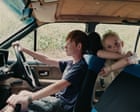
Top gear … Dominique & Alba, 2022Wed 15 Jul 2026 02.00 EDTLast modified on Thu 16 Jul 2026 11.52 EDT
ShareAlpha, Sihle, Sphesihle & Omega, 2022
Mapalakata is the debut publication from South African photographer Robin Bernstein. The title, meaning ‘visitors’ in Bapedi, is drawn from oral histories and was used to describe traders from the east who moved through southern Africa before European colonisation.
Mapalakata by Robin Bernstein is available from Gost ShareMarlie, 2022
The work is situated in Mpumalanga province, South Africa, on the escarpment bordering Mozambique and Eswatini. A place where lush cliffs abruptly pierce the hot, red earth of the lowlands, it serves as a geophysical symbol for the edge of the South African frontier. It is a collision point that has inspired countless folk tales and the beginnings of the modern-day story of gold in the country
ShareGirl, 2019
Today, plantations of non-native trees blanket the landscape while mills churn steam as they pulp pine into paper. In the valleys below, gold mines that have been chiming steel against rock for the past one hundred years ring their ceaseless chorus. The surrounding terrain is littered with relics of another time – the remnants of a forgotten precolonial society
SharePeter & Jack Rose at Jathira, 2025
Mapalakata looks at the transient nature of ‘visitors’ to the landscape, drawing attention to how the history of the region is continually rewritten as different groups of people attempt to erase the narratives bound to their predecessors, each driven to occupy the space for the resources that it holds. This process leaves an archive of physical artefacts scattered across the landscape, which become ephemeral traces of the histories that have played out
ShareStephan at Nox Timbers, 2020
Through a photographic investigation of these remnants of the past and the people who now inhabit these spaces, this work aims to engage with the nuances of social conditions in South Africa and consider how place roots itself in the consciousness of those who inhabit it
ShareWild Horse, 2019
Robin Bernstein: ‘This is an early image made for Mapalakata, taken outside the small hamlet of Kaapsehoop, before I began using rangefinders. It was shot hand-held with a waist-level RZ finder. It was pretty tricky to get up close to the horses, but with some persistence and horse whispering, I managed to get a few frames. It’s speculated that the wild horses of Kaapsehoop are descendants of horses abandoned after a failed gold rush in the region, two decades prior to the discovery of gold in Johannesburg – a formative event shaping South Africa’s modern history’
ShareMarycate & Sibahle, 2025
Bernstein: ‘Marycate and her daughter Sibahle, photographed in 2025 in the front room of her grandmother’s home in the Emjindini location on the outskirts of Barberton. It was one of the first homes built in the location during the Group Areas Act of 1950, which enforced the creation of racially segregated neighbourhoods’
ShareGiffy in Emgwenya, 2020
Writer Desmond Latham: ‘The name Mapalakata once meant traders. Men who came inland with cloth and beads, their packs heavy with salt and brass. They followed the flow of rivers, trading what they could carry for gold and hides and grain. The world they moved through was a web of bargains. Even now the region works with the same logic’
ShareBerlin Plantation, 2019
Robin Bernstein: ‘This image was made in the living room of a forestry fire officer’s home in the South African Forestry Company-owned Berlin plantation, which sprawls between Mbombela and Kaapsehoop, where I was invited in for tea’
ShareBulembu Asbestos Mine, 2025
Bernstein: ‘Asbestos samples in the Bulembu Museum. Bulembu sits just over the border of Eswatini in the Makhonjwa mountains and was once the starting point for the second longest cableway in the world, used to carry asbestos to Barberton. The asbestos mining industry saw an immediate termination in the early 2000s when the substance was banned globally. Bulembu is hard to get to and the museum doesn’t see many visitors these days’
ShareThandi on the road to Bulembu, 2022
Bernstein’s practice examines the sociospatial intersections of land, history and globalisation. Working between London and Cape Town, Bernstein’s process is rooted in collaborative engagement, exploring the reciprocal relationship between individuals and their environments.
https://www.robinbernsteinphoto.com/ShareExplore more on these topics