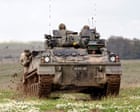
Collective training exercises for UK-based units to be suspended for most of this year amid budget pressures
Jamie GriersonFri 4 Sep 2026 02.44 EDTLast modified on Fri 4 Sep 2026 02.46 EDTSharePrefer the Guardian on GoogleThe British army has been ordered to halt non-essential training exercises in an effort to save money.
Troops preparing to be deployed or on deployments, those who are on standby or in a quick-reaction role will continue to train as normal. But collective training exercises for UK-based units are being suspended for most of this year amid budget pressures.
Cancelled exercises included those involving tanks and Apache helicopters, according to reports in the Times and BBC.
The army did not deny the cuts and said a training regime informed by lessons from the Ukraine conflict – such as on drone warfare and modernisation – was being prioritised.
An army spokesperson said: “Our training continues and we are prioritising activity that contributes most directly to readiness, deployability and operational effectiveness.
“We are also investing £2bn to transform training for the British army over the next 15 years.”
Andy Burnham is under pressure to increase defence spending to 3% of national income by 2030, rising to 3.5% by 2035.
At prime minister’s questions on Wednesday, Burnham was urged by the chair of the Commons defence select committee, the Labour MP Tan Singh Dhesi, to “urgently commit to charting a pathway to reaching 3% of GDP spend on defence by 2030 which, as his chancellor rightly noted, is critical to keeping our country safe”. Dhesi told the prime minister that “vibes alone just isn’t going to be enough”, when it came to funding the UK’s armed forces
Plans set out in the defence investment plan (Dip) include defence spending rising to 2.7% of GDP by 2027/28, but there are no firm details on how further increases will be achieved beyond that date.
The Treasury has consistently said the government will set out plans for reaching 3% and 3.5% at the spending review, due to take place next year.
skip past newsletter promotionFree newsletter | Every weekdaySign up to First Edition
Our morning email breaks down the key stories of the day, telling you what’s happening and why it matters
after newsletter promotion
The chancellor, John Healey, resigned from Keir Starmer’s government as defence secretary in June, in protest against what he argued was the then prime minister’s failure to adequately fund defence.
But in his new post in No 11 Downing Street, Healey has made clear that he will wait until next year’s spending review before presenting a plan to meet Labour’s pledge of devoting 3.5% of GDP to defence by 2035.
Healey will present his first budget on 28 October and needs to find approximately £1.4bn a year over the next three years to pay for Starmer’s defence investment plan – which Healey in his last job derided as inadequate.
Explore more on these topicsShareReuse this contentRAF Chinook crash victims’ families ask Andy Burnham for review of disaster
26 Jul 2026UK ‘ready to defend itself’ after Iranian threat over US bases
23 Jul 2026MoD cancels army training in Kenya over powers to prosecute British soldiers
23 Jul 2026Falling backwards and plunging through clouds: British paratroopers’ landing on Tristan da Cunha
14 May 2026MoD has no system to detect civilian deaths caused by military, study shows
5 May 2026How war in Gulf reveals the ‘cut corners’ on British defence
14 Apr 2026Starmer’s ‘corrosive complacency’ on defence has put UK in peril, says ex-Nato chief
14 Apr 2026UK’s armed forces are in a sad state – and they have only themselves to blame
14 Apr 2026What has conflict in Iran revealed about UK’s geopolitical standing and military readiness?
8 Apr 2026