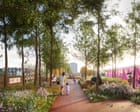
The Camden Highline, a multimillion-pound effort to transform a disused rail line into a greenery-filled walking and cycling paradise, has been all but scrapped.
Nearly a decade since it was conceived as London’s answer to New York’s fabled High Line, the project has fallen victim to high costs and the energy crisis.
The scheme’s organisers said: “The team was built around the ambition to transform a disused railway viaduct into a new local park, garden walk and wildlife corridor. However, over the last five years, the UK has experienced a series of sustained economic shocks, with construction costs in particular rising well above general inflation. Until now, these pressures have been factored into the project’s modelling, but the emerging 2026 energy shock represents a further step change.”
The statement said the project would be “pausing with immediate effect”.
The Camden Highline routeThe Camden Highline routeThe Camden Highline was intended to run almost a mile of elevated rail track from Camden to King’s Cross, with landscaping to encourage walking and cycling, and planting to attract butterflies, bees and birds. The route would have passed the Camden Road overground station and finished at York Way in King’s Cross.
It was first suggested after the success of the New York High Line, which has been credited with revitalising postindustrial neighbourhoods on Manhattan’s west side and was itself inspired by the Coulée Verte elevated park in Paris. Since opening in 2009, the High Line has become a tourist attraction in its own right and inspired a movement to reclaim abandoned infrastructure in other cities.
Oliver O’Brien, a geography researcher at University College London, put forward a London version and the idea was promoted by the Kentishtowner newspaper and the Camden Town Unlimited business association.
An aerial view of the proposed route for the Camden Highline. It was supported by the local business association and 1,200 donors. Photograph: HandoutOne stretch of the Highline has been completed as part of the Coal Drops Yard development, involving a bridge across the Regent’s canal from the Camley Street nature reserve that transforms into a landscaped walkway popular with office workers and tourists.
Highline organisers blamed their decision on the squeeze on “discretionary capital projects, as support is increasingly focused on essential and statutory services. Taken together, rising costs and reduced funding capacity mean the project is not currently viable in the present economic climate.”
Simon Pitkeathley, the group’s chief executive, said: “To the thousands of people who joined our walking tours, the hundreds who supported our planning application, the 1,200 donors, the 530 schoolchildren who took part in our workshops and the many members of our team and volunteer squad over the past decade, we are truly grateful and deeply sorry. Despite your support, and the outstanding advice and commitment of experts across many fields, this extraordinarily ambitious challenge has, for now, proved a stretch too far.
New York’s popular High Line has been credited with revitalising post-industrial neighbourhoods in Manhattan. Photograph: Spencer Platt/Getty Images“Green infrastructure in cities matters. Finding space for it is rare. And battling through the treacle to make projects like this happen is difficult, lengthy, and expensive. Which is why today’s announcement is so painful to make.”
Richard Terry, the chair of the Camden Highline trustees, said: “The work is not lost. The planning, creativity and imagination that brought the Camden Highline this far will be carefully preserved by the trustees, so that whether it is us or others who one day pick up the mantle again, the project’s achievements can be carried forward for the future.
“It is, in that sense, a time capsule: a record of what has been imagined, designed and built in partnership with the community, waiting to be reawakened when the time and conditions are right once more.”