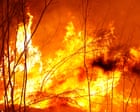
Researchers found the shift from open woodland to dense forest after 1788 led to more intense fires, consistent with loss of cultural burning practices
Supported byAbout this contentPetra StockWed 7 Oct 2026 11.00 EDTLast modified on Wed 7 Oct 2026 17.15 EDTSharePrefer the Guardian on GoogleThe drastic land use changes wreaked by colonisation created a “catastrophic wildfire loop” that rendered south-east Australia more susceptible to climate-fuelled bushfires, experts say.
A team of researchers, working with the Gunaikurnai Land and Waters Aboriginal Corporation, an organisation that represents traditional owners, reconstructed 1,000 years of vegetation and fire history at Purghagoolah, a lake surrounded by forest in Croajingolong national park in Gippsland, Victoria.
Bruce Pascoe’s new book may spark another culture war. He hopes for ‘decency and intellectual curiosity’ this timeRead moreThey analysed pollen and charcoal particles deposited over time in a metre-long sediment core, uncovering historical changes in the landscape and the interactions between weather, eucalypt cover and fire frequency and intensity.
Aerial view of Purghagoolah (Lake Elusive) in Croajingolong national park in Gippsland, Victoria. Photograph: Michael-Shawn FletcherThe results, published in Nature, revealed the shift from open woodland to dense forest after colonisation led to more intense fires, changes consistent with the loss of cultural burning practices and the removal of traditional owners, the Gunaikurnai people, from the land.
Michael-Shawn Fletcher, a professor at the University of Melbourne and the study’s lead author, said prior to colonisation “this was a cared for and managed landscape”.
“Gunaikurnai are removed from Country and you see a change in the amount of trees and shrubs in the landscape, and that drives more fires,” he said. “It’s actually land use change, more than a century before climate changes, that has allowed shrubs to increase, fires to get hotter. Those hot fires then trigger eucalypt recruitment. And the eucalypts then increase, driving further fire.”
Fletcher said the research provided scientific evidence for the value of cultural burning, and the importance of integrating Indigenous knowledge into modern fire management strategies.
The field research team carries equipment through Croajingolong national park. Photograph: Michael-Shawn FletcherCultural burning refers to the way First Nations people use low-temperature fire to maintain a safe and productive landscape. These practices, which are still used in parts of Australia today, are based on a responsive “right time, right place” approach that differs from mainstream prescribed burning practices undertaken by government agencies for hazard reduction.
“Hopefully this opens a conversation around the possibilities, into a new future where we can actually start getting control of the catastrophic fire problem,” Fletcher said.
skip past newsletter promotionFree newsletter |When he publishesSign up to Clear Air Australia
Adam Morton brings you incisive analysis about the politics and impact of the climate crisis
after newsletter promotion
Narooma payphone heritage-listed for connecting people when mobiles failed during black summer bushfiresRead moreProf David Bowman, a fire scientist based at the University of Tasmania, who was not an author of the paper, said the research was significant and contributed to the “growing realisation” about the legacy of landscape change resulting from the loss of Indigenous fire management.
“Other factors have exacerbated these changes, [such as] the introduction of non-native animals, non-native plants in some cases. These are very complex ecological processes, but taking out traditional fire management is a very significant thing to have happened.”
The long-term records were “critically important” for piecing together the historical changes in fire regimes, and how they’re responding to climate drivers, he said. “One of the big questions in wildfire science is how anomalous, or how unprecedented, is the stuff that’s happening?”
Bowman described the research as “like a pipe opener”. “I really hope that it opens up a conversation that we really need to have about managing our landscapes as the fire crisis is worsening.”
- Environment
- Australian climate and environmental reporting
- Bushfires
- Indigenous Australians
- Victoria
- Climate crisis
- news
Chris Minns says activists shouldn’t get ‘overexcited’ about ‘technical’ landmark coalmine decision
3h agoUnderlying causes of recurrent bacterial vaginosis identified by Australian scientists
7d agoNarooma payphone heritage-listed for connecting people when mobiles failed during black summer bushfires
29 Sept 2026Has the high court set Australia’s fossil fuel producers shaking in their boots? They should be
8h ago…… commentsAn ocean away from Nepal, Sonia spends her spare time piecing together clues about missing flood victims: ‘I wanted to be useful’
9 Sept 2026‘Prepare early’: bushfire authorities sound alarm for NT, NSW and Queensland
19 Aug 2026Overseas, Albanese sees ‘the very definition of climate injustice’ – but at home, he still wants coal
18h ago…… commentsBlaring sirens on smartphones to warn of major disasters under overhaul of Australia emergency alert system
26 Feb 2026‘A real-life moment from The Castle’: the retired couple who took on a coal giant and won
18h ago…… commentsFlushing the toilet can release a ‘plume’ of breathable pathogens – and closing the lid won’t stop their escape
8 Sept 2026