Trillions of dollars have been wiped from China’s stock markets in recent months amid increasing anxiety about the future of artificial intelligence, as Beijing races against the United States for dominance in the sector.
The STAR 50 Index, which tracks technology and innovation companies on the Shanghai stock exchange, has plunged 40% since June. Other indexes of major companies dropped by about 20% over the same time period.
The precipitous drop has wiped out $2.4tn from the Chinese stock market since May, according to Bloomberg.
AI stocks account for over 40% of the stock market value in China and Hong Kong, according to Goldman Sachs, meaning that any dent in value will send shockwaves across the whole domestic market.
US bans use of China’s DeepSeek AI tools by government agenciesRead moreThe fall suggests that despite the government’s best efforts to boost China’s technology industries, particularly those which harness the power of AI, the domestic economy does not have the power to sustain a booming market.
The Chinese government has invested heavily into AI, including a 60bn yuan state-backed AI investment fund which started pumping money into domestic developers this month. But Chinese consumers have proved stubbornly reluctant to part with their cash in many parts of the economy – including technology – meaning that many tech companies struggle to turn a profit.
The lack of profits is one of several reasons for the sell-off. Another is the threat of western countries, especially the US, extending bans on Chinese technology.
“This year, the profit margin is not as good as expected. And the US is raising rates. And China’s domestic demand is so weak,” said Dan Wang, the China director for the Eurasia Group. She said that there was a “general anxiety” among technology companies about whether or not the state-backed model would work in the face of weak consumer demand.
The US has banned humanoid robots from China, citing national security risks, and is thought to be considering a ban on Chinese components in data centres. China is heavily reliant on exports and restrictions in the US hurt its domestic companies, which struggle to sell enough products at home.
As China races with the US to pull ahead in AI, Beijing has doubled down on robotics – also known as embodied AI – as the key to rolling out the technology across society. Robotics is also seen as the answer to China’s demographic problems, such as the ageing population and the shrinking workforce.
But the demand for robotics is being driven by government agencies and research institutions, rather than everyday consumers, for whom the products are still too expensive and not yet practical for home use. Humanoid robotics and robotic dogs have been popular in the entertainment industry but are yet to be useful in home settings.
Shares in Unitree, China’s leading robot-maker, have halved since they started trading in August.
“It doesn’t look like embodied intelligence could turn into profits in the in the mass market,” said Wang. Thin profit margins, rising rates in the US, and weak domestic demand were all contributing to a “general anxiety” among technology companies, she said.
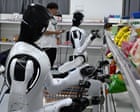
Humanoid robotics and robotic dogs have been popular in the entertainment industry but are yet to be useful in home settings. Photograph: Costfoto/NurPhoto/ShutterstockChina’s government wants local investors to invest their money domestically. China has in recent months restricted overseas investment, with more regulations taking effect from 1 December, but these moves have not led to greater investment in the Chinese markets.
Wang added that there was still optimism in other technology sectors, such as AI research and satellites, the latter because their links to the military indicates long term state support for the sector. And globally the AI boom is expected to last for at least another year.
On Monday, US AI company Anthropic, which makes the chatbot Claude, filed paperwork ahead of a planned IPO that could be the biggest stock market debuts of all time. The company is expected to bring in as much as $100bn.
China has no such blockbuster IPOs on the horizon. And despite pressure on policymakers to introduce stimulus measures to boost investment, none are expected to be announced during a politically sensitive period in China.
This week the top officials in the Chinese Communist party are gathering for the fifth plenum, an important meeting that will lay the groundwork for next year’s 21st Party Congress. The Congress is expected to anoint Xi Jinping, China’s leader, for a fourth term. There is no appetite for risky or potentially destabilising policy measures before then, even if there is a chance they could boost the economy.
Any stimulus measure would be “high risk”, Wang said. “What if it doesn’t work out? Then whoever came up with that policy, that guy would be held accountable”.
