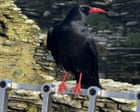
Decades after disappearing from the jagged cliffs around Tintagel Castle on the coast of north Cornwall, a bird with legendary connections to the area has returned.
The custodian of Tintagel, English Heritage, and local ornithologists have declared that choughs – charismatic corvids with red beaks and feet – are back.
Choughs are considered Cornwall’s “national bird” and feature in its coat of arms but vanished as a resident from the far south-west of the UK in the early 1970s, largely because of the decline of their grazed clifftop habitat.
Their disappearance was keenly felt across Cornwall but particularly, perhaps, in and around Tintagel because of the bird’s connections to the legend of King Arthur.
The once and future king is said to have been conceived at Tintagel and his spirit is said to live on in the shape of a chough, the red feet and beak representing his bloody end.
Since the turn of this century, choughs have staged a comeback in Cornwall and English Heritage announced on Thursday that they had made it back to Tintagel.
The remains of the castle on a rocky headland on the north Cornish coast. Photograph: Nigel Wallace-IlesWin Scutt, an English Heritage curator, said: “People have told stories for centuries about choughs at Tintagel, so to see them here again, a place so bound up with the legend of Arthur, feels extraordinary. It’s a rare moment where nature and myth seem to meet.”
Speaking to the Guardian as he clambered the cliffs around the castle, which is built half on the mainland, half on a headland projecting into the waves, Scutt said: “They’re on the coat of arms with a fisherman and a tin miner, so they’re very much tied in with Cornish identity.”
Tintagel among castles at risk unless England can hold back the tideRead moreChristina Hazel, a visitor assistant at Tintagel, said she was mesmerised by the choughs when they reappeared. “They’re fascinating and magical to watch. We started with one male and now have three birds that visit.”
Choughs have been seen from time to time at Tintagel since September 2024 but their return has not been widely publicised to give them time and space to settle. Hazel said: “It’s wonderful to see them back on our coastline.”
Hilary Mitchell, of Cornwall Birds, said: “They have been recorded on the cliffs and in the castle itself. Some people have been lucky enough to have the choughs visit their gardens. A pair has become established and up to four seen together. It’s a historic moment, especially given the choughs’ connection to the King Arthur legend.”
Mitchell said the Cornish chough population revival came after a pair arrived from Ireland on the Lizard peninsula in south Cornwall in 2001.
“The Tintagel birds are our furthest north and east and we hope in time they will spread further along the coast into north Devon and Somerset and ultimately join up with the population in south Wales,” she said. “Historically, choughs would have been found along much of the length of the South West Coast Path and it would be wonderful if that could be the case again.”
The RSPB describes choughs as “master flyers” and highlights that as well as suffering through loss of habitat, they were persecuted throughout medieval times, as folklore told they were fire raisers and got their red legs and bill from paddling in the blood of Thomas Becket after his murder in the 12th century.