Mining giant’s backsliding on climate commitments due to ‘weakness’ of policy, Kate Chaney says
Read more from the BHP files investigation here
Get our breaking news email, free app or daily news podcast
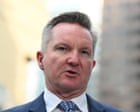
Australia’s climate change minister, Chris Bowen, says he has made it “crystal clear” that he expects industrial polluters including BHP to reduce their onsite emissions after leaked documents revealed that the world’s biggest miner has backtracked on climate action.
An exclusive investigation based on documents leaked to by the Guardian and the ABC show BHP has scrapped a project to significantly reduce global emissions, delayed vast renewables projects in the Pilbara and war-gamed options to push the electrification of its polluting diesel truck and train fleets into the next two decades.
It did so despite internal memos as recently as 2023 saying that: “Urgent decarbonisation in line with BHP’s public commitments effectively underpins [the Western Australian iron ore division’s licence to operate, sustain and grow.”
Experts and analysts say the slowdown in BHP’s decarbonisation progress shows the failure of a key climate policy, the safeguard mechanism, and the influence of the diesel tax break the federal government gives to big miners including BHP.
Sign up for the Breaking News Australia emailBowen said on Tuesday that BHP was still subject to the safeguard mechanism and he had made his expectations “crystal clear” to emitters publicly and privately.
He said the safeguard did “provide some flexibility” because the roughly 200 major industrial polluters that it applied to faced “different challenges and opportunities” to cut emissions.
Quick GuideWhat is the safeguard mechanism?
ShowAustralia’s safeguard mechanism requires the country's largest polluting industrial facilities to cut their greenhouse gas emissions intensity year on year.
It applies to about 200 facilities that each year emit more than 100,000 tonnes of carbon dioxide, or the equivalent in other greenhouse gases. These include mines, gas facilities, processing plants, smelters and manufacturers.
Facility owners can make cuts onsite or by buying carbon offsets.
The policy was introduced in 2016 by the rightwing Coalition government with a promise it would stop industrial emissions increasing. But it was not applied as promised and total pollution from the sites continued to rise.
The Albanese Labor government revamped the scheme in 2023, setting new emissions limits, known as baselines, for each facility.
Under the changes, facilities are required to reduce emissions intensity – the amount of pollution per unit of production – by up to 4.9% a year. Companies can choose whether they make direct cuts or buy carbon offsets to meet their reduction obligations.
They have access to two different types of carbon credits to offset their pollution. They can buy Australian carbon credit units, which are created through government-approved projects said to draw CO2 from the atmosphere or prevent its release.
Or they can also use "safeguard credits", which are created when a facility emits less than its safeguard baseline. The owner gets one safeguard credit for every tonne of CO2 they are below their baseline. These within-scheme credits can be sold to other polluting facilities that emit more than their baseline and need offsets.
New polluting facilities, including gasfields and coalmines, are allowed to open and enter the scheme with baselines set at “international best practice”. For new gasfields, that means offsetting all CO2 pollution so they are net zero.
A deal between Labor and the Greens introduced an absolute "cap" so that total emissions under the scheme need to come down over time. The pace of reduction was not stipulated under the deal and is set by the climate change minister.
Was this helpful?Thank you for your feedback.“But I want to see all large emitters reducing emissions onsite,” he said. “That applies to BHP and everyone else.”
Earlier the resources minister, Madeleine King, said she was not concerned about the revelations and BHP was “doing their job”.
“BHP is committed to cutting emissions,” she told ABC radio. “They will make their commercial decisions, as do others. BHP and other miners are subject to the safeguard mechanism.”
The independent MP Kate Chaney said the safeguard needed to be tightened so companies had stronger incentives to cut emissions onsite, rather than pay for an unlimited number of contentious carbon offsets.
Australian taxpayers subsidise Big Mining’s use of fossil fuel to the tune of $4bn a year. It’s a strange way to tackle emissions | Adam MortonRead more“It’s important that companies have flexibility in the way they reduce emissions, but it’s the government’s job to drive ambitious decarbonisation for a safe climate and stable economy,” she said.
Chaney said the government should also reform the diesel fuel tax credit scheme that gives some industry a full rebate on the 52.6c a litre applied to fuel. Chaney said the rebate should be limited for the “largest and most profitable companies like BHP” but left in place for farmers and small businesses.
She said the current version, under which BHP receives more than $600m a year in fuel tax credits, meant “we have our foot on the break and accelerator at the same time”, as the incentive to keep burning diesel was greater than that to cut emissions by shifting to renewable energy and electric trucks and trains.
“Large resource companies like BHP produce a huge chunk of Australia’s emissions,” she said. “Without strong decarbonisation from these companies, Australia will not be able to meet its emissions targets and international commitments.
“But companies will always play within the rules that have been set. This speaks more to weakness in government policy than a failure of business.”
In a statement, BHP said it was making significant strides in emission reduction, cutting emissions by 36% from 2020 levels. It has a medium-term target of 30% by 2030 and a goal of net zero by 2050. BHP points to analysis that it is one of the best performers on emission reductions of large publicly listed companies and has transitioned 70% of its energy use to renewables.
The company blames its slowed progress on operational decarbonisation on the lack of availability of battery-electric trucks. It says it is trialling the technology but it is not yet ready to deploy at scale.
Fortescue, one of its main competitors, says the technology is ready and has ordered hundreds of battery-electric trucks. It is expecting to be able to run without any fossil fuels for 24-hour periods by 2027, though it recently was responsible for a spike in emissions.
Explore more on these topics- BHP
- The BHP files
- Chris Bowen
- Australian politics
- Greenhouse gas emissions
- Mining (Business)
- Mining (Environment)
- Pollution
- news