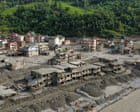
Scientists say global heating was a destabilising factor in collapse of 200,000 sq metre glacier in August
Damien GayleWed 16 Sep 2026 19.01 EDTSharePrefer the Guardian on GoogleClimate breakdown probably weakened the glacier that collapsed causing catastrophic floods and killing hundreds of people in Nepal and Tibet last month, the first scientific study of the disaster has found.
Researchers identified unusually warm conditions before the glacier’s collapse, which sent an avalanche of 110m cubic metres (3,885 cu ft) of snow and ice into the valley below. This triggered flash floods on an almost unprecedented scale, hitting communities downstream without warning.
How the deadly Nepal and Tibet flash flood unfolded – a visual guideRead more“Communities in Nepal are paying with their lives for a crisis driven by fossil fuel emissions thousands of miles away,” said Dr Friederike Otto, a climate science professor at Imperial College London, which carried out the study.
“When warming destabilises the roof of the world, no amount of local adaptation can fully shield vulnerable people downstream from this scale of destruction. Without much faster action to transition to zero fossil fuel emissions we will inevitably see more disasters of this scale occurring in the years to come.”
A impromptu memorial in Kathmandu commemorates some of the people killed in the flooding. Photograph: Narendra Shrestha/EPAMore than 1,300 people were killed and more than 5,000 people remain missing after a massive section of overhanging glacier and rock measuring roughly 200,000 sq metres (2,153,000 sq ft) fell from Langtang Lirung mountain on 26 August.
It dropped about 1,400 metres (4,660ft), slamming into the valley floor with such intensity that it registered as an earthquake, liquidising ice and sparking a freezing flood that careened downriver at speeds exceeding 110 mph.
The devastating flood of water, ice, rock and sediment swept away families, homes, settlements, roads, bridges and other infrastructure, leaving survivors stranded and cut off.
“Rock avalanches of this size are rare, with annual frequency estimates of approximately one event this size every 1,000–10,000 years,” the study said. “This event shows that limits to adaptation are already being reached.”
The research was unlike previous studies by Otto and her team at World Weather Attribution (WWA) – a collaborative project between Imperial and other climate specialists worldwide – in that the role of climate breakdown could not be ascribed to one particular weather event.
Instead, the researchers found the disaster was the result of a compound crisis, with a number of factors made worse by decades of atmospheric heating as a result of greenhouse gas pollution.
Dr Ben Clarke, who researches extreme weather and climate change at Imperial, said the “fingerprints of climate change” were clear in the long-term changes that happened around the glacier before its catastrophic collapse.
‘Communities in Nepal are paying with their lives for a crisis driven by fossil fuel emissions thousands of miles away,’ said Dr Friederike Otto. Photograph: Suryams Upreti/AAPAmong the study’s key findings were:
skip past newsletter promotionFree newsletter |WeeklySign up to Down to Earth
The planet's most important stories. Get all the week's environment news - the good, the bad and the essential
after newsletter promotion
In the region where the collapse happened, climate breakdown has caused about 2C of warming since pre-industrial times, and about 1.5C of warming in July and August specifically;
July and August 2026 were the warmest on record locally, reaching 5C above the 30-year average in the days before the collapse;
The freezing threshold in the Himalayas has risen by about 100 metres per decade since the 1980s, with higher and longer thaw temperatures weakening mountain slopes shaped by permafrost;
The warming temperature had already driven substantial glacier recession, removing stabilising ice from around the site where the collapse occurred and contributing meltwater;
A 7.8 magnitude earthquake in 2015 further contributed to slope failure, though its specific contribution to the disaster in August could not be confirmed.
Otto, Clarke and the WWA team said their study did not directly ascribe climate breakdown as the fundamental cause of the catastrophe. Instead, it was best understood as a destabilising factor on the existing geology.
Clarke said: “We found that climate change is transforming the high mountain environment, influencing many of the possible drivers of this collapse.”
A major earthquake in Nepal in 2015 may also have contributed to the glacier’s collapse. Photograph: Ishwar Rauniyar/The GuardianNepal has filed a formal request with the UN loss and damage fund for financial support to address the destruction caused by the flood, a process that requires proof of a link to the climate crisis. The country’s foreign minister, Shisir Khanal, has also demanded that top emitting nations such as China and India “wake up” and accept shared responsibility for the disaster.
Madhab Uprety, senior technical advisor for the Red Cross Red Crescent Climate Centre, which is part of WWA, said only aggressive cuts to global emissions could begin to address the “losses and damages faced by vulnerable frontline communities”.
He added: “In addition to the human tragedy on an unimaginable scale, the cost of recovery for this disaster is substantial. For a nation that’s done virtually nothing to contribute to this problem, it underlines the need to find fairness in helping climate vulnerable nations cope with the problems they have not unleashed.”
Explore more on these topicsShareReuse this contentRescuers in Nepal find two more people alive after flash flood disaster
5 Sept 2026Two workers pulled alive from tunnel nine days after Nepal-Tibet floods
4 Sept 2026‘Everyone seems to have forgotten’: In Tibet, flood-hit families search for the missing and grapple with China’s silence
4 Sept 2026‘They’ll be finding bodies next year’: a renowned forensic scientist on Nepal’s ‘extreme challenges’
4 Sept 2026Dozens of trapped hydropower tunnel workers in Nepal could still be alive, official says
3 Sept 2026After the flood: human suffering on an unfathomable scale in Nepal’s worst-hit districts
2 Sept 2026British aid worker mistakenly identified as a survivor of Nepal-Tibet disaster
1 Sept 2026China is concealing scale of flood disaster, say Tibet campaigners
31 Aug 2026Nepal rescuers race to reach hundreds feared trapped in hydropower tunnels
31 Aug 2026‘The house got carried 100 metres away’: some Nepal flood victims had minutes of notice. Others had seconds
30 Aug 2026