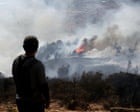
Colombian authorities declared a public calamity as a wildfire burned through mountains surrounding one of the country’s best-known colonial towns in the north-east, scorching large swaths of vegetation and forcing evacuations.
Nearly 20 active fires are burning across the South American country. Dry conditions have increased fire danger in Colombia as it braces for the effects of El Niño, which can help wildfires spread.
The fire in Villa de Leyva, a popular tourist destination about 160km (100 miles) north-east of the capital, Bogotá, began Saturday on a mountain overlooking the town. By Sunday evening, authorities said about 290 hectares (717 acres) had been affected – an area roughly equivalent to 400 soccer fields – and the blaze was about 50% under control.
Strong winds have complicated efforts to contain the flames, which at times advanced toward populated areas. Local authorities declared an emergency, suspended in-person classes Monday and carried out preventive evacuations, including at hotels near the fire.
Flames and smoke rise from a wildfire in Villa de Leyva, Colombia, on 20 September 2026. Photograph: Sebastian Arguello/ReutersMore than 400 firefighters, emergency workers, residents and volunteers took part in the response, while four helicopters dropped water on the flames. Carlos Amaya, the governor of Boyaca, where Villa de Leyva is located, said aircraft carried out about 170 water drops Sunday, releasing 240,000 liters (63,400 gallons).
Fabio Arjona, Colombia’s environment minister, said preliminary information from the disaster management agency suggested it may have been deliberately started, but authorities were still investigating.
Abelardo de la Espriella, the Colombian president, said Sunday on X the Villa de Leyva fire was about 50% controlled and contained on the ground.
Colombia’s national disaster management agency said in its latest nationwide update that authorities were monitoring 27 forest fires, with 19 still active and eight under control. Nine of the active fires were in Tolima, a mountainous region south-west of Bogotá, while others were burning across several parts of the country’s Andean region.
The weather agency said last week that 279 municipalities were under some level of wildfire warning, including 36 under its highest, red-alert level, with much of the risk concentrated in the Andean and Caribbean regions.
Between 16 June 16 and 6 August, Colombia recorded 438 forest fires in 191 municipalities, affecting about 7,153 hectares of vegetation, according to government figures.
Neighboring Ecuador is also battling a wave of wildfires. Ecuador’s national risk management agency said Sunday that 12 fires remained active across the country, while more than 21,800 hectares of vegetation have burned so far this year.
High temperatures and strong winds have helped flames spread rapidly in some areas. A fire on the slopes of Ecuador’s Imbabura volcano burned about 300 hectares before being brought under control Sunday after three days of firefighting.
El Niño is a periodic warming of the tropical Pacific Ocean that can reduce rainfall and raise temperatures in parts of the country, creating conditions that allow wildfires to spread more easily.
Disaster officials have said the period of greatest risk across the region from the developing El Niño is expected between October and April, with wildfires and water shortages among the main concerns.
