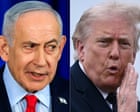
Recent exchange of missiles between Iran and Israel highlights diverging views between US president and Israeli PM
Mon 8 Jun 2026 14.23 EDTLast modified on Mon 8 Jun 2026 14.41 EDTShareThe latest eruption of hostilities between Iran and Israel appears to have been contained for now after Donald Trump insisted he called “all the shots” in the Middle East, but in a dangerously fragile region Benjamin Netanyahu has again shown he is ready to take shots of his own.
The exchange of missiles on Sunday and Monday was ample demonstration of the inherent instability of the current limbo between war and peace, but it also shone a bright light on the complex and conflicted relationship between the US president and the Israeli prime minister, frenemies who could determine the fate of the current ceasefire.
Trump went out of his way on Sunday to stress that he was the dominant partner in the relationship.
“I call all the shots. He doesn’t call the shots,” he told the Financial Times. Less than a week earlier, the White House had leaked details of a foul-mouthed tirade from Trump, telling Netanyahu he was “crazy”, suggesting he did not know what he was doing, and informing him “everybody hates you now”.
The tongue-lashing was reportedly aimed at warning Netanyahu against attacking Beirut in his pursuit of Hezbollah, a red line for Iran in terms of what it considered a violation of the broader regional ceasefire.
Trump routinely uses public humiliation in response to any perceived insubordination. Against Netanyahu, it worked for less than a week. After a string of Israeli casualties in Lebanon over the weekend, the prime minister ordered the bombing of the Hezbollah stronghold in the southern Beirut district of Dahiyeh on Sunday, triggering a salvo of Iranian missiles aimed at Israel in response.
Despite managing to intercept the incoming projectiles and Trump’s urging not to retaliate, Netanyahu ordered a response in kind: missile strikes against targets in Iran. The exchanges spilled into Monday morning before both sides declared a halt so Trump could declare the ceasefire back on track, with a blockade kept in place on the strait of Hormuz, “until a ‘final deal’ is reached.
“Things should move quickly,” Trump promised on his Truth Social platform, in a well-worn assurance he has offered repeatedly over the past two months of the ceasefire – with diminishing impact on global oil prices.
Trump and Netanyahu went to war together against Iran on 28 February but fell out of step within days, as soon as it was clear that the quick victory and regime change promised by the Israelis was unlikely to materialise. From then on, their interests have increasingly diverged.
Once Iran closed the strait of Hormuz, the spike in the oil price and the interruption in the flow of globally traded chemical products became a political threat to Trump. Despite Republican gerrymandering and voter suppression, Democrats have a plausible shot at capturing at least one chamber of Congress in November elections, undermining his authority. More immediately, the president would clearly prefer to steer clear of global distractions while he hosts football’s World Cup.
The electoral pressure on Netanyahu pushes him in the opposite direction. Unless he can orchestrate a turnaround, his ruling coalition stands to lose in the vote, which must be held before the end of October. As things stand, for all the bombing of the past three years, he cannot claim to have fulfilled any of his pledges to neutralise Israel’s major adversaries: Iran, Hezbollah and Hamas.
Netanyahu’s political logic drives him towards further onslaught in the hope of a breakthrough, such as regime collapse in Tehran. To secure support from the Israeli far right, Netanyahu has to show himself ready to defy Trump from time to time in pursuing that multi-front campaign, but no leader of Israel can afford to burn bridges with Washington, its principal security guarantor. That leaves a fine line to tread.
Persuading Trump to join the attack on Iran was the biggest victory of Netanyahu’s career, but that triumph is crumbling. The US-Iranian peace deal is being negotiated without Israeli participation, and in its current reported form, would leave the regime in power with a restricted but continuing nuclear programme. By Tehran’s insistence, any agreement would also tie Israel’s hands in dealing with Hezbollah in Lebanon.
Netanyahu’s best bet for his political survival is that the peace talks will fail, and the US will be drawn back into the war on Iran. Officials in his government have consistently predicted that outcome in off-the-record briefings, and so far they have been right. For all his repeated claims that peace is almost at hand, Trump has clearly found it hard to stomach any deal that would compare to the nuclear agreement achieved by Barack Obama in 2015, especially if it involves anything as visually embarrassing as the delivery of unfrozen Iranian assets in the form of pallets of cash flown into Tehran. The weekend’s eruption of hostilities and their temporary resolution does not bring an exit from that limbo any closer.
Both Trump and Netanyahu rose to the top thanks to a knack for spotting the weaknesses of rivals, and they can clearly see each other’s vulnerabilities. They both sit atop fractured political machines, and face serious legal jeopardy once they lose their grip on power.
“You’d be in prison if it weren’t for me,” Trump is said to have yelled at Netanyahu last week.
So far this year, the two ageing leaders have found common remedy for their domestic predicament by going to war. Netanyahu is still determined to press on and take US military might with him, while Trump is wavering. As long as this two-man drama remains unresolved, the Middle East will continue to pay the price.
Explore more on these topics- Donald Trump
- Benjamin Netanyahu
- Iran
- Hezbollah
- Israel
- Strait of Hormuz
- Middle East and north Africa
- analysis
Israel and Iran step back from renewed conflict after Trump calls for halt
35m agoIran war: who is fighting and why?
4h agoWill Iran give up on ceasefire talks as strait of Hormuz blockade continues?
5h agoKuwait and Bahrain targeted by Iran after exchange of fire with US
2d agoBlackouts, hyperinflation, dissent: Iran considers perilous prospect of peace
2d agoTwo men convicted of wounding journalist in London ‘on orders of Iran’
3d agoIsrael strikes southern Lebanon after ordering evacuations of nine villages
3d agoThree Lebanese hospitals hit by Israeli forces in under a week
5d ago