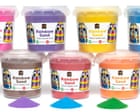
Colourful children’s play sand that was sold in Australia while contaminated with asbestos can release hazardous airborne fibres of the toxic mineral, researchers have discovered.
The Australian Competition and Consumer Commission (ACCC) and the lead researcher of the Auckland University of Technology (AUT) study, which found 90% of craft sand samples released asbestos into the air when played with, confirmed the products had been sold in Australia.
At least 22 children’s sand products, many of which were sold at leading Australian retailers, were recalled between November 2025 and May this year due to concerns they could contain asbestos.
Some of those products were also sold in New Zealand, prompting jointly funded research into whether the contaminated products contained asbestos which could become airborne and potentially more easily inhaled by children.
Sign up for the Breaking News Australia emailLed by Associate Prof Terri-Ann Berry, the AUT study tested 15 products sold by three different companies: 11 were dusty “craft” sands and four were “moulding sand” containing an additive to make them sticky and clumpy.
Berry said they simulated the way children might play with the sand by using “plastic spoons, toy cars, little scoops and all sorts”.
Nine of the craft sands produced airborne asbestos fibres regardless of the intensity with which they were “played”, Berry said.
Only one did not release any fibres, and another was an uncontaminated control sample.
None of the moulding sands released airborne particles, Berry said.
While the study is yet to be peer reviewed, Berry described the results as concerning.
She and her colleagues had hoped to prove correct the initial public messaging that the recalled products were low risk because the asbestos “couldn’t get from the sand into the air”.
“Our idea was, well, wouldn’t it be great if we can test and there are no fibres in the air and everyone takes a sigh of relief,” she said. “Obviously, [the findings] were not what we wanted.”
Berry said she didn’t want parents to panic, and that health authorities in New Zealand and Australia would decide on the next steps.
Last week, Berry presented the findings to about 50 people from the relevant Australian bodies, including the Asbestos and Silica Safety and Eradication Agency (Assea).
Assea and health officials had been provided with a list of the affected products, Berry said, but she would not disclose them publicly.
skip past newsletter promotionFree newsletter | When neededSign up to Breaking News Australia
Get the most important news as it breaks
after newsletter promotion
Officeworks and Kmart, two of the biggest retailers who recalled sand products, said they had asked AUT for a copy of the findings.
When their products were recalled, Officeworks said there was “no identifiable safety hazard”.
At the time, Kmart said “traces of asbestos” had been detected in a sand castle building set in New Zealand, which was also sold in Australia, but the fibres were unlikely to be released unless it was mechanically crushed.
Both companies on Wednesday said safety was their priority, and they had “processes in place” to ensure products were tested to government regulatory requirements.
They said they would work out whether to take any further action as the AUT study “moves through the standard stages of peer review and evaluation”.
The ACCC said it was “working with suppliers of recalled products on the wording of their recalls” where necessary, after alerting retailers to the AUT findings.
Retailers “should consider this new information as part of their risk assessment, and take further action, including recall action, as appropriate to address the risk to consumers”, an ACCC spokesperson said.
Guardian Australia contacted Assea for comment.
