Russian and Ukrainian strikes in July killed more crew than in whole war to that month, preventing grain exports
Joanna PartridgeFri 4 Sep 2026 10.35 EDTLast modified on Fri 4 Sep 2026 11.38 EDTSharePrefer the Guardian on GoogleA summer of hostilities in the Black Sea proved deadly for seafarers, as Russia and Ukraine attacked each other’s ships and port infrastructure, preventing vital grain exports and prompting concerns that the conflict will push global food prices even higher.
More crew were killed in the Black Sea in July than during the entirety of the war before that month as the conflict has intensified, making the body of water the most dangerous in the world for commercial shipping. This is despite the conflict between the US and Iran, with vessels still being targeted in the strait of Hormuz, Red Sea and Gulf of Aden.
As many as 23 people died in July as a result of attacks on 35 ships in the Black Sea, according to estimates from the Turkish seafarers’ union Türkiye Denizciler Sendikası.
Attacks on vessels continued into August and escalation in the Ukraine war has prompted the head of the UN shipping agency, the International Maritime Organization, to condemn the “deterioration of maritime security around the globe”.
Russia first launched waves of attacks on port infrastructure and vessels anchored in Ukrainian Black Sea ports in the months after its invasion in 2022, preventing Kyiv from exporting grain. In July, Russia again struck Ukraine’s main grain export hubs of Odesa and Chornomorsk.
Firefighters tackle a blaze on a civilian vessel hit during Russian missile strikes on Chornomorsk last December. Photograph: State Emergency Service Of Ukraine/ReutersHowever, the recent escalation in the Black Sea and neighbouring Sea of Azov – connected by the Kerch strait – has also resulted from Ukrainian retaliatory attacks. Drones have hit Russian vessels, including tankers Kyiv says belong to a shadow fleet of hundreds of ships used by Russia to evade sanctions on its oil exports. Ukraine has targeted ships and port buildings at the Russian Black Sea port of Novorossiysk, vital for oil and grain exports.
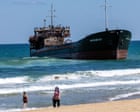
In a grim illustration of the danger to vessels and their crew, an abandoned Russian-flagged cargo ship – with a burned-out command deck – recently ran aground on Turkey’s Black Sea coast as startled holidaymakers looked on.
The Omskiy-107’s crew abandoned ship after it was hit by a Ukrainian drone near Novorossiysk, leaving the unmanned vessel to drift hundreds of miles and end up close to the Bosphorus, the narrow strait straddled by Istanbul that is one of the world’s busiest shipping lanes.
A damaged Liberian-flagged bulk carrier is escorted by a safety boat through the Bosphorus this week. Photograph: Murad Sezer/ReutersShipping in the region is under increased threat, according to analysts at the maritime risk intelligence firm Vanguard. “Merchant vessels are now more likely to be affected because of the ports they visit, their trading activity and the cargoes they carry. Attacks have also extended beyond ports and their immediate approaches, increasing the risk to vessels across a wider area of the Black Sea,” they said.
The precarious maritime situation has already significantly reduced Russian and Ukrainian grain exports, raising concerns the disruption will worsen the impact of other food price shocks and hurt countries reliant on imported wheat, barley and maize.
Russia is the world’s largest grain exporter, with its produce mostly going to the Middle East and north Africa, particularly Turkey and Egypt, while Ukraine is the fifth-largest.
In July, Russia suspended shipping in the Sea of Azov after a wave of Ukrainian drone attacks, before deciding to redirect some grain exports to alternative routes such as via the Caspian and Baltic seas and the Pacific. However, more than 70% of Russia’s seaborne grain exports are shipped from Black Sea ports, and a further 20% from the Sea of Azov, according to analysis from Oxford Economics.
“I have seen estimates that Russian grain exports were down to 40% of normal export capacity in August,” said Tatiana Orlova, the lead emerging markets economist at Oxford Economics.
A satellite image shows damage to a grain conveyor, after a Ukrainian drone and missile attack on Novorossiysk last month. Photograph: Vantor/ReutersUkraine, which had a bumper and early grain harvest this year, has also found itself unable to export large volumes through its Black Sea ports. Kyiv exported only a third – about 1.4m tonnes – of the grain it could have exported, using sea, rail, river and road, according to recent comments from Ukraine’s food minister.
Global wheat prices have been trading higher in recent weeks, but remain below levels at the beginning of the Ukraine war in 2022.
However, analysts say the latest disruption to seaborne grain exports is likely to push prices higher and exacerbate other food supply shocks, including the Iran war and lower European grain yields after extreme summer heat and the rapidly developing El Niño weather system.
Global food prices are forecast by Oxford Economics to rise by nearly 12% this year and a further 4.8% in 2027.
Unlike in 2022, when many big food importing countries were caught napping by Russia’s invasion of Ukraine, “a lot of countries have grain stocks, which should help, so there is better preparedness for this kind of shock”, said Orlova. “But it is pretty clear the food price is going to be affected.”
Russia strikes Ukraine intelligence HQ in ‘major escalation’
33m agoGrinding up fish to feed to fish is ‘absurd’: fears over UN aquaculture plan
23h agoBhutan hosts first ‘conscious food summit’ amid threats to global supplies
4d agoEurope calls out Russia’s ‘hybrid war’ in public. But how can it make Putin pay?
11h agoShootout in Kyiv between Ukrainian spy services ‘disgraceful’, says Zelenskyy
1d agoFishy business: who really profits when sardines go viral? - video
25 Aug 2026Russian airspace becoming unsafe for commercial airlines, Zelenskyy says
2d agoSubterranean salad: underground farmers seek solution to food crisis in disused UK mines
22 Aug 2026Russia targets Ukraine’s rail network as war enters deadly new phase
3d agoMilk, wine, salad: how your food will be affected by the summer of heat
14 Aug 2026