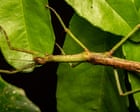
Two new large stick insect species have been identified by Australian researchers, in a discovery they say illustrates how little we still understand about insect diversity.
The two species, both found in far north Queensland, are described in a study published in Austral Entomology.
One, named Anchiale robusta, was hiding in plain sight: the stick insect has long been popular among enthusiasts and scientists, but analysis has only now revealed that its previous designation was a case of mistaken identity.
“When we went out into the field, and we saw a whole bunch of different individuals that looked morphologically different, and they were also living in … different habitats, that was our first hint that there was a bit more of a complicated story here,” said the study’s lead author, Dr Braxton Jones of the University of Sydney.
Sign up for the Breaking News Australia emailCombining analysis of DNA and museum collections, citizen science records and surveys, the team discovered the insect had been misidentified for decades.
Anchiale robusta females grow to a body length of 12 to 16cm; males reach 9 to 10cm in length. “Mostly their wings are black but some of them have a little bit of purple on the underside of their hindwing,” Jones said.
“Males are always smaller than females – it’s incredibly rare for a female to be able to still fly because they are quite heavy with … eggs.”
A female Anchiale robusta, during a threat display. Photograph: Paul D Brock/Natural History MuseumThe team also described Anchiale mabiensis, a species that lives in the critically endangered Mabi rainforest of Queensland’s Atherton tablelands. Females of the species are about 11 to 12cm long.
The eggs of the species have an unusual structural “lid”, which detaches when the insects hatch, Jones said.
In describing two new species and confirming the existence of a third, the research revealed that what were once considered two species are in fact five species in habitats stretching from northern New South Wales into tropical north Queensland.
That finding had important conservation implications, Jones said, given that the species are found in smaller habitat ranges than previously thought.
Jones said animals of the Anchiale genus were one of the most documented stick insects on citizen science platforms, because “there’s quite a lot of them and they can hatch in large proportions and population sizes”.
Despite this, he said, “there’s so much we don’t know about them”.
The study also identified another probable new species in Cape York, but more specimens are needed for confirmation.
Last year, also on the Atherton tablelands, scientists discovered a 40cm-long new species, Acrophylla alta, which weighs slightly less than a golf ball and which they noted could be the heaviest insect in Australia.
Australia’s longest species, the gargantuan stick insect, is also found in northeastern Queensland; females of the species can grow to more than half a metre in length.