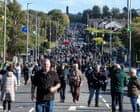
Governments will be hoping row over the contentious Orange Order march down Garvaghy Road can be defused
Shane HarrisonSun 27 Sep 2026 12.56 EDTLast modified on Sun 27 Sep 2026 13.33 EDTSharePrefer the Guardian on GoogleLike a ghost from its troubled past, Drumcree has unexpectedly reappeared to remind people how far Northern Ireland has changed in 30 years but also how easily history can undermine the present, if imperfect, peace and stability.
Three decades ago parts of Northern Ireland came to an almost annual standstill as Protestant Orange Order protesters blocked roads in support of members wanting to march down what they called its traditional route, the Garvaghy Road, on the Sunday before the annual 12 July parade.
Because the Garvaghy Road is a main thoroughfare in a predominantly nationalist area, residents opposed the march. The standoff led to violence and murders at a time when Northern Ireland’s fragile peace process was in its infancy.
Tense standoff over loyalist march in Portadown as protesters block routeRead moreIn 1998, the newly formed Parades Commission was established to defuse tension around controversial marches and to regulate parades.
The commission, which was opposed by the Orange Order and unionist political parties, banned the Drumcree parade and has done so every year since, until 2026.
In August, the high court overturned a Parades Commission ruling preventing the march, saying the commission had erred in not following its own rules and procedures in its decision.
That ruling has been described by the Irish taoiseach, Micheál Martin, as “incomprehensible and wrong”.
The decision then allowed the order to resubmit an application giving the statutory 28 days’ notice for this year’s controversial march, which was opposed once again by residents.
Armoured police vehicles lined up in Portadown after the high court ruled the Orange Order’s march could go ahead on Sunday. Photograph: Charles McQuillan/Getty ImagesOver the last few days, the issue returned to the courts several times as those opposed to the parade sought to prevent it happening.
On Saturday, Justice Patricia Smyth in the high court blocked the commission by means of an injunction, saying the “long-running dispute has the potential to escalate” across Northern Ireland. She urged the parties involved to, “be big enough to step back from the abyss”.
The injunction had the effect of pausing the Orange Order’s notification of the parade; that was described by the order’s barrister as “rewriting history”.
But that ruling, which was described by Siobhan Keegan, Northern Ireland’s lady chief justice, as “unfortunately” an error in law, was in turn appealed against and led to the high court in the early hours of Sunday morning ruling the initial Parades Commission decision to allow the march to take place had to be respected.
But the ruling has not gone down well with residents, their supporters and political leaders who blocked any march by 35 Orangemen, saying that after 28 years there could be no return to the past.
skip past newsletter promotionFree newsletter |Every weekdaySign up to First Edition
Our morning email breaks down the key stories of the day, telling you what’s happening and why it matters
after newsletter promotion
Northern Ireland now is, however, very different from three decades ago.
Tense standoff over loyalist march in Portadown as protesters block routeRead moreThere is no longer a unionist majority; indeed the first minister, Michelle O’Neill, is from Sinn Féin.
After Brexit, Irish nationalism is more self-confident and is pushing – some would say, if not unrealistically, then certainly prematurely – for preparations for a border poll on unity with the rest of the island.
Changing demographics and the Brexit-inspired sea border on trading goods between Britain and Northern Ireland have made many unionists uneasy.
That and a barely functioning multi-party executive at Stormont ahead of assembly and local elections next year are the background to the Garvaghy Road standoff.
And so we have unionists who opposed the Parades Commission accusing nationalists of refusing to respect the law and those nationalists, who, in the past, called for respect for the commission’s rulings, refusing to comply with its latest.
The two governments will be hoping the standoff can be defused so the ghosts of the past can no longer haunt today’s still emerging Northern Ireland.
Explore more on these topicsShareReuse this contentTense standoff over loyalist march in Portadown as protesters block route
2h agoLoyalist parade in Northern Ireland given go-ahead as almost 30-year ban overturned
15h agoDrumcree ruling raises fears of sectarian confrontation in Northern Ireland
28 Aug 2026‘Nobody’s in charge’: is power sharing still working in Northern Ireland?
10 Apr 2026What do the new Northern Ireland Troubles legacy proposals entail?
19 Sept 2025British and Irish governments to present new Troubles legacy proposals
19 Sept 2025Johnson’s Brexit left ‘wholly negative legacy’ across Ireland, says new SDLP leader
4 Nov 2024Ex-TV news presenter Mike Nesbitt to return as Ulster Unionists’ leader
30 Aug 2024Colum Eastwood resigns as leader of Northern Ireland’s SDLP
29 Aug 2024