If you get Global News from Instagram or Facebook - that will be changing. Find out how you can still connect with us.
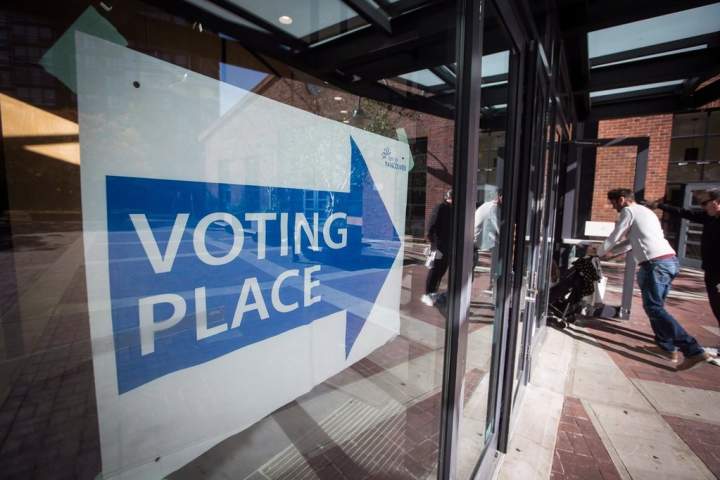
View image in full screen People enter a municipal election polling station in Vancouver, on Saturday, Oct. 20, 2018. THE CANADIAN PRESS/Darryl Dyck. DDCori Ramsay, a candidate for city council in Prince George, B.C., says a voter told her they can’t wait to cast a ballot for her on Oct. 24. The voter would surely be disappointed, as Ramsay’s election is a week earlier, on Oct. 17.
As British Columbians contend with local and provincial elections in October, some candidates say the overlap is confusing and overwhelming voters.
The local elections on Oct. 17 will see voters elect mayors, councillors, school board trustees and other local officials, while a provincial vote will be held Oct. 24 to elect 93 members of the legislature, which will determine B.C.’s next premier.
NDP Leader David Eby’s decision to call a snap election came as the local election campaign period had already begun, and earned swift condemnation from the Union of BC Municipalities, which represents local governments in the province.
Ramsay, the union’s former president, said she thinks the decision has put an unfair strain on the electorate.
“I’m hearing candidates going door-to-door for the municipal election being told that ‘I can’t vote for you because I’m voting for our MLA,'” she said.
The union’s current president, Jenna Stoner, who is running for mayor in Squamish, B.C., said she’s seen voters confused about where and when to vote.
While the election dates are separate, the local election day overlaps with provincial advance voting.
“There’s just so much confusion in the community right now that we’re having to navigate, and it’s just so frustrating,” Ramsay said.
She said the dual elections are hurting voters’ ability to assess candidates in a crowded field, and that one frustrated and overwhelmed voter said she would base her vote on a “vibe check.”
Related Videos 1:56 Nova Scotia unions rally in Halifax opposing changes to federal labour laws- Nova Scotia unions rally in Halifax opposing changes to federal labour laws
- N.S. labour protection bill praised by advocates but opposition says changes don’t go far enough
- Labour Day thoughts on the U.S-Canada trade war
- B.C. government under pressure to settle nurses’ dispute
- Nova Scotia is providing $25 million to NSCC for a new skilled trades institute
- Remote work concerns
- BCGEU escalating job action on Tuesday
- Pickets coming down at Surrey ICBC office
- UK deputy PM resigns after admitting to underpaying property tax on 2nd home
- B.C. premier comments on BCGEU strike
Tanya Webking, who is running with the BC Green Party for Vancouver-Strathcona in the provincial election, said she’s had voters mistake her as running for the Green Party of Vancouver. A few said they forgot about the double elections.
Get breaking National news
Get breaking Canada news delivered to your inbox as it happens so you won't miss a trending story. By providing your email address, you have read and agree to Global News' Terms and Conditions and Privacy Policy.She said she’s heard from multiple voters who are angry about the provincial election call and view it as costly and unnecessary.
Paul Thompson, a Vancouver voter, said it’s been difficult to get a handle on the multiple candidates running in the city’s municipal elections, where there are more than 100 people on the ballot.
“It’s pretty much impossible to sit down and read every single person’s point of view and what they’re campaigning for,” he said.
It was also hard to understand how the city and its various bodies, such as the park board, differ, he said.
Thompson has since cast his votes early in both elections, but said the provincial election call was a poor choice.
“They had the majority in the government and they still went ahead and wasted taxpayers’ money on something that nobody that I’ve spoken to actually wanted,” he said.
When asked about the overlapping elections at a campaign event on Wednesday, Eby said he had confidence in electors’ ability to vote in two elections.
“The local candidate elections, as far as I can tell, are running just fine,” he said, adding that a future report from Elections BC may address the issue.
Elections BC said it hasn’t weighed the outcomes or impacts of the dual elections because the provincial election campaign is not finished.
- Envoy says France admires Carney’s U.S. stance
- What Albertans can expect when they go to vote
- Alberta Premier Smith calls out federal interference in Edmonton housing rules
- Republicans face midterm backlash from factory workers squeezed out of jobs by Trump’s tariffs
The independent agency, which administers the provincial election, added that it has received a “large number” of applications for election officials and other staff, more than the last provincial election. It previously said 17,000 election officials were needed for the 2026 election.
“However, in rural and remote communities, we are still hiring election officials and office staff up to final voting day,” Elections BC said in an email on Thursday.
Stoner, Ramsay and Webking each expressed concerns about the dual elections’ effect on campaign volunteers and election staffing.
Stoner said she’s seen volunteer burnout, and there is the potential of volunteers or polling staff being pulled to provincial campaigns at the expense of local efforts.
“There’s limited capacity in the system and we’ve doubled the requirement of that system without necessarily doubling the resources,” she said.
Ramsay said the local election has lost some campaign workers who went to work on the provincial election instead, since it offers a few extra days of employment at more pay.
Michael MacKenzie, a professor of political studies and the Jarislowsky chair in trust and political leadership at Vancouver Island University, said the overlapping campaigns are bad for democracy.
“We tend to think that our municipal governments are somehow less important. This is not true. They make important decisions that affect our lives,” he said.
He noted that both local and provincial candidates often rely on the same volunteer base to run their campaigns, and resources are stretched thin. Some of his own students are volunteering in multiple elections or have switched campaigns entirely.
He said he doesn’t think voter fatigue will be an issue because British Columbians are already used to having elections every four years.
“The problem really is just the work that needs to be done to cast an informed vote,” he said.
Municipal elections tend to have abysmal voter turnouts, and competing with the more visible provincial election could siphon the attention of voters, MacKenzie said.
In Prince George, where Ramsay is pursuing a third term on city council, voter turnout in the local elections has been among the lowest in the province in recent years.
“I’m hoping that we see some activity at the polls, but I do think that voters will favour one election over the other at the end of the day,” she said.
This report by The Canadian Press was first published Oct. 10, 2026.
Add Global News as a Preferred Source on Google to see more of our stories in your search results.
Journalistic standards Report an error © 2026 The Canadian Press