The Dutch prime minister, Rob Jetten, has formally apologised for the “heartless” mistreatment of thousands of Moluccan soldiers who fought for the Dutch colonial army during Indonesia’s struggle for independence.
About 12,500 men from a group of Indonesian islands who served in the Royal Dutch East Indies army came with their families to the Netherlands in 1951, many having been given no choice. They thought it would be a temporary evacuation after Indonesia had won independence.
They hoped for their own Moluccan republic after a six-month stay but instead they were involuntarily discharged, banned from work and voting, and housed in places such as the former Nazi transit camp Westerbork. A republic never came and some never unpacked their suitcases.
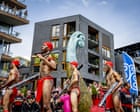
At the unveiling ceremony for a crowdfunded national monument on the harbourside in Rotterdam, where their last boat arrived, Jetten said: “For their heartless and dishonourable discharge as soldiers, for their inadequate reception and housing, for being unseen and abandoned, for the unfulfilled longing for home, for the grief and pain in so many Moluccan families.
“For this, I offer apologies today on behalf of the Dutch government. It is not only high time, but it is also necessary if we want to move forward.”
Rob Jetten said his apology was ‘necessary if we want to move forward’. Photograph: Robin Utrecht/EPAActivism by the descendants of those Moluccan families in the 1970s – including a school hostage-taking and an armed train hijack – ended in a bloody raid by Dutch special forces. There was a 1986 agreement with the government, including cultural funding and jobs schemes, but pressure had since grown for a formal recognition of the wrongs done.
Jetten stressed that a forthcoming parliamentary investigation, involving the community that now numbers 70,000 descendants, was vital.
Carola Schouten, the mayor of Rotterdam, said she hoped the monument would be a place for stories to be told openly. “They were treated with coldness, their loyalty had a high price and it was often a silent sorrow,” she said at the opening ceremony. “It is important that there is recognition of the injustice that was done to you.”
The project to create the monument – by the artists Jaïr Pattipeilohy and Maurice den Boer, and representing the prow of a traditional ship – had been a 10-year struggle, said Yordi Tahamata, the chair of the monument foundation.
The Moluccans who arrived in 1951 hoped for a republic of their own that never came. Photograph: ANP/Shutterstock“I stand here as the grandson of my grandfathers … part of a generation that came to the Netherlands under military orders and built a life in a strange land, unsure about a future none of them had predicted,” he said. “This is about the right to tell our history and to give it on to new generations.”
There was some criticism that the government had in effect gatecrashed the opening of a community’s monument, and that the words of apology had come too late for many people who lived through the exclusion and injustice.
Eduard Latuheri, 98, was invited to bless the monument, with several other surviving soldiers and first-generation family members. His grandson Dennis van Peterson spoke for Latuheri. “He is thankful just to come here,” he told the Guardian. “There’s a mixed feeling about an apology. For Grandad, it’s the right thing, but the first generation are mostly not here any more – it’s too late.”
There was some criticism that the words of apology had come too late for many. Photograph: Robin Utrecht/EPAOthers recalled the lifelong bitterness of their parents over the broken promise from the Dutch government to help them return. Fred Roos, 70, was born and lived for five years in Westerbork and said his late father was never allowed to work and always felt angry. “Everything was always ready to go back but it never happened,” he said. “This is a loaded moment.”
Fridus Steijlen, a co-author of a recent history of the Moluccan community in the Netherlands, said that because the Moluccans’ stay was always supposed to be temporary, integration was affected for generations – despite the community’s own resilience.
“An apology should address the parternalistic attitude of the Dutch government at the time, and that it didn’t think about how they could go back,” he said. “That’s why the pain went on.”