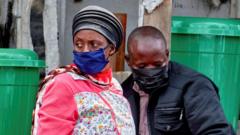
The public health risk from the current Ebola outbreak in the Democratic Republic of Congo has been increased from "high" to "very high" by the World Health Organization (WHO).
In an update on Friday, the WHO's head Dr Tedros Adhanom Ghebreyesus also said the risk in the wider region in Africa was "high", but it remained "low" at a global level.
The rare species of Ebola, known as Bundibugyo, has no proven vaccine and kills around a third of those infected. So far, the outbreak centred on DR Congo has resulted in 177 suspected deaths and 750 suspected cases.
It comes as scientists at Oxford University in the UK are developing a new vaccine that could be ready for clinical trials within two to three months.
There are no guarantees the vaccine will prove effective and it will take animal research and trials on people to know if it will be.
Another separate experimental Bundibugyo vaccine is also in development, but it is expected to take six to nine months for any dose of that to be ready for testing.
Speaking at Friday's news briefing in Geneva, Tedros said: "We are now revising our risk assessment to very high at the national level, high at the regional level, and low at the global level."
He said that "so far, 82 cases have been confirmed in DRC, with seven confirmed deaths".
Tedros added the situation in neighbouring Uganda - where they have been two confirmed cases of the Bundibugyo species and one death - was "stable" with both cases from people who travelled from neighbouring DR Congo.
Ebola is a rare but deadly disease caused by a virus. Although less deadly than other Ebola species, the rarity of Bundibugyo means there are fewer tools to stop it.
Ebola viruses normally infect animals, typically fruit bats, but outbreaks among humans can sometimes start when people eat or handle infected animals.
On Sunday, the WHO declared a public health emergency of international concern, but said it was not at pandemic level.
The WHO chief also said on Friday it was crucial to build trust, warning that violence and insecurity in the conflict-ridden region were hampering the response to the Ebola outbreak.
He was speaking after angry relatives set fire to a hospital in the eastern DR Congo after health workers had refused to release the body of a patient, because of the risk of contamination.
'Ebola has tortured us': Fear grips eastern DR Congo as deadly virus spreads
What is Ebola and why is stopping the latest outbreak so difficult?
Democratic Republic of CongoWorld Health Organization (WHO)AfricaPublic healthEbola virusRelatedUK scientists developing Ebola vaccine that could be ready for trials in months
Angry crowd sets Ebola hospital tents on fire in DR Congo
DR Congo cancels World Cup training camp over Ebola outbreak
More from the BBC7 hrs agoUS sanctions Tanzanian police official over 'torture' of rights activists
The sanctions come amid growing scrutiny of Tanzania’s human rights record in recent years.
7 hrs ago7 hrs agoAfrica summit in India postponed over Ebola outbreak fears
The India-Africa summit was set to be held next week in Delhi after more than a decade.
7 hrs ago17 hrs agoUS-bound plane diverts to Canada after person from Ebola-hit region boards 'in error'
17 hrs ago21 hrs agoWhat is Ebola and why is stopping the latest outbreak so difficult?
21 hrs ago1 day agoDozens of vehicles burnt as Mali jihadists enforce blockade ahead of Eid holiday
The blockade has led to shortages of fuel and food ahead of next week's Muslim holiday of Eid.
1 day ago