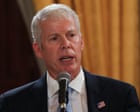
US energy secretary Chris Wright said on Sunday morning that the US may not be able to reach a nuclear agreement with Iran that would prevent the country from having nuclear weapons.
Asked on ABC on Sunday morning about any sign of such a deal, as negotiations appear stalled and the US-Israel war on Iran continues, Wright said: “There may not be a nuclear agreement.”
He talked about options for ending the “existential threat” of a nuclear armed Iran coming about by further US military action to knock out the country’s capacity to manufacture and deploy such missiles, saying: “It may be simply [a case of] destroying their capabilities to do it” or else “an agreement may await the next administration in Iran”.
He later said on CBS that the US was not shutting down diplomatic outreach and was “always open for a deal”. Wright told that network’s Face the Nation show that the “biggest role” of the US military in the Gulf region currently was to stop Iranian energy exports.
“We are strangling their economy to try to bring either a change in policy from the existing regime or a new regime,” he said.
In an earlier interview with CNN on Sunday, Wright declined to declare the strait of Hormuz safe for oil tankers – unless they are being escorted by the US navy – and stopped short of saying whether the navy would need to remain in the Gulf region “indefinitely” in order to keep the vital energy passageway operating, as the conflict drags on.
How the Iran war unfolded: every attack and oil price change – visualisedRead moreThis came despite Donald Trump’s repeated claims that ships can safely navigate the narrow marine waterway, and the US president’s insistence last week that the US controls the strait, while floating the idea that it be named after him – statements that were followed by further strikes from both sides in the area.
Wright, appearing for an interview on CNN’s State of the Union show on Sunday as well as ABC and CBS, was asked whether he could “unequivocally” assure safety to merchant ships transiting the strait. The question came after a New York Times report found that August was the deadliest month for merchant vessels in the area since March.
“We’re working cooperatively with fleets that do want to transit. Some ships aren’t transiting, and, of course, that’s their choice. But the United States is working with teams from all the nations in the Gulf to get transits and to continue to ramp them up,” Wright said.
“But you’re not saying that it’s currently safe?” host CNN Dana Bash asked, to which Wright replied: “We’re getting a lot of ships through, but, of course, it requires the US military to do that. We are not [at] pre-conflict levels, if that’s what you’re asking.”
Bash then asked: “If a country or a company wants to send its tanker through the strait of Hormuz, can they do so safely?”
“Well, if they want to work with the United States navy, I think they can,” Wright said.
Bash then asked whether the US navy would remain in the region “indefinitely” and whether its presence in the strait was becoming “the new normal”.
Wright responded: “Well, it is today, but I think, as you look forward, other nations will come and work with us in this endeavor. Certainly, trade for the world is important. It shouldn’t be just the United States’s responsibility.”
“But until Iran changes their position or changes their government, we’ll have to deal with them. But, slowly, their capabilities are being degraded and ours are being enhanced,” he added.
Iran war likely to drag on for another six months, ex-US defense secretary warnsRead moreNuclear and diplomatic talks between the United States and Iran appear to have stalled after a June interim agreement to end military operations collapsed without producing a lasting settlement on peace or the future of what remains of Iran’s nuclear program after US strikes last summer caused huge damage.
Wright was also asked by CNN if he would say the US is still at war. “We’re still in a conflict, for sure,” he said. On Thursday, the US vice-president JD Vance said at a White House press briefing: “I wouldn’t call it a war,” instead referring to a military conflict. Trump then defended Vance, saying: “A lot of people do not call it a war, I would call it a military conflict, because it’s small potatoes for us … it’s not a big thing.”
The Republican US senator John Kennedy of Louisiana was asked on Sunday by NBC if the war would be over by November.
“Probably not,” he said.
The conflict passed the six-month mark in late August. The former defense secretary Leon Panetta warned in an interview with the Guardian this weekend that it could last a lot longer.