It may have been a place for ceremony or a barn for pack animals. It could have been a place for weary labourers to rest their heads. Or perhaps there was no building at all.
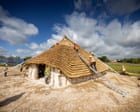
English Heritage has unveiled a 7-metre-high reconstruction of what a 4,500-year-old Neolithic hall may have looked like at Stonehenge, offering visitors a glimpse into the lives of the prehistoric builders who raised the world’s most famous stone circle.
Archaeologists say they have proof humans carved huge pits near StonehengeRead moreThe £1m project is in its final stages of construction near the Stonehenge visitor centre on Salisbury Plain. Built entirely by hand over nine months by a team of more than 100 volunteers, the Kusuma Neolithic Hall will open to the public this summer before transforming into an immersive, historical learning space for schools.
The structure is based on the archaeological footprint of an anomaly known as Durrington 68, a unique “square in the circle” building discovered two miles away near Woodhenge, another Neolithic site. First excavated in 1928 by Maud Cunnington, and re-examined in 2007 by the Stonehenge Riverside Project, the original site features a horseshoe-shaped ring of post holes surrounding four massive internal roof support pillars.
Because centuries of plowing destroyed the original floor and hearths, its true purpose remains a mystery. However, discoveries of animal bones and grooved ware pottery nearby point towards winter feasting, ritual gatherings or even communal storage.
The seven metre-high Kusuma Neolithic Hall is based on archaeological evidence of a large prehistoric structure that was discovered two miles away from the stone circle. Photograph: Christopher Ison/English Heritage/PALuke Winter, an experimental archaeologist, who analysed European Neolithic carpentry and prehistoric pollen data to design the hall, explained the construction’s rigorous scientific backing.
“Everything in that building was growing in this landscape 5,000 years ago,” he said. “We’ve been using replica stone tools to create every aspect of this building … we’ve counted literally every blow every axe has made.”
Winter said while he was initially sceptical about whether the archaeological footprint represented an actual roofed building, the construction process changed his mind. “I was 50/50 it might have been a structure. As we’re nearing completion … I’m now 75% sure it was a structure with a roof.”
Like the nearby stone circle, the building perfectly aligns with the winter solstice. “When we got the frame in on the solstice morning, I was here, and I stood there, my shadow cast on the middle post at the back,” Winter said.
The project forms the first phase of an educational expansion by English Heritage. Alongside the hall, a new learning centre housing the Clore Discovery Lab and Weston Learning Studio is scheduled to open by the end of 2026.
Iona Keen, English Heritage’s head of learning and interpretation, said the organisation’s goal was to double its educational capacity to nearly 100,000 students annually over the next five years. Keen said the site and its new resources would be completely free to any educational or youth group.
“The Neolithic period is firmly on the national curriculum,” Keen said, adding that the interactive hall would allow children to “step back in time” by gathering around an open fire to make prehistoric cheese and pinch pots. “You learn by doing, and you understand by having a go and trying to work it out yourself.”
Luke Winter at the site of Kusuma Neolithic Hall near Stonehenge. The £1m project is in the final stages of construction and will be open to the public this summer. Photograph: Christopher IsonThe project aims to understand the wider Stonehenge landscape. Stonehenge’s curator, Win Scutt said Stonehenge and the barrows and dwellings surrounding the Neolithic monument were driven by a “society that wanted connection”.
Scutt said: “This whole thing is about social society, not science,” with the camaraderie and “feeling of belonging” generating the motivation to build. Rather than being “obsessed with individualism” like modern society, these groups used massive cooperative projects as a medium for collective representation, he said.
He said the monuments and other structures would have been a “pure expression of the society”, revealing the instincts of the Neolithic peoples: “Now we’re all together, let’s create something that represents us.”
For Sarah Davis and James Humphrey, two volunteers, the project was a transformative experience. Reflecting on the monumental human effort required by the original builders, Davis said: “It’s just amazing to think of the people who actually built the original structure.”
Humphrey said: “It really brings history to life when you’re actually doing it yourself.”