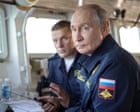
Without an agreement sanctions on nearly 3,000 entities accused of supporting the war on Ukraine will lapse at the end of the day
LIVE Updated 26s agoJakub KrupaTue 22 Sep 2026 06.42 EDTFirst published on Tue 22 Sep 2026 05.11 EDTShareKey events- 15s agoLithuania's PM worries about 'emotional state' of the public amid increased worries about Russia
- 25m agoEuropean spy chiefs warn Moscow is planning more decisive action against Nato
- 49m agoKremlin says all Russia sanctions are illegal, should be lifted
- 1h agoMacron, Zelenskyy discuss Russia's strikes on energy infrastructure ahead of winter
- 1h agoEU deadlocked over plans to remove two Russian billionaires from sanctions list
- 2h agoMorning opening: Welcome to New York
Morning opening: Welcome to New York
Jakub KrupaGlobal leaders are gathering in New York this week for the 81st UN general assembly and given the state of the world, it’s likely to be a lively one.
We are expecting to hear today from the US president, Donald Trump, Finland’s president Alexander Stubb, and France’s Emmanuel Macron (in his last UNGA appearance), among others.
Macron got to New York early and already held talks with Trump and Ukraine’s Volodymyr Zelenskyy last night, possibly trying to mediate ahead of the pair’s closely watched meeting later today. Trump and Zelenskyy are expected to sit down together in the late afternoon or early evening.
Ukrainian president Volodymyr Zelenskyy meeting with French president Emmanuel Macron in New York, USA. Photograph: Presidential Press Service Handout/EPAOutside the main UNGA room, it will also be worth keeping an eye on Trump’s meeting with Denmark’s Mette Frederiksen and Greenland’s Jens-Frederik Nielsen as they meet to sign the new Greenland deal on Arctic security.
Expect potentially diverging interpretations of what the deal actually involves…
Denmark’s prime minister Mette Frederiksen and Greenland's government leader Jens-Frederik Nielsen visit the 9/11 memorial and Ground Zero in New York. Photograph: Mads Claus Rasmussen/APSeparately, I will also keep an eye on events back in Europe as EU ambassadors meet in Brussels to discuss the latest Russia sanctions list with some controversial attempts to amend it and take some fairly well-known names out of it. More on that shortly.
Lots for us to cover today.
It’s Tuesday, 22 September 2026, it’s Jakub Krupa here, and this is Europe Live.
Good morning.
ShareKey events- 15s agoLithuania's PM worries about 'emotional state' of the public amid increased worries about Russia
- 25m agoEuropean spy chiefs warn Moscow is planning more decisive action against Nato
- 49m agoKremlin says all Russia sanctions are illegal, should be lifted
- 1h agoMacron, Zelenskyy discuss Russia's strikes on energy infrastructure ahead of winter
- 1h agoEU deadlocked over plans to remove two Russian billionaires from sanctions list
- 2h agoMorning opening: Welcome to New York
Lithuania's PM worries about 'emotional state' of the public amid increased worries about Russia
Lithuanian prime minister Mindaugas Sinkevičius has warned that citizens in his country are increasingly affected by concerns about potential Russian aggression.
Speaking on BBC Newsnight last night, he described the emotional toll on the population, highlighting overnight air raid alarms triggered by drone activity in Lithuanian airspace.
Lithuania's prime minister Mindaugas Sinkevičius addresses a press conference in Vilnius, Lithuania. Photograph: Petras Malūkas/AFP/Getty Images“It’s an alarming thing, you know when you in the middle of the night you receive an alarm and your phone starts alarming, go to the shelter and maybe yellow, red signal of threat. That’s not a good emotional situation,” he said.
Sinkevičius also confirmed that while Lithuania has no plans to surrender, contingency evacuation plans are in place if required:
“There are plans prepared for evacuation. Of course there would be groups of people, handicapped, elderly people, that will be priority groups of citizens that will be needed to be assisted and evacuated. We’re thinking about a variety of scenarios, not all of them are being discussed very much publicly.
Calling for a “shift in mindset” among western allies, Sinkevičius also added:
Share25m ago06.18 EDT“When we’re closer to the border and closer to threat, the shift in mindset of political actors is quicker. … We face concrete threats, not on a daily basis, but we’re experiencing them and it’s a true reality for us.”
European spy chiefs warn Moscow is planning more decisive action against Nato
Shaun WalkerMeanwhile, European leaders attending the UN general assembly in New York will also have the growing concerns about Russia’s aggressive posture in eastern Europe at the back of their mind.
The coat of arms of Russia hangs from a post on the Estonian-Russian border. Photograph: Carl Court/Getty ImagesAs the Guardian’s Shaun Walker reported over the weekend, European intelligence officials have raised the possibility of an imminent Russian test of Nato, with one saying a potential attack could come in a matter of “months, not years”.
European spy chiefs warn Moscow is planning more decisive action against NatoRead moreShare49m ago05.54 EDT“Michal Koudelka, the head of the Czech Republic’s BIS security service, said that as well as increased drone activity, a small-scale invasion of Nato territory that bordered Russia could be part of the Kremlin’s plans.
“It’s possible. It could involve a limited incursion, false-flag provocations, a massive influence campaign,” he said, in a rare interview at the agency’s headquarters in Prague.
He said this scenario could play out in a matter of “months, not years” but added that “a lot of people are doing everything they can to make sure this doesn’t happen””
Kremlin says all Russia sanctions are illegal, should be lifted
Meanwhile, the Kremlin said it considered all western sanctions on Russian individuals to be illegal and that they should all be revoked.
Kremlin spokesperson Dmitry Peskov was answering a question about a push by some EU countries to lift sanctions on Russia-linked billionaires Alisher Usmanov and Mikhail Fridman in return for keeping thousands of other individuals and businesses under sanctions related to the war in Ukraine, Reuters reported (11:15).
ShareUpdated at 05.54 EDT1h ago05.31 EDTMacron, Zelenskyy discuss Russia's strikes on energy infrastructure ahead of winter
During their last night’s meeting, France’s Macron and Ukraine’s Zelenskyy discussed Russia’s continuing strikes on Ukraine’s energy infrastructure, which the French president said “threaten to deprive millions of families of heating and electricity.”
Volodymyr Zelenskiy meets Emmanuel Macron in New York“France will stand by Ukraine to face the winter, and the G7 Energy will also be mobilised at its side,” Macron added.
He also said:
“We are strengthening its air defence with the signing of a contract for the delivery of radars, as well as the supply of interceptors.
I also discussed this support with President Trump, as well as the prospect of an energy truce and a moratorium in the Black Sea, which we support. This will be a key issue in the negotiations that must resume and that must lead to a just and lasting peace.”
Zelenskyy added that the pair “spoke primarily about security and the winter support package for Ukraine.”
But just hours after their discussions we received further reports of Russian strikes on Ukraine’s oil and gas facilities, including in Poltava region.
Largest Ukrainian oil and gas company, Naftogaz, said the attack using ballistic missiles caused “critical damage” to the site, effectively making it impossible to restore it, Reuters reported.
ShareUpdated at 05.31 EDT1h ago05.15 EDTEU deadlocked over plans to remove two Russian billionaires from sanctions list
Jennifer Rankinin Brussels
The EU is deadlocked over a plan to remove two Russian billionaires, Alisher Usmanov and Mikhail Fridman, from its sanctions list as part of a bitterly disputed deal to keep broader restrictions in place on nearly 3,000 people and companies accused of enabling Vladimir Putin’s war on Ukraine.
Russian president Vladimir Putin shakes hands with Russian businessman and founder of USM Holdings Alisher Usmanov during an awarding ceremony at the Kremlin in Moscow, Russia in 2018. Photograph: SPUTNIK/ReutersAmbassadors from the EU’s 27 member states failed to reach agreement at a meeting early on Tuesday – their third session in around 24 hours on the topic. The senior diplomats will reconvene later today just hours ahead of a legal deadline.
Without an agreement sanctions on nearly 3,000 people and entities accused of supporting the war on Ukraine will lapse at the end of Tuesday 22 September.
The list includes Vladimir Putin, foreign minister Sergei Lavrov, Duma deputies, Russia’s major banks, energy companies and military industrial complex.
The EU can also agree a short-term extension pending a longer agreement and has already prolonged the deadline by one week. One diplomat suggested that was a likely outcome.
Latvia emerged as the last-minute block on an agreement. Like many member states the Baltic state has strong objections to the de-listings, which are demanded by France and Slovakia.
Latvia’s prime minister Andris Kulbergs tweeted late Monday night that he could not accept the proposed compromise – the de-listings of Usmanov and Fridman in exchange for a 36-month extension of the blacklist of nearly 3,000 names, far longer than the usual six-month rollover.
He said:
Latvian prime minister Andris Kulbergs attends the European Arctic Summit in Rovaniemi, Finland last week. Photograph: Kaisa Siren/EPA“Extending sanctions for 36 months would be the right step. However, the price for it must not be simply striking both individuals from the sanctions list. Latvia cannot accept SUCH an offer.”
He added that his foreign minister, Baiba Braže, would work with “Brussels and Paris to find a solution SUITABLE for Latvia’s interests. We will seek support in the EUROPEAN UNION for Latvia’s position”.
When details of the expected deal emerged on Monday, Ukraine’s foreign minister, Andrii Sybiha, said the delisting was “unacceptable and would send the wrong signal to Moscow at a time when pressure needs to increase”.
France infuriated and stunned EU member states by joining Slovakia’s populist government in petitioning for Usmanov’s de-listing earlier this month. France has told EU diplomats only that the delisting is on national security grounds. The Financial Times has reported that it is linked to a prisoner exchange deal with Azerbaijan involving the release of French nationals.
Azerbaijan, along with the Organisation of Turkic States, has previously lobbied western decision-makers to remove Usmanov from sanctions listings, describing him as “a renowned philanthropist” who has built bridges between the West, Central Asia and wider Turkic world. Slovakia began lobbying for Usmanov and fellow billionaire Mikhail Fridman to be removed from the EU sanctions list in the summer.
Luxembourg has argued that Fridman should come off the list, if Usmanov is removed. Fridman is seeking $16bn in damages from Luxembourg for freezing his assets.
Share2h ago05.11 EDTMorning opening: Welcome to New York
Jakub KrupaGlobal leaders are gathering in New York this week for the 81st UN general assembly and given the state of the world, it’s likely to be a lively one.
We are expecting to hear today from the US president, Donald Trump, Finland’s president Alexander Stubb, and France’s Emmanuel Macron (in his last UNGA appearance), among others.
Macron got to New York early and already held talks with Trump and Ukraine’s Volodymyr Zelenskyy last night, possibly trying to mediate ahead of the pair’s closely watched meeting later today. Trump and Zelenskyy are expected to sit down together in the late afternoon or early evening.
Ukrainian president Volodymyr Zelenskyy meeting with French president Emmanuel Macron in New York, USA. Photograph: Presidential Press Service Handout/EPAOutside the main UNGA room, it will also be worth keeping an eye on Trump’s meeting with Denmark’s Mette Frederiksen and Greenland’s Jens-Frederik Nielsen as they meet to sign the new Greenland deal on Arctic security.
Expect potentially diverging interpretations of what the deal actually involves…
Denmark’s prime minister Mette Frederiksen and Greenland's government leader Jens-Frederik Nielsen visit the 9/11 memorial and Ground Zero in New York. Photograph: Mads Claus Rasmussen/APSeparately, I will also keep an eye on events back in Europe as EU ambassadors meet in Brussels to discuss the latest Russia sanctions list with some controversial attempts to amend it and take some fairly well-known names out of it. More on that shortly.
Lots for us to cover today.
It’s Tuesday, 22 September 2026, it’s Jakub Krupa here, and this is Europe Live.
Good morning.
ShareExplore more on these topicsShareReuse this content