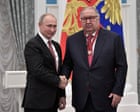
Alisher Usmanov and Mikhail Fridman delisted in what Ireland’s EU presidency called ‘a difficult compromise’ for the bloc
Jennifer Rankin in BrusselsTue 22 Sep 2026 13.00 EDTLast modified on Tue 22 Sep 2026 13.01 EDTSharePrefer the Guardian on GoogleThe EU has agreed to remove two Russian billionaires, Alisher Usmanov and Mikhail Fridman, from its sanctions list, while extending restrictions on nearly 3,000 individuals and companies accused of supporting the war on Ukraine for the next three years.
With an end-of-Tuesday deadline looming to preserve the Russia blacklist, the EU’s 27 member states found a compromise that meant delisting the two oligarchs in spite of very few countries wanting this outcome. EU sanctions have to be approved unanimously.
Ukraine war briefing: Sanctions must continue, EU’s top diplomat stresses, as Russian attacks kill fiveRead moreFrance stunned and infuriated EU governments this month when it called for Usmanov, a Russian-Uzbek national, to be removed from the list on “national security” grounds, reported to refer to a prisoner exchange deal involving French nationals and Azerbaijan.
Luxembourg then asked for the same treatment for Fridman, the Russian-Israeli magnate, who is suing the Grand Duchy for $16bn (£12bn) for freezing his assets.
The exemptions angered many EU countries that believe it sets a bad precedent by allowing member states to weaken sanctions in defence of national interests.
Mikhail Fridman was removed from the sanctions list. Photograph: Pavel Golovkin/APUkraine criticised the removal of the men from the sanctions list as unacceptable. Shortly after the decision emerged, Ukraine’s president, Volodymyr Zelenskyy, wrote on social media: “No name on the sanctions list is there by accident: each one represents a reason why this war started and continues to this day”.
The Ukrainian foreign minister, Andrii Sybiha, called the decision “shameful and unjustifiable” on X. “Moscow is celebrating because it got what it wanted: a sense of impunity, the humiliation of the EU, and division among Europeans,” he added.
In order to enable the delistings that many EU member states found unpalatable, it was proposed that the sanctions be rolled over for 36 months, rather than the usual six.
A spokesperson for Ireland’s EU presidency, which brokered the talks, said the bloc had reached “a difficult compromise”. They said: “Until now, these listings have been reviewed and assessed on a six-monthly basis; today’s decision to renew on a 36-month basis enhances the durability and predictability of the EU sanctions framework.”
A decision had been expected earlier this week, but Latvia’s government, facing parliamentary elections on 3 October, announced a last-minute objection to the delistings on Monday. Latvia’s prime minister, Andris Kulbergs, said late on Monday night that he could not accept the proposed compromise and instructed his foreign minister to enter talks with Paris and Brussels to find a solution.
Diplomats said Latvia had finally agreed to abstain on the two delistings. The blacklist includes Russia’s president, Vladimir Putin, and foreign minister, Sergey Lavrov, as well as Duma deputies, the country’s major banks, energy companies and military industrial complex.
Senior EU officials have promised to present about 1,600 new designations – individuals and entities involved in the Russian military industrial complex – to foreign ministers next month. But the latest standoff, which followed the tortuous agreement on the EU’s 21st round of sanctions in July, suggests the process could be difficult.
Explore more on these topicsShareReuse this contentEuropean spy chiefs warn Moscow is planning more decisive action against Nato
2d agoUkraine targets Moscow with hundreds of drones on final day of Russian election
2d agoLatvia’s president warns that Europe is not up to date with drone and aerial warfare in Ukraine
4d agoRussian strike on passenger train will not deter Ukraine’s backers, Nato chief says
14 Sept 2026Trains carrying Boris Johnson and ex-CIA chief may have been targeted in Russian strike, officials say
13 Sept 2026Russia targets Kyiv petrol stations for first time with jet-powered drones
11 Sept 2026Orthodox church sends medieval prince’s remains to Russian troops in Ukraine
10 Sept 2026Remilitarisation and support for Ukraine must not slacken, US tells Europe
8 Sept 2026US envoys Kushner and Witkoff visit Kyiv for first time after Putin talks
6 Sept 2026Witkoff and Kushner discussed ‘next steps’ with Putin to end Ukraine war, says US
6 Sept 2026