Macron, Merz and von der Leyen among those due to gather in Montenegro for talks on integration of six countries
Jennifer Rankin in BrusselsFri 5 Jun 2026 00.00 EDTLast modified on Fri 5 Jun 2026 00.02 EDTSharePrefer the Guardian on GoogleEuropean leaders will seek to show six western Balkan countries that they have a real chance of joining the EU one day, despite splits over how to handle enlargement of the 27-member bloc.
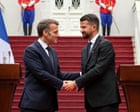
Emmanuel Macron, Friedrich Merz, Giorgia Meloni and Ursula von der Leyen are among more than 30 leaders expected to gather in the Montenegrin coastal resort of Tivat on Friday for summit talks. The focus will be on integrating the six Balkan countries – among them Montenegro and Albania – more deeply into the EU single market, paving the way for them to join the bloc.
“The commitment of the European Union to the western Balkans is real. As real as the opportunity for enlargement,” said the European Council president, António Costa, earlier this week in Sarajevo.
Costa described EU enlargement, as Russia and China vie for influence in the region, as a “geostrategic interest for Europe” and an “investment in the peace, stability and security of our continent”.
More than 30 EU leaders are expected to gather in the Montenegrin coastal resort of Tivat on Friday for summit talks. Photograph: Stevo Vasiljević/ReutersThe summit comes after Hungary’s new government dropped its veto over Ukraine moving to the next stage of EU talks, a step hailed as a milestone by insiders. Péter Magyar’s decision on Wednesday enables Ukraine and Moldova to open negotiations later this month on the first chapters of the EU rulebook, the section dedicated to the rule of law and democratic standards.
The two eastern European countries were fast-tracked to EU candidate status after Russia’s full-scale invasion in 2022. But EU institutions are anxious to show six western Balkan countries they are not in the slow lane.
EU could deny new member states veto rights as bloc pushes for enlargement Read moreMontenegro, which hopes to become the EU’s 28th state by 2028, is the most advanced in its membership quest, prompting existing members to put safeguards on new joiners. The Guardian reported earlier this month that new member states could be denied veto rights for several years, to prevent a repeat of the experience with the Russia-friendly former Hungarian prime minister Viktor Orbán, who repeatedly blocked EU decisions.
Albania is seen by Brussels as the next country likely to join, although some EU governments harbour doubts about its progress in tackling organised crime.
The hopes, meanwhile, of North Macedonia, Kosovo, and Bosnia and Herzegovina are clouded by internal and external political disputes. Serbia is perceived as drifting away from the EU under its autocratic president, Alexander Vučić, who has cracked down on anti-government protesters and refused to align with European sanctions against Russia.
Faruk Bašić, a researcher at the Brussels Institute for Geopolitics, said the region was no longer peripheral for the EU but a strategic priority. “The war in Ukraine has singlehandedly reframed what European enlargement is meant to be and what it is for.”
While the EU’s traditional enlargement logic was that “you align with EU values and principles and you eventually join”, Bašić said, Ukraine’s candidacy – granted within four months in 2022 – showed “real geopolitical urgency that we haven’t seen before”.
EU leaders are at odds over when and how Ukraine should join. A German proposal for Ukraine to gain associate membership – essentially, representation in EU institutions without voting rights, as a step to fully joining – has gone down badly in Kyiv and some EU countries.
Berlin thinks the associate membership plan – presented in a letter by Merz to von der Leyen and Costa – is an unprecedented and generous offer that will accelerate Ukraine’s path to EU accession, in the face of unspoken reluctance from some member states, notably France.
Despite these assurances, some EU member states have doubts. One senior EU diplomat said the German proposals on associate membership were a “substitute” for Ukraine joining the EU that would make it “almost impossible” for that to happen. “It will decrease the will to move forward and find the solutions,” the person said.
While Ukraine’s path to EU membership is seen as unique because of its status as a country at war and colossal needs for postwar recovery finance, its treatment is likely to affect the western Balkans.
One EU official said “people underestimate the progress being made”, citing the first meeting of a technical group tasked with drafting Montenegro’s accession treaty last month. “This is actually something extremely real, which starts a clock ticking for the next accession of the European Union.”
Members of Montenegro's army special forces secure the port area in Tivat during a pre-summit press conference. Photograph: Stevo Vasiljević/ReutersSources also cautioned against expecting further big announcements on membership talks on Friday, suggesting the focus would be on how the EU could make a tangible difference to people’s lives in the region.
Before the summit, the EU council rubber-stamped a decision to begin talks on dropping mobile roaming charges in the western Balkans. The abolition of the charges, often presented as an EU success story, would be extended to western Balkan states pending their take-up of relevant EU law and further negotiations.
While no launch date for the policy is fixed, it would give European citizens reciprocal benefits to make calls, texts and use data without facing extra charges while travelling in the European Economic Area or the six western Balkan countries.
The “roam like at home” plan is part of a wider strategy of gradually integrating the western Balkans into the EU single market. Several Balkan countries, for instance, have joined schemes under the single euro payments area, which harmonises electronic payments, enabling consumers to use just one account and card when making payments in euros.
Explore more on these topicsShareReuse this contentEU aims to ensure foreign governments or firms cannot disrupt tech services with ‘kill switch’
1d agoEU to discuss potential restrictions on Chinese imports amid fears of overreliance
28 May 2026EU fines Temu for failing to stop sale of illegal and dangerous products
28 May 2026EU proposes end to ‘five tabs, three apps and a prayer’ for cross-border train bookings
13 May 2026EU preparing to offer key concession to UK in new post-Brexit agricultural deal
11 May 2026EU farmers and hauliers to get up to €50,000 to cover extra costs of Iran war
29 Apr 2026EU officials arrive in Hungary for high-stakes talks with Magyar’s government
17 Apr 2026US tech firms successfully lobbied EU to keep datacentre emissions secret
17 Apr 2026UK steel exports to EU at risk as bloc doubles tariffs and halves quotas
14 Apr 2026‘Weak and pathetic’: why is the EU not using its leverage to stop Israel?
2 Apr 2026
