If you get Global News from Instagram or Facebook - that will be changing. Find out how you can still connect with us.
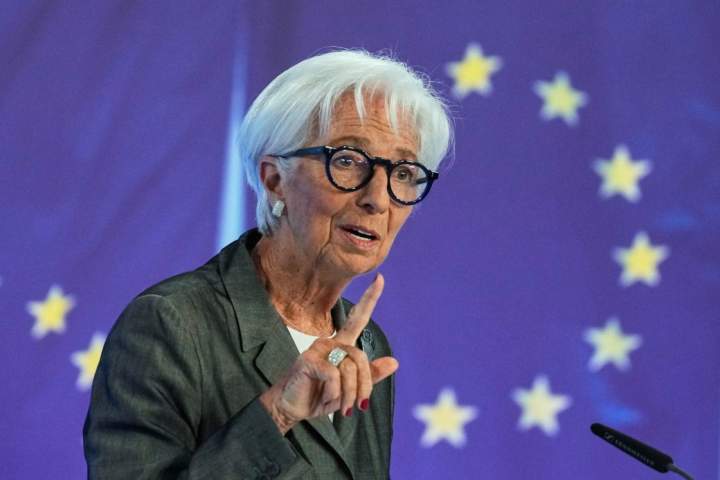
View image in full screen FILE - President of European Central Bank Christine Lagarde addresses the media in Frankfurt, Germany, Thursday, July 23, 2026, after a meeting of the ECB's governing council. AP Photo/Michael ProbstEuropean Central Bank President Christine Lagarde announced her resignation on Thursday, ending months of speculation about her future just as Europe enters a period of rising economic volatility and divisive electoral politics.
Lagarde will step down on February 7, giving current European Union leaders time to pick a successor well before a French presidential election that polls show far-right candidate Marine Le Pen is favored to win.
The move comes as the ECB battles inflation risks from an Iran-driven oil shock while a sharp rise in bond yields, especially in France, threatens to dampen growth.
“I leave this institution with a sense of good work done and an ECB that is fit for the future,” Lagarde said in a short video shared on social media.
A source with direct knowledge of the matter said Lagarde had resigned so she could weigh in on political matters in her native France and globally. As ECB president, she was expected to remain neutral to safeguard the institution’s independence.
European Council President Antonio Costa said in a statement the process to find a successor for Lagarde would begin immediately. The former central bank governors of the Netherlands and Spain, Klaas Knot and Pablo Hernandez de Cos, are widely seen as frontrunners.
“The rumored successors are both very competent, well established central bankers, so for markets, it won’t matter too much,” Piet Haines Christiansen, an economist at Danske Bank, said.
Financial markets did not move much after the announcement, with some analysts noting the ECB had by now built a reputation that outlived any of its leaders.
“The ECB is now quite well established, the market is familiar with the way it operates,” Goldman Sachs’ head of Fixed Income Macro Investing Simon Dangoor said. “Our view is that institutional behavior is likely to outlast Lagarde, and be quite similar, whoever takes over.”
Lagarde’s term was scheduled to run until the end of October 2027 but speculation about an early departure had been mounting for months, with the World Economic Forum seen as a likely destination.
2:47 Bank of Canada raises key interest rate to 2.5%, first hike since 2023RATE HIKES AND BOND TURMOIL
The ECB is in the middle of a rate-hiking cycle aimed at preventing an oil-price shock linked to the Iran war from feeding into other prices and wages.
But it must also contend with a surge in government bond yields — especially in debt-laden France — that has pushed up borrowing costs for households and businesses and which Lagarde has said will curb growth and inflation.
Get breaking National news
Get breaking Canada news delivered to your inbox as it happens so you won't miss a trending story. By providing your email address, you have read and agree to Global News' Terms and Conditions and Privacy Policy.Caught between persistent inflation fueled by a renewed surge in energy costs and deteriorating financing conditions, the ECB is widely expected to keep its deposit rate at 2.5 per cent on Thursday while signaling that another increase, potentially as soon as December, remains likely.
“There is likely a low bar to another hike in December, given the likelihood of another upward revision of the ECB’s inflation forecast due to higher energy prices,” Oliver Rakau at Oxford Economics said.
The ECB is due to announce its interest rate decision at 1315 GMT on Thursday, followed by Lagarde’s regular press conference at 1345 GMT.
- King Charles faces calls for apology, slavery reparations on Caribbean tour
- Man detained after Prince Albert of Monaco’s relative found dead
- Russia-Ukraine ceasefire holds in southern Ukraine city, officials say
- 6 Canadians injured in Spain train crash that killed 68, minister says
Money markets are currently pricing another three rate increases from the ECB by the end of next year, which would take the deposit rate to 3.25 per cent, a level that is widely seen as restricting economic growth.
3:16 Clashes erupt across France as thousands take to the streets in protestFRENCH TURMOIL IN FOCUS BUT NO ACTION
The more immediate challenge for policymakers may be turmoil in bond markets.
A global rise in yields, fueled by stronger growth expectations, higher debt issuance and massive investment linked to artificial intelligence, is pushing up borrowing costs for governments, households and businesses alike.
In France, investors have become increasingly uneasy about the country’s growing debt burden and uncertain fiscal outlook following this year’s elections. Concerns have been amplified by suggestions from parts of the political left that debt held by the ECB could be written off.
The result has been a sharp increase in French borrowing costs. France is now paying some of the highest yields in a quarter-century to raise money on bond markets, while the premium investors demand to hold French debt over benchmark German bonds is larger than for any other euro zone country.
That has fueled speculation that the ECB might be forced to respond, if only verbally for now.
“They’ve typically come up with a new tool that’s customized for that specific set of circumstances,” said Dangoor at Goldman Sachs.
The ECB’s first line of defence would probably be flexible reinvestment of proceeds from bonds acquired during its vast asset-purchase programs of the previous decade.
Beyond that, it could activate its never-used Transmission Protection Instrument, a scheme designed to counter what policymakers deem unjustified market pressure.
Add Global News as a Preferred Source on Google to see more of our stories in your search results.
Journalistic standards Report an error © 2026 Reuters