If you get Global News from Instagram or Facebook - that will be changing. Find out how you can still connect with us.
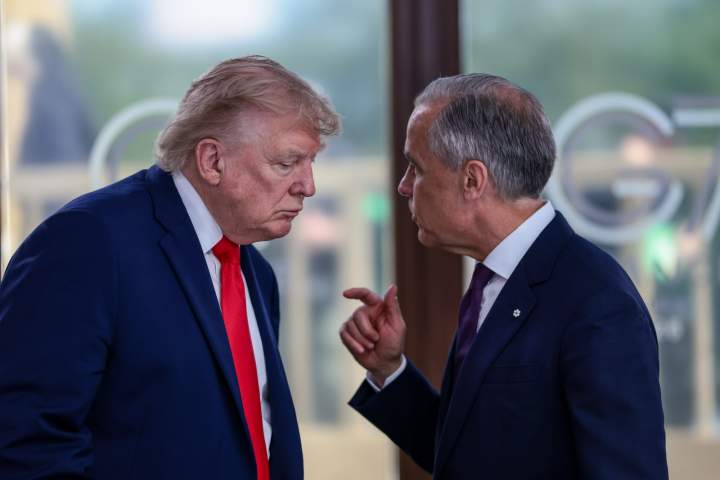
View image in full screen President Donald Trump speaks with Canadian Prime Minister Mark Carney, right, at a working lunch with leaders of G7 and the Middle East in Evian-les-Bains, France, Tuesday, June 16, 2026. (Evelyn Hockstein/Pool Photo via AP,File). Evelyn Hockstein Pool photo via AP Photo via The Canadian PressCanada’s tariff response must ensure that no community is left behind, a new report says.
The report, released by the Federation of Canadian Municipalities, in partnership with the City of London and Ivey Business School found that the consequences of the U.S.-Canada trade war are felt all across Canada, but the severity of those impacts are unevenly distributed.
The industrial composition of a community is more closely tied to how it feels the pressure of tariffs than its size alone, the report said.
“There is an opportunity … to strengthen the Team Canada approach in terms of responding and creating resilience in the economy. I think we should take that seriously,” Romel Mostafa, an economist and assistant professor of international business at the Ivey Business School, told Global News.
Municipal governments are on the ground connecting with businesses and residents, which Mostafa said gives them valuable intel that is integral to the federal government’s economic response.
Whether it is Mackenzie, B.C., a town of 3,700 residents that relies on forestry and mining; Windsor, Ont., with deep roots in the auto industry; or a larger city that has multiple tariff-impacted industries, all of these communities have had to respond to the consequences of the trade war.
Get daily National news
Get daily Canada news delivered to your inbox so you'll never miss the day's top stories. By providing your email address, you have read and agree to Global News' Terms and Conditions and Privacy Policy.“Understanding these nuances means that there are different policy implications for it,” Mostafa said.
5:43 Carney says US ‘offered too little,’ ‘asked too much’ in trade talksOne of the biggest challenges for municipalities has been working through the uncertainty brought forth by a constantly evolving economic relationship with the U.S., London, Ont., Mayor Josh Morgan told Global News.
“The uncertainty has created a real pause in investment and job creation. In some cases there are job losses, in some cases, there are job gains,” he said. “For the most part, many businesses have just paused their decision-making, waiting to see a more stabilized environment because the unpredictability of the state we’re in is really not conducive to business investment.”
- Ontario hospital plans to cut hundreds of jobs amid province-directed budget plan
- Crombie proposes subway extension into Mississauga in election bid
- AI ‘superintelligence’ ban proposed in U.S. as rogue agent concerns ramp up
- OpenAI’s agent hacked an Australian government website. What we know so far
London recorded the highest unemployment rate among Canada’s 20 largest municipalities, sitting at 9.1 per cent in March, compared to six per cent a year earlier. But Morgan said the statistics don’t tell the whole story.
“We have seen actual net job creation. But we’ve seen a migration of the labour force from smaller communities that may be more impacted by the trade situation, migrating to larger cities like London for job opportunities,” he said. “And so the labour force has actually expanded at a pace faster than job creation we’ve had in the city.”
This context behind the statistics is the intel that Morgan said municipalities can bring to the table in discussions with upper levels of government as well as with cities on the other side of the border.
“Municipalities in Canada and municipalities in the U.S. are facing the same sort of impacts. We have that common ground and we are actively talking to each other,” he said. “We’re not against them, we’re on their side, we’re on the same team here.”
Mostafa said it is important to bring all of these voices into the conversation.
“I think there’s a real opportunity to think about, given the lanes that we have, how can we make the process of getting municipal intelligence to reach the policymakers at the higher order of the government?” he said.
Add Global News as a Preferred Source on Google to see more of our stories in your search results.
Journalistic standards Report an error © 2026 Global News, a division of Corus Entertainment Inc.