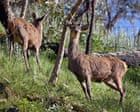
The invasive species has increased in spread and numbers and is costing farmers millions of dollars
Get our breaking news email, free app or daily news podcast
An unpublished government report on feral deer shows Australia is failing in its efforts to stop the spread of what one advocate warns could become “Australia’s next feral pig”.
The five years from 2020-2025 over which the national feral deer action plan was assessed covers a period in which the famously elusive species has increasingly encroached upon major cities, leading to more frequent encounters – including a memorable occasion in which two men in various degrees of undress were fined after becoming lost in the bush when they were spooked by deer while nude sunbathing.
The report says deer, one of the country’s “most rapidly increasing invasive pests”, have both increased in numbers and spread in territory, costing more than $91m in production loss and management time every year.
‘Australia’s next rabbit plague’: calls for feral deer in Victoria to be considered a pest instead of wildlifeRead moreDeakin University’s Prof Euan Ritchie, president of the Australian Mammal Society, said he was “not at all” surprised by this year’s national vertebrate pest management report card.
“This report shows that governments are failing miserably to invest enough to control deer populations and the severe impacts that they can have on agriculture, native wildlife and the environment, road safety and culturally significant sites,” Ritchie said.
“This is what sustained failure to act sufficiently results in.”
Six species of feral deer are established in Australia – chital, fallow, hog, red, rusa and sambar – with well-established populations across south-eastern Australia, where densities are highest. There are smaller, more localised populations in South and Western Australia and the Northern Territory.
Sign up for the Breaking News Australia emailThe report card, produced by the National Vertebrate Pest Coordinators, shows every state and territory is failing or floundering in their efforts to control feral deer – with one notable exception. South Australia, which launched an ambitious statewide eradication plan in 2022, received a green in all four categories assessed under the traffic light system of marking. The report showed – with high confidence – that the state had decreased the abundance, distribution and environmental and agricultural impacts of deer.
New South Wales and Tasmania were given reds in all four categories, while Queensland and the ACT both received three reds and a yellow. No jurisdiction but SA received a single green pass mark.
Invasive Species Council advocacy manager Reece Pianta said the report confirmed what land managers had been seeing on the ground for some years. In May 2025, the council released footage and images that it said showed the Gold Coast “under feral deer siege”.
Pianta said the report, leaked to his organisation, points to “a long-term systemic underfunding of deer control”. He said deer did not have the recognition of other more notorious invasives, but controlling them was every bit as necessary.
“Deer are the next feral pig,” he said. “The difference with deer is that an intervention now could make a significant difference to the population numbers and contain, or even reverse, that spread.”
skip past newsletter promotionFree newsletter |When neededSign up to Breaking News Australia
Get the most important news as it breaks
after newsletter promotion
While Pianta said deer “probably can’t be eradicated” from the entire continent, he said South Australia’s “A+” report score showed it was possible to do so in some states and territories, while others would require a long-term effort to contain the spread of deer and mitigate their impacts.
Adelaide University Environment Institute director Prof Andrew Lowe said the report was a “good news story” for his state that rang true with what he was seeing on the ground.
Lowe, who is also member of the Hills and Fleurieu Landscape Board, which is involved in managing deer, said SA grappled with its “massive problem with deer” in earnest from 2022, after an agricultural impact estimate showed the $36m worth of damage done every year by deer there was set to increase to $241m by 2031.
But although deer had “massively declined” in the few years since a $4m eradication program began, Lowe said deer were seeking refuge on the fringes of urban areas, where culling was more expensive. He said functional eradication of deer from SA would take about another $10m over 10 years.
The cost of inaction, though, was of a different magnitude.
“If we don’t do that, then the population will go up again and we’re going to be in the same situation,” Lowe said. “So $10m versus $240m – do the math.”
Explore more on these topicsShareReuse this content‘Worldwide legacy’: almost $20m raised to protect majestic tract of land in far north Queensland
1d agoEndangered turtles and ‘exceptional’ coral at risk from Woodside’s gas drilling in WA, watchdog says
4d agoMenindee Lakes water levels drop to lowest in five years as experts warn of mass fish deaths
1d agoKoalas are cute, furry, iconic – and dying of chlamydia. But how well does the approved vaccine work?
5d agoCounting crows (and cockatoos, and kookaburras): BirdLife Australia’s Aussie bird count takes flight for 2026
7d agoDecomposing whale near Sydney’s Coogee beach should be towed out to sea, Indigenous rangers say
23 Oct 2026Full StoryWill Australia ever get Snowy Hydro 2.0? – Full Story podcast
4d agoOutback kaleidoscope: Australia’s fabled desert lake bursts to life in rare sight
6d agoThe great moth revival: how bogongs have bounced back
22 Oct 2026…… commentsComplex issues: how to get your apartment block off gas – before it’s too late
6d ago