They arrived in the royal park shortly before the Great Fire of London, when the Russian ambassador presented a pair to King Charles II as a gift.
But although pelicans have been living in St James’s Park since 1664, none ever learned the art of courtship – until now, when for the first time in more than 360 years, chicks have been born.
The chicks have a ferocious appetite, staff say. Photograph: Dan Kitwood/Getty ImagesThe first of four chicks hatched on 17 May and all have now survived their first month, to the delight of the Royal Parks manager, Mark Wasilewski. “This really is a first for us,” he said. “We’re gobsmacked.”
There are six adult great white pelicans living in the park: two males, called Sun and Moon, and four females, called Star, Isla, Tiffany and Gargi.
“Pelicans normally only breed when they’re in large groups of 10, 12 or more,” said Wasilewski. “We’ve always had between two and six – never a great number – and as the pelicans have passed away, we’ve decided when it’s time to bring in some more … just to keep that tradition going, which we think is a really important tradition for St James’s Park.”
Five eggs were laid in three nests, and eight-year-old Star and 30-year-old Gargi, an “elderly female pelican”, shared sitting on one nest. “One of the two males must have impregnated one of them, but unfortunately we don’t know which of the two actually laid the eggs,” he said. “And we don’t know which dad has played around.”
Gargi has been a permanent resident of St James’s Park since she was found in a garden in Southend 1996, although she has occasionally been spotted flying to London zoo in Regent’s Park to steal fish.
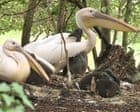
Wasilewski is working with Blackpool zoo, Royal Veterinary College, the Zoological Society of London and the Wildfowl & Wetlands Trust, to provide expert care for the chicks. He said they had a ferocious appetite – “which is good news” – and were “ever so ugly”. “Someone said they look a little like dinosaurs. They’re completely black, they’re featherless and already they’ve got the little pointed bills.”
They are beginning to grow “nice furry chestnut-brown down”, but they will not start getting feathers until they are eight or nine weeks old.
The chicks are “just beginning to waddle” around the nest but are vulnerable until they take to the water with their parents when they are about 12 weeks old. Visitors have been urged to give them space and avoid disturbing them.
“They’re growing at an enormously fast rate. Week one, they were the size of a pigeon. Week two, they were the size of a very small duck. We were looking at the eldest one and we think it’s probably about 2ft high now already.”
The chicks in their nest: ‘Someone said they look a little like dinosaurs.’ Photograph: The Royal Parks/PAWhen the first egg hatched “our wildest dreams were fulfilled”, he said. “We were always hoping that something like that would happen but we never really thought it would. It’s absolutely delightful … with the world as it is, to see something like this. It’s nature at its best.”
Wildlife officers have particularly enjoyed “seeing the mothers nestling the youngsters under their wings”.
The pelicans were enclosed on Duck Island during the avian flu outbreak earlier this year and were released on 9 April. “On the 13 April, we discovered they were making a nest. So when you’re cooped on Duck Island with nothing to do for several weeks, we know now what they do,” he said. “There was no television to watch.”