If you get Global News from Instagram or Facebook - that will be changing. Find out how you can still connect with us.
2:00 Optogenetics: 3 researchers win Nobel Prize in medicine for brain research WATCH ABOVE: Optogenetics: 3 researchers win Nobel Prize in medicine for brain researchFrancis Halzen won the Nobel Prize in physics on Tuesday for his efforts to demystify a rare group of neutrinos, tiny cosmic particles that scientists believe offer clues to how the universe evolved.
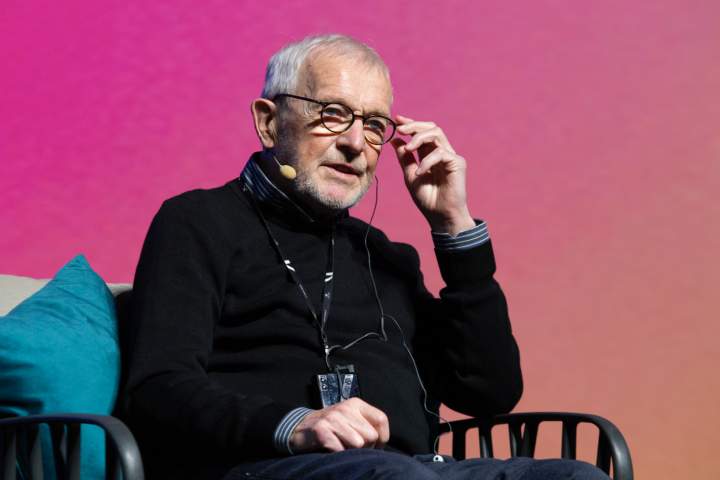
“It was a great surprise and I obviously didn’t expect it,” Halzen said, speaking to the committee by phone from Italy, in a call broadcast at the news conference to announce the winner.
Halzen said it was predicted before that he would win the Nobel Prize but the announcement still made him feel “strange.”
“I am working on a proposal, and I hope that this prize will help getting it approved,” he said to chuckles from the audience.
Halzen paved the way for a new kind of astronomy
The Nobel Committee for Physics also said Halzen’s work was instrumental to the construction of the IceCube Neutrino Observatory in Antarctica.
“Francis Halzen realized that the ice at the South Pole could visualize these neutrino messengers from cosmos,” committee member Eva Olsson said during the news conference. “People joined him in the quest for these neutrino messengers. The messenger is bringing information from cosmos. They opened the door to distant galaxies and tell us about the processes of exploding stars.”
Born in Belgium, the 82-year-old scientist is affiliated with the University of Wisconsin–Madison in the U.S, which operates the IceCube Neutrino Observatory. Efforts by The Associated Press to reach him were not immediately successful.
Get daily National news
Get daily Canada news delivered to your inbox so you'll never miss the day's top stories. By providing your email address, you have read and agree to Global News' Terms and Conditions and Privacy Policy.Neutrinos are tiny cosmic particles with a mind-bogglingly small mass. Yet they are everywhere: they spew from stars like the sun and trillions zip through our bodies every second.
Scientists can’t glimpse the mysterious ghost particles zooming around on their own. Instead, they measure what happens when the tiny particles collide with other bits of matter, producing flashes of light or charged particles.
Halzen helped pull the curtain back on a rare gang of neutrinos that scientists consider messengers from the cosmos, offering clues to how the universe evolved.
“This experiment in the Antarctic is a revolutionary way of understanding the universe that we didn’t have before,” said Michael Moloney, chief executive officer for the American Institute of Physics.
In a post on social media, Belgian Prime Minister Bart De Wever sent his “sincere congratulations” to Halzen, who he said is the 11th Belgian to win a Nobel prize.
De Wever called the award “impressive recognition for a lifetime dedicated to shedding light on the great mysteries of the cosmos through its smallest components.”
A representative from the IceCube Neutrino Observatory did not immediately return a request for comment. The University of Wisconsin–Madison did not immediately have a comment when reached by the AP.
1:54 Nobel Peace Prize: Is Prime Minister Mark Carney a contender for the prestigious award?- University of Regina studies new concussion treatment option: CBD
- Nobel Prize in chemistry goes to Kagan and Saoi for solving molecular mystery
- Nobel prize in medicine goes to U.S., German scientists for brain research
- AI ‘journalists’ start to appear in Canada
Prize money is about US$1.2 million
Ellen Moons, secretary-general of the Royal Swedish Academy of Sciences, announced the award Tuesday in Stockholm. She is the first woman to head the prestigious academy and present the award.
The prize money this year is 12 million Swedish kronor (about US$1.2 million), whether for an individual, a small group of laureates or an organization.
Last year, three scientists won the Nobel Prize in physics for research on the strange behavior of subatomic particles called quantum tunneling that enabled the ultrasensitive measurements achieved by MRI machines and laid the groundwork for better cellphones and faster computers.
The announcements of this year’s prizes began Monday with the Nobel Prize in medicine being awarded to three scientists whose work led to a tool that uses light to help unravel how the brain works.
This week’s awards continue Wednesday with the chemistry prize and literature on Thursday. After Friday’s peace prize is awarded, the Nobel Memorial Prize in Economic Sciences will be announced on Monday.
Add Global News as a Preferred Source on Google to see more of our stories in your search results.
Journalistic standards Report an error © 2026 The Canadian Press