Rising heat in Saudi Arabia threatens millions of Muslim pilgrims – but cutting fossil fuels would keep it safer
Damian Carrington Environment editorThu 28 May 2026 19.01 EDTLast modified on Thu 28 May 2026 19.02 EDTSharePrefer the Guardian on GoogleGlobal heating has “fundamentally altered” the climate of Mecca and is exposing millions of hajj pilgrims to extreme and dangerous heat even in months outside summer, new analysis has found.
Carbon dioxide emissions from fossil fuels means scorching temperatures of 40C (104F) are now regularly experienced in May, the study showed. In past decades, such peaks would only have occurred in summer. The researchers said that hajj, the annual Islamic pilgrimage to Mecca, would take place amid dangerous heat almost all year round by the end of the century without a rapid transition away from fossil fuels.
Saudi Arabia, which hosts hajj, is the world’s second biggest oil producer and a long-term obstructer of climate action.
$170,000 a minute: why Saudi Arabia is the biggest blocker of climate actionRead moreMuslims around the world are now celebrating the start of Eid al-Adha as devotees in Mecca finish their rituals during this year’s pilgrimage. Hajj follows the Islamic lunar calendar, which means it falls earlier each successive year. All Muslims able to do so are expected to make the pilgrimage at least once in their lives, which involves walking long distances outside over five days.
More than 1,300 pilgrims died due to extreme heat and humidity in 2024, when hajj was in June. May has historically been cooler, with 40C temperatures rare. However, the analysis found that 40C is now expected in May once every two to three years as a result of the climate crisis.
The average temperature for May is now 3.5C hotter than before human-caused global heating. The result is that hajj in May “is now as dangerous as the height of summer used to be”, said the scientists from the World Weather Attribution group.
The Saudi authorities have introduced heat action plans, including shaded walkways, cooling stations, misting systems and expanded medical services, which have helped reduce cases of heat-related illnesses among pilgrims.
“However, this requires more than just reactive mitigation,” said Prof Friederike Otto at Imperial College London, who is an author of the study. “If we don’t rapidly reduce our dependence on fossil fuels – an industry at the very centre of the Saudi economy – we are resigning ourselves to the fact that millions of Muslims will be forced to carry out the hajj rituals in a climate that is simply unsuitable for it.”
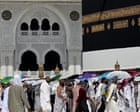
Muslim pilgrims walk under water misters on the second day of the stoning ritual, during the annual hajj pilgrimage. Photograph: Ibraheem Abu Mustafa/ReutersDr Clair Barnes, also at Imperial College London, said: “Our analysis shows very clearly that less of the year is now safe for the millions of Muslims who wish to undertake the hajj. As long as we continue to burn fossil fuels, the window for bearable hajj temperatures will continue to shrink.”
The hajj pilgrimage to Mecca is one of the five pillars of Islam. The Islamic lunar calendar is 10–11 days shorter than the solar Gregorian calendar used in most of the world. As a result, the dates of hajj shift earlier each year relative to the seasons and, over a cycle of about 33 years, hajj moves through every season.
If global temperatures rise by 3C by the end of the century, in line with the trajectory current of the world’s climate policies, about 97% of all hajj pilgrimages would endure dangerous levels of heat in Mecca, a 2022 study found. “Thus, a rapid transition away from fossil fuels is essential to avoid ever more dangerous hajj,” the Imperial researchers said.
Dr Emmanuel Raju at the Copenhagen Centre for Disaster Research said: “Extreme heat during the hajj presents a unique humanitarian challenge because it involves millions of people moving through an outdoor environment for days on end. Measures like misting fans and water stations are vital, but we must face the reality that if temperatures continue to climb at this pace, the health and lives of millions during their pilgrimage is at risk.”
The Ministry of Hajj and Umrah in Saudi Arabia was contacted for comment.
Explore more on these topicsShareReuse this contentAt least 1,300 hajj pilgrims died during extreme heat, Saudi Arabia says
23 Jun 2024Egypt to prosecute travel agents for ‘fraudulent’ hajj trips
22 Jun 2024One man’s desperate search for wife as more than 1,000 hajj pilgrims die in extreme heat
21 Jun 2024More than 1,000 hajj pilgrims die amid temperatures approaching 52C in Mecca
20 Jun 2024Search for missing pilgrims continues after hajj heat deaths
19 Jun 2024More than 550 hajj pilgrims die in Mecca as temperatures exceed 50C
18 Jun 2024At least 14 pilgrims die during hajj pilgrimage amid soaring temperatures
16 Jun 2024Thousands suffer heat stress on hajj pilgrimage as temperatures reach 48C
29 Jun 2023The road to Mecca is fraught with challenges – but there’s nothing like the hajj pilgrimage to turn hearts
28 Jun 2023…… comments