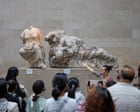
But Kyriakos Mitsotakis says he cannot accept any arrangement that recognises British Museum’s ownership of the sculptures
Rowena Mason and Nadia KhomamiThu 24 Sep 2026 02.00 EDTSharePrefer the Guardian on GoogleThe Greek prime minister has said a deal can still be reached to return the Parthenon marbles with “political will” but his country will not accept a loan in the style of the Bayeux tapestry’s visit from France.
Writing for the Guardian, Kyriakos Mitsotakis said Greece “cannot accept any arrangement that would require it to recognise the British Museum’s ownership of the sculptures, or a scheme that would mean we ‘borrow’ parts of our own monument”.
He made the intervention weeks after the British Museum director, Nicholas Cullinan, told the Financial Times that France’s 10-month loan of the Bayeux tapestry to the British Museum could provide a model for a deal. The director said there was “no cookie-cutter template” but the exchange was an example of a successful international partnership.
In his article, Mitsotakis says the situation with the Parthenon marbles was completely different as half of the frieze is in Athens – and no one would suggest cutting the Bayeux tapestry in two.
Pointing out that Andy Burnham once backed returning the marbles, the Greek prime minister said “political will and courage” would be needed but Greece would not accept anything less than “reunification” of the marbles in Athens.
He said this could become “the foundation of a broad and enduring cultural partnership between our countries, creating new opportunities for exhibitions, scholarship, conservation and exchanges between Greek and British museums” which was “the prize”.
It comes amid speculation about the status of talks between the British Museum and the Greek government about the return of the antiquities, with the Telegraph reporting they were on the brink of collapse.
Sources close to the talks disputed that characterisation but acknowledged there was a large gap to bridge in the long running dialogues.
Burnham, who once said the marbles should be given back to Greece, said more recently it was a matter for the British Museum.
The Parthenon marbles are also known as the Elgin marbles after the British peer Lord Elgin, who removed them from Athens more than 200 years ago.
Carved 2,500 years ago by Phidias, a master sculptor, the antiquities embellished the Parthenon’s monumental frieze before their removal in highly contentious circumstances by Elgin, who was Britain’s ambassador to the Ottoman empire. Bankrupted by his endeavours, Elgin then sold them to the British government in 1816.
It has been a decades-long cultural dispute between the UK, which prevents the British Museum from returning items from its collection, and Greece, which considers the objects to have been plundered.
George Osborne, the former chancellor and current chair of the British Museum, confirmed in 2023 he was in talks with Greece about a deal but also that he was not attempting to change the law – a reference to the British Museum Act 1963, which prohibits the museum from permanently removing objects from its collection.
At the time, it was proposed it could involve the sculptures being in London and Athens at different times and Britain receiving “Greek treasures” in return.
The British Museum said its position and openness to a deal was unchanged.
Explore more on these topicsShareReuse this content