Action taken to prevent bottom trawling in the marine protected area and conserve porpoise populations
Damien Gayle Environment corresponentMon 2 Nov 2026 08.10 ESTLast modified on Tue 3 Nov 2026 05.58 ESTSharePrefer the Guardian on GoogleGreenpeace activists have dropped boulders in the North Sea to snag the dragnets of industrial trawlers fishing in a marine protected area.
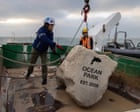
Activists onboard the Greenpeace ship Arctic Sunrise dropped the giant stones to form an underwater barrier around the Southern North Sea marine protected area (MPA) – the UK’s most bottom-trawled MPA.
Boulders were loaded on to the Arctic Sunrise in Le Havre. Photograph: Andrew McConnell/GreenpeaceThe Southern North Sea is an area of importance for harbour porpoises, supporting nearly 20% of the UK North Sea population. But despite its MPA status, there are no restrictions on fishing in most of it. Bottom trawlers, dredgers and other industrial fishing vessels scour it daily.
Bottom trawlers logged more than 37,200 fishing hours in the protected zone in 2025, an act akin to “a bulldozer tearing through a treasured national park”, Greenpeace UK said.
Greenpeace campaigners drop boulders onto the seabed to create anti-trawler barrier“Hulking great ships prowl the sea day after day, stripping it of fish and killing precious wildlife like porpoises, sharks and sea birds,” said Will McCallum, the campaign organisation’s co-executive director. “With our ship and a movement behind us, we’re doing what the government isn’t: protecting our seas.”
The “boulder barrier” had effectively closed 116 sq km (about 45 sq miles) of the Southern North Sea MPA to bottom trawling, Greenpeace UK said. Over the coming days, the Arctic Sunrise will patrol the area to deter any other kinds of industrial fishing. The activists have declared the zone an “ocean park”, in the spirit of Britain’s national parks.
Greenpeace campaigner explains the “boulder barrier” on the seabedThe Southern North Sea MPA lies along the east coast of England, from north of Dogger Bank to the strait of Dover in the south. It is intended to protect porpoise populations, partly by ensuring the “availability of prey is maintained”. Greenpeace UK’s activists say intensive fishing in the area contradicts this objective.
“We announced in June that if the government didn’t act soon, Greenpeace UK would take direct action,” McCallum said.
The boulders form an underwater barrier to prevent bottom-trawling fishing in the ‘ocean park’ zone. Photograph: Andrew McConnell/GreenpeaceThe action coincided with the nationwide premiere of Blue Planet III, the latest BBC wildlife documentary narrated by David Attenborough to focus on the oceans and the human-made threats they face. In 2025 bottom trawlers and dredgers tore through a cumulative 55,600 sq km of MPA seabeds, an area 58 times the size of Dartmoor national park, according to a Greenpeace analysis.
skip past newsletter promotionFree newsletter |WeeklySign up to Down to Earth
The planet's most important stories. Get all the week's environment news - the good, the bad and the essential
after newsletter promotion
‘We need a ban on bottom trawling and properly protected ocean sanctuaries,’ said Kerry McCarthy, an MP and former climate minister who has supported the campaign. Photograph: Andrew McConnell/GreenpeaceBottom trawling to continue in English protected waters, government rulesRead moreA number of notable figures added their names to boulders tipped from the Arctic Sunrise into the North Sea. Among them was the Labour MP Kerry McCarthy, a former climate minister and a member of the all-party parliamentary group for the ocean, who said: “Industrialised fishing is having a hugely destructive impact on our marine environment, yet less than 1% of our seas are protected from it.
“[Fishing boats] can legally tear through supposedly protected areas of the ocean, wreaking havoc upon the seabed, precious habitats and the sea life that lives there. Progress is too slow and nature can’t wait, which is why I’ve added my name to one of Greenpeace UK’s boulders. We need a ban on bottom trawling and properly protected ocean sanctuaries, both here in UK waters and right across the Atlantic Ocean.”
A Defra spokesperson said: “We have strict legislation in place to protect our marine environment while supporting sustainable fishing and coastal communities.
“All Marine Protected Areas are safeguarded by legislation, with damaging fishing activities banned in more than 100 sites and we are also considering further restrictions where there may be benefits in doing so. Activities at sea should be carried out lawfully and with due regard for the safety of other sea users.”
Explore more on these topicsShareReuse this contentWaitrose suspends sale of mackerel because of overfishing
26 Feb 2026‘Success story’ hailed as bluefin tunas caught off Yorkshire for first time since 1960s
19 Aug 2026Iberian orca known for ramming boats seen with suspected gunshot wounds
14 Aug 2026Salmon farmer accused of blocking UK investigations into alleged animal rights breaches
24 Sept 2025Mackerel stocks near breaking point because of overfishing, say experts
9 Apr 2025Bottom trawling to continue in English protected waters, government rules
8 Sept 2025‘Half the place would be blown to bits’: the Irish villages under threat from Trump’s tariffs
9 Apr 2025UK waters hit with extreme heatwave as global sea temperatures reach record levels
8 Jul 2026The rise of blue-space therapy: how the sea is helping people deal with trauma, anxiety and addiction
8 Jul 2026An unexplained death, ‘abuse and slavery’: Indonesian fishers reveal life on long haul vessels
1 Apr 2025