Archaeologists solve 1,800-year-old Roman fresco puzzle in London
London researchers have reconstructed a large Roman wall plaster collection, revealing 1,800-year-old frescoes that decorated a high-status building. (Source: MOLA)
NEWYou can now listen to Fox News articles!An ancient Roman military camp tied to the era of a legendary emperor has been unearthed in Slovakia — complete with soldiers' remains, weapons and armor.
The discovery, made near Šurany in western Slovakia, was announced by the Institute of Archaeology of the Slovak Academy of Sciences (SAS) earlier this summer.
The excavation was conducted ahead of construction of an industrial park and covered roughly 370 acres.
1,740-YEAR-OLD ROMAN COIN BEARING EMPEROR'S NAME FOUND AS ENGLAND RAIL DIG REVEALS CLUES
The second-century A.D. camp dates to the reign of Marcus Aurelius. It was likely used during the Marcomannic Wars, a series of bloody conflicts involving Germanic tribes along the Roman Empire's northern frontier.
Aurelius, who ruled Rome from 161 to 180 A.D., is remembered as both a powerful emperor and Stoic philosopher whose writings were compiled into the influential work "Meditations."
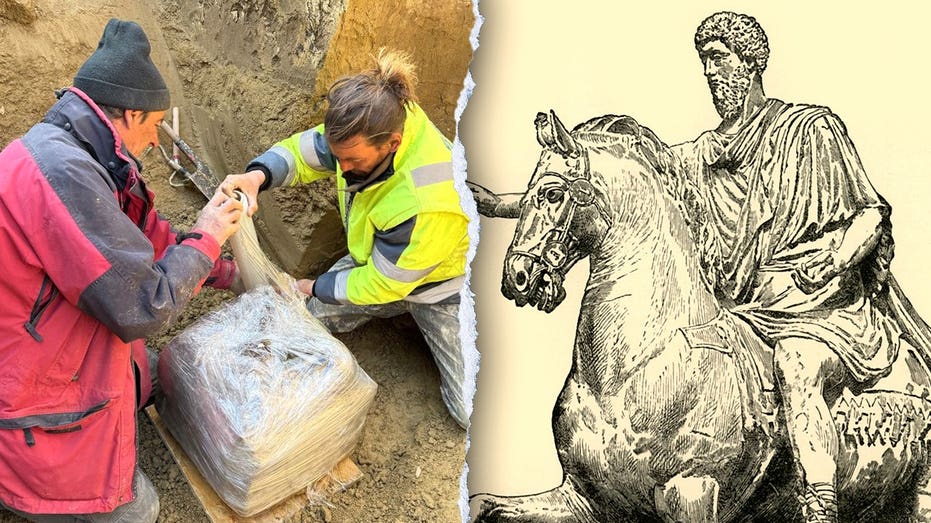
Archaeologists in western Slovakia uncovered an ancient Roman military camp dating to the reign of Emperor Marcus Aurelius, depicted at right. (The Print Collector via Getty Images; The Print Collector via Getty Images)
"The Šurany discovery follows the earlier identification of the first Roman camp in the Hron River region near Želiezovce, where it is believed that Emperor Marcus Aurelius wrote parts of his philosophical work Meditations," a statement noted.
It is the first Roman military camp discovered in the Nitra region of Slovakia. Unlike similar Roman camps, the site "does not follow the typical rectangular layout," officials said.
Instead, the camp has an unusual, irregular layout while still retaining the typical features associated with Roman marching camps.
ANCIENT CLUE CRACKS OPEN A 2,000-YEAR-OLD MYSTERY NEAR FAMED COLOSSEUM
"It contains all the characteristic defensive features of a Roman marching camp, including five entrance gates, fortifications, and a clavicula, a distinctive gate design featuring a curved ditch and rampart that forced attackers into a vulnerable approach," the release added.
"This is the first time a clavicula gate has been identified in Slovakia."
Archaeologists uncovered human skeletal remains, weapons, armor and everyday objects while excavating the ancient Roman military camp. (Matej Ruttkay; Petra Chebenová)
Archaeologists also found what officials described as "an extraordinary number" of human skeletal remains.
Complete skeletons and scattered bones were found in storage pits, wells, shallow graves and defensive ditches.
ANCIENT GOLD RING UNEARTHED AT GRAVE CARRIES 2,000-YEAR-OLD SECRET MESSAGE
Although the camp appears to have been abandoned after a conflict between Roman and Germanic forces, the identities of the dead remain uncertain.
Lead archaeologist Marek Vojteček said preliminary findings suggest many were Roman soldiers.
"It fills an important gap in our understanding of Roman activities north of the Danube during the final third of the second century."
"Alongside the skeletal remains, we uncovered numerous pieces of Roman military equipment, including spears, arrowheads, fragments of helmets, segmented and scale armor, legionary belt fittings, coins and the distinctive caligae military sandals, identified by the iron hobnails preserved in their soles," Vojteček said in the release.
CLICK HERE TO SIGN UP FOR OUR LIFESTYLE NEWSLETTER
"We also recovered everyday objects such as an axe, a knife and gaming dice."
Research at the site will continue, with officials describing the excavation as a "long-term scientific process" that could take years to yield answers.
Archaeologists recovered distinctive Roman caligae military sandals, shown above) — and identified by iron hobnails preserved in their soles — at the ancient camp. (Marek Vojteček)
In a statement, Matej Ruttkay, director of the Institute of Archaeology, said the discovery "has significance far beyond the borders of present-day Slovakia."
CLICK HERE FOR MORE LIFESTYLE NEWS
"It fills an important gap in our understanding of Roman activities north of the Danube during the final third of the second century," he said.
"The circumstances are also exceptional. We are investigating a site that appears to have been abandoned immediately after a military conflict between the Romans and the Germanic tribes, as demonstrated by numerous archaeological finds."
TEST YOURSELF WITH OUR LATEST LIFESTYLE QUIZ
The discovery is the latest in a series of ancient Roman finds unearthed across Central Europe in recent years.
The discovery offers new evidence of Roman military activity during the reign of Marcus Aurelius in the second century A.D. Armor found at the site is seen right. (Universal History Archive/Getty Images; Petra Chebenová)
Last year, archaeologists uncovered an ancient mass grave beneath a soccer field in Vienna containing the remains of as many as 150 people, believed to include Roman soldiers and Germanic tribesmen.
CLICK HERE TO DOWNLOAD THE FOX NEWS APP
In Switzerland, excavators found the remains of an ancient Roman building after a pedestrian spotted an unusual arrangement of stones and brick fragments.
Andrea Margolis is a lifestyle reporter for Fox News Digital and Fox Business. Readers can follow her on X at @andreamargs or send story tips to andrea.margolis@fox.com.
