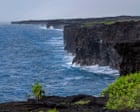
A famed centuries-old sea arch on Hawaii’s remote and rugged coastline has collapsed into the Pacific Ocean, the National Park Service confirmed on Friday, following a stretch of rough storms in the region in recent weeks.
The beloved landmark, Hōlei sea arch, stood at around 90ft high for over half a millennium in Hawaii’s Volcanoes national park, located on the dramatic southern coast of the Big Island. It was naturally formed around 550 years ago due to differential erosion by ocean waves.
The exact timing of the collapse is unknown. The National Park Service (NPS) said the arch was still standing on Wednesday 23 September, when the park was temporarily closed during Tropical Storm Nolo, but had collapsed by Sunday night, on 27 September.
“The arch formed in ancient lava flows by removing rock along cracks and weaker rocks,” the US Geological Survey said in a description of the arch in 2014. “It will not be here for ever. Every day the ocean crashes against the pillar of the arch, eroding it a little more. One day, it will be gone.”
Indeed, the cliffs on either side of the sea arch had shown signs of instability for years amid tropical systems and volcanic activity, the NPS said, meaning the arch’s collapse had long been expected.
Earthquakes during the 2018 Kīlauea volcanic eruption and summit collapse damaged the cliffs around the arch. Then, in January 2020, new cracks and instability prompted the park to close the original viewing area and open a safer one further from the cliff edge three months later. Later that year, huge surf from Tropical Storm Darby broke off a chunk of rock from the arch’s lower portion.
The Hawaiian islands have seen an unusually high number of severe storms this year, with storm activity in the Pacific running above average during what is already the peak of hurricane season. Experts say the pattern is consistent with El Niño years, when the Pacific often sees more tropical storms and hurricanes.
Nolo, which rapidly intensified into a hurricane on 24 September – causing Volcanoes national park to shutter - was the third major storm to devastate the islands of Hawaii in recent months. Residents were still recovering from hurricanes Lala in August and Lowell in early September, which had flooded homes and roads, toppled trees and caused power outages, when Nolo then battered the islands with heavy rain and high surf.
Forecasters have warned there is a high probability that this “supercharged” El Niño will reach a historic intensity, with its effects in strengthening the storms compounded by the broader overheating of the planet caused by the burning of fossil fuels.