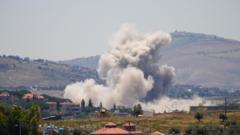
The Lebanese armed group Hezbollah has emphatically rejected the terms of a US-backed ceasefire between Israel and Lebanon.
In a strongly-worded statement, the Iran-backed group's leader Naim Qassem said negotiations had been "futile" and "humiliating" for Lebanon, and rejected categorically by "broad segments of the Lebanese people".
It comes after Israel and Lebanon announced a renewal of their fragile ceasefire with the creation of "pilot" security zones inside Lebanon in which Hezbollah operatives would be banned.
In a joint statement released on Wednesday by the US State Department, the three countries said the deal was "contingent on a complete cessation" of fire by Hezbollah.
Watch: Lebanon-Israel ceasefire deal made in 'hope rather than expectation'But responding on Thursday, the leader of Hezbollah - which was not part of the talks - said the "supposed ceasefire", interpreted as Hezbollah halting fire and withdrawing fighters from the southern front with Israel, amounted to surrender and would fulfil Israel's objectives.
The mood was similar on the streets of Beirut's southern suburbs - a stronghold of Hezbollah, also known as Dahieh - with a storekeeper expressing doubts about the agreement.
Sami, who has run his business there for 25 years, told the BBC: "You cannot have a ceasefire from one side, it's going to be an all side or no ceasefire."
There had been strikes in Lebanon on Thursday, he said. If this was supposed to be a truce, what did that make it?
"This is surrender. This is not a peace agreement. This is a surrender agreement," he added.
Across the road, Hadi, whose family store has been around for 35 years, said he saw no hope - and that this was not a new feeling.
"My generation, my dad's generation, my grandpa's generation, they didn't see anything of hope from these people - not necessarily the Israeli people. You can say the Israeli government," he said.
The agreement between Israel and Lebanon, reached after a fourth round of US-mediated talks in Washington, is contingent on the "evacuation of all [Hezbollah] operatives" from an area between the Israeli border and the Litani river, about 30km (19 miles) to the north, which is currently occupied by Israeli ground forces.
According to the deal, the US would help guide the creation of "pilot zones in which the Lebanese Armed Forces will take exclusive control of the territory to the exclusion of all non-state actors".
It did not include any maps to indicate where the pilot zones would be located, or any explanation of how they might work in practice.
The agreement followed a partial ceasefire announced on Monday, which Lebanon said would see Israel refrain from bombing the Lebanese capital, Beirut, in exchange for Hezbollah not attacking Israel.
The two countries' representatives will meet again on 22 June to hold further talks "with a view toward reaching a comprehensive agreement".
Hezbollah, a Shia Muslim militia, political party and social movement, is Lebanon's most powerful group.
With support from Iran, it has built an armed force more formidable than the Lebanese army and has fought a series of conflicts with Israel. It is designated as a terrorist organisation by Israel and many other countries, including the UK and US.
Watch: CCTV shows explosive strike in southern LebanonLebanese President Joseph Aoun said the ceasefire "could be implemented within 24 hours of its final approval" by all concerned parties.
Meanwhile, Israeli Defence Minister Israel Katz said the Israeli military would "for the time being, continue its fire and operations on the ground" in order to "dismantle terrorist infrastructure in the area".
Lebanese media reported multiple Israeli strikes across southern Lebanon on Thursday.
The state-run National News Agency (NNA) said five people were killed in air strikes on the Bekaa Valley town of Sohmor on Thursday, and that another person was killed when a motorcycle was targeted by an Israeli aircraft in the town of Maaroub, near the city of Tyre.
The United Nations peacekeeping force in Lebanon (Unifil) meanwhile said one of its peacekeepers had died of wounds he sustained when mortar shells struck his position near Marjayoun late on Wednesday.
Serbia's defence ministry identified him as Senior Sergeant Milovan Jovanovic, one of around 170 Serbian peacekeepers in the 7,500-strong force.
The Israeli military accused Hezbollah of firing mortars that landed inside the UN position overnight. The group has not yet commented on the incident.
The Israeli military also said it had identified impacts of several "suspicious aerial targets" in an area of southern Lebanon where Israeli troops were operating on Thursday afternoon. No injuries were reported, it added.
Hezbollah said earlier that it had targeted Israeli troops and military vehicles in the Lebanese town of Qantara and the area of Beaufort Castle with attack drones and rockets on Thursday.
Lebanon was drawn into the war between the US, Israel and Iran on 2 March, when Hezbollah launched rockets into Israel in retaliation for an Israeli strike that killed Iran's supreme leader. Israel responded with an air campaign across Lebanon and a ground invasion in the south.
A US-brokered ceasefire between Israel and Lebanon on 16 April failed to stop the fighting, and last week Prime Minister Benjamin Netanyahu ordered the Israeli military to intensify its strikes on Hezbollah and advance deeper into Lebanon in response to drone and rocket attacks on communities in northern Israel.
At least 3,526 people have been killed in Lebanon since the start of the war, according to the country's health ministry. Its figures do not distinguish between combatants and civilians.
The UN says more than one million people have also registered themselves as displaced in Lebanon, where Israeli evacuation orders cover more than an eighth of the country.
Israel says 26 of its soldiers and four Israeli civilians have been killed on both sides of the border during the war.
Israel and Lebanon agree to implement ceasefire if Hezbollah stops attacks
'Crazy' phone call between Trump and Netanyahu complicates Iran talks
IsraelLebanonHezbollahRelatedIsraeli strikes kill 11 people in Gaza City, medics say
Watch: Lebanon-Israel ceasefire deal made in 'hope rather than expectation'
Israel and Lebanon agree to implement ceasefire if Hezbollah stops attacks
More from the BBC2 days agoIsrael strikes southern Lebanon but partial truce with Hezbollah appears to hold
2 days ago2 days agoClashes continue in Lebanon despite Israel and Hezbollah accepting US partial ceasefire plan
2 days ago3 days agoIsrael PM orders strikes on Beirut suburbs as Hezbollah conflict escalates
3 days ago4 days agoIsrael seizes castle in Lebanon as it expands ground offensive
4 days ago7 days agoIsrael intensifies strikes on Lebanon during ceasefire, videos show
Verified videos show strikes on densely populated neighbourhoods in southern Lebanon.
7 days ago