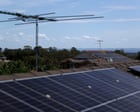
Australia leads world in residential solar per capita with 22GW installed but commercial and industrial sector has deployed only a quarter of that
Get our breaking news email, free app or daily news podcast
Australia’s revolution in rooftop solar has left behind commercial and industrial buildings where installations have lagged far behind homes, according to new analysis.
Australia leads the world in residential solar on per capita terms, with 22GW installed as of last December. But businesses have only installed about a quarter of that – 5.6GW – despite consuming more electricity than households, a report from the Institute for Energy Economics and Financial Analysis (IEEFA) has found.
Its authors argued that helping businesses fill roof spaces with solar could play a major role in adding power generation as coal plants close.
The household battery revolution that could change energy bills … and the world Read moreThe commercial and industrial sector must “play a far larger role in accelerating Australia’s energy transition … if the country is to meet its renewable energy targets”, the report’s authors wrote.
Sign up for the Breaking News Australia emailCommercial and industrial solar “can be deployed faster than utility-scale alternatives, because it generally doesn’t require extensive planning and environmental approval processes, nor new transmission build that can add several years to the rollout of utility-scale power projects”, the report found.
The analysis defined commercial and industrial solar as non-residential, non-utility energy users such as manufacturers, retailers, farms, hospitals and schools.
Co-author Johanna Bowyer, lead Australian electricity analyst at IEEFA, said the power-generating capacity installed on household roofs in Australia was “roughly equal to that of the coal plants in our grids”.
“However, we have not seen the same scale of action within Australia’s commercial and industrial buildings, even though they consume substantially more electricity than the household sector.”
The forecast capacity of the sector was between 17 and 31GW by 2050. “Storage deployment is well behind households, though demand is increasing quickly,” the report noted.
“The technical rooftop potential could be higher than that,” Bowyer said. “If you also include agricultural areas, it could be above 80GW of technical potential.”
Commercial loads in the national electricity market were higher in the middle of the day, the report noted. “The middle of the day is usually when businesses are operating, and that is very well suited to the solar profile,” Bowyer said.
The IEEFA analysis identified four key barriers to uptake, including: that businesses often rent their premises, making investment in long-lived assets more complex; inconsistent network tariff structures; and slow and often unpredictable grid connection processes.
“Tenants might want upgrades because that will reduce their energy bills, but the landlord is the final decision-maker,” Bowyer said, adding that business owners may not “have confidence that their lease is going to be long enough for the upgrades to be paid back”.
The report also suggested business premises are the “missing middle” because “systems are typically too large for residential incentives, such as the Cheaper Home Batteries Program, but too small for the utility-scale Capacity Investment Scheme”.
“We’ve recommended that governments look at incentive schemes that can support this missing middle,” Bowyer said, suggesting as an example an increase to the instant asset write-off for systems and batteries over a certain size.
The report also recommends the review and standardisation of network tariffs, and reform of the economic regulation of distribution services.
In Victoria, the opposition has proposed creating “urban solar parks” to encourage solar and battery installations on commercial and industrial rooftops in greater Melbourne, arguing it would reduce the need for additional transmission lines.
“There are thousands of hectares of roof space on warehouses, factories, buildings in urban areas where we can be putting up solar farms with battery power and using the energy closer to where it’s stored,” state Nationals leader, Danny O’Brien, said last month.
But experts have said increasing rooftop solar was not a viable replacement for building transmission lines. “Victoria’s already got pretty good incentives for commercial and industrial solar,” Bowyer added.
Explore more on these topicsShareReuse this content‘That’s a bad combination’: why Australia may be in for a slushy snow season
4d agoGetting into your comfort zone: easy steps to an electric, snug and sustainable abode
3d ago…… commentsElusive gull drifts thousands of kilometres off course to Australia, turning birdwatching into ‘extreme sport’
5h agoMore than 100,000 cockroaches worth $200,000 seized from NSW breeder in record-breaking bust
3d agoAustralia’s GDP figures are meaningless when the boom in datacentres means destroying jobs and the climate
5d ago…… commentsOne Nation says it wants a Norway-style gas policy – but it’s not actually in favour of higher taxes on profits
6d ago…… commentsSecond wave of South Australia’s toxic algal bloom could be imminent, scientist warns
29 May 2026Damaged, deserted, dilapidated … what comes next for the Great Barrier Reef island resorts lying in ruins?
29 May 2026…… comments‘Gateway to full-scale fracking’: Santos could drill for new gas in Northern Territory within weeks
6d agoGas usage has peaked and is now in structural decline across Australia, report says
31 May 2026