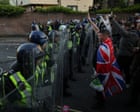
Data discredits claims reawakened by the death of Henry Nowak that UK police actions disadvantage white people
Haroon Siddique, Michael Goodier, Carmen Aguilar García and Vikram DoddFri 5 Jun 2026 11.05 EDTLast modified on Fri 5 Jun 2026 11.39 EDTSharePrefer the Guardian on GoogleThe US government has joined criticism of alleged two-tier policing in the UK in the wake of Henry Nowak’s murder. How did the term enter the mainstream, and is there any basis for the claim?
Where did the concept of two-tier policing originate?
The term, which suggests police deal more harshly with white people than other ethnic groups, first came to prominence through its use by people on the far right. Tommy Robinson, whose real name is Stephen Yaxley-Lennon, complained in 2012 of “a two-tier system where Muslims are treated more favourably than non-Muslims”. He repeated his theory when Muslims were convicted in child sex grooming scandals.
How did it enter the mainstream?
Suella Braverman, the then home secretary, accused police of in 2023 of “double standards” after the Met gave the go-ahead for a pro-Palestine march on Armistice Day.
But the concept of two-tier policing that disadvantages white people really gained traction in 2024, with claims that white far-right “protesters” involved in the Southport riots were treated more harshly because of their race or beliefs.
Robinson, with the support of Elon Musk, was among those making the claims, as was the Reform UK leader, Nigel Farage, who pointed to what he claimed was “soft policing of the Black Lives Matter protests”.
The phrase “two-tier” has become commonplace on the front pages of rightwing newspapers, not always in relation to policing, but emphasising claims that white British people are being disadvantaged more generally.
Is there any truth to the claims?
The comparison of the far-right violence in the Southport riots with Black Lives Matter protests or those organised by pro-Palestinian groups appears to be deeply flawed, given that the latter two were organised protests and involved limited disorder. As Priti Patel observed when she was a Conservative leadership candidate in 2024: “There’s a clear difference between effectively blocking streets or roads being closed to burning down libraries, hotels, food banks and attacking places of worship.”
The Met also took the unusual step of using its mounted branch for the Black Lives Matters protests, and organisers of the pro-Palestinian protesters have complained of restrictions placed on routes that led to the recent convictions of two of them for breaching conditions placed on a protest. The policing inspectorate criticised Braverman’s 2023 comments as “unfair”.
Mounted police try to break up an anti-racism rally in support of Black Lives Matter in London in June 2020. Photograph: James Veysey/Rex/ShutterstockThere were undoubtedly serious policing failures with respect to grooming gangs, but the suggestion that a fear of racism claims was the reason has continued to be contested. Victim blaming has been highlighted as another factor.
What does the data say?
In England and Wales, police use of force, which includes handcuffing, batons and Taser use, is three times more likely to be applied against black people than white people, according to data.
Racial disparities in the criminal justice system often start with arrest. Black people are twice as likely as their white counterparts to be detained.
Even when the use of force is adjusted to account for disparities in the number of arrests, black people were still 1.7 times as likely to have force used against them last year. This is likely to understate the true disparity because only 70% of use-of-force reports led to an arrest.
Black people remained more likely than any other ethnic group to be subjected to almost every form of force, from handcuffing and dog bites to firearms and Tasers, when compared with population or arrest figures.
Police were also 3.8 times more likely to stop and search a black person than a white one in the year up to March 2025.
For people of Asian origin , the picture is mixed. They were slightly less likely than white people to have force used against them or to be arrested, but more likely to be stopped and searched.
How the myth of ‘two-tier policing’ took hold – podcastRead moreHow has policing around race changed over time?
The 1999 Macpherson report into the police failings that left Stephen Lawrence's killers free promised a sea change in how racist crimes were dealt with and how police treated ethnic minorities. It was the second report, after Lord Scarman’s in 1981, to say things must improve.
Macpherson has led to some changes, but lawyers and campaigners say few of the promises have been met, an argument reinforced by the official data.
Police forces got better at dealing with overt racism, but the prejudice alleged in how officers use their powers remains plagued by racial disproportionality, especially against black men.
The Lawrence inquiry, which started in 1998, came after decades of cases in which police had met racist violence with indifference.
In the same area of south-east London where Lawrence was murdered in 1993, Rohit Duggal was killed the previous year and Rolan Adams in 1991. In each case police were criticised for their investigation and reluctance to accept a racial motive.
Some have compared the Nowak case to that of Stephen Lawrence, but in Nowak’s case, the suspect was arrested, charged, tried, convicted and sentenced within six months. In the Lawrence case it took 19 years for two of a gang at at least five to be convicted.
Explore more on these topicsShareReuse this contentNo 10 dismisses US claim of ‘two-tier’ UK policing after Henry Nowak murder
2h agoHenry Nowak: controversy behind US intervention in a murder case that has rocked Britain
4h agoDid police anti-racism policies lead to appalling treatment of Henry Nowak and if not, what did?
2d agoReform’s Andrea Jenkyns storms out of meeting after discussion of Henry Nowak murder
21h ago‘The police can’t do it alone’: head of police watchdog on how to cut crime
30 Mar 2026Starmer accuses Musk of trying to ‘whip up division’ in UK over Henry Nowak murder
22h agoHertfordshire police to reinvestigate Andrew Tate sexual abuse claims
26 Mar 2026Former police officer in hiding after being falsely linked to Henry Nowak arrest
2d agoWatchdog investigating how police handled Andrew Tate sexual abuse claims
25 Mar 2026‘It’s horrible how scared people were’: Southampton picks up the pieces after night of violence
2d ago