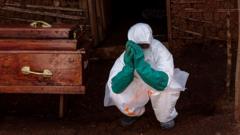
Health workers in the east of the Democratic Republic of Congo are racing against the clock to help Ebola patients manage their symptoms, as well as keep themselves safe and prevent the risk of spreading the virus, while the number of cases continues to rise.
All patients - suspected and confirmed - are isolated and all those who come into contact with them are supposed to wear full personal protective equipment (PPE), and use other equipment to minimise transmission.
One such device is the Cube, a transparent "self-contained treatment unit for highly infectious diseases" that allows a patient to receive medical treatment without direct contact from medical staff.
Created in the aftermath of the 2014-2016 Ebola outbreak in West Africa, the Alliance for International Medical Action (Alima) designed them to allow medical staff to treat patients from outside, with the use of attached tunnel-like gloves.
Jennifer Lazuta/ALIMAThe Cubes have been used in previous Ebola outbreaks, including in DR Congo in 2019"You don't need to have full PPE to be in contact with patients, so it's a very, very important device in this kind of outbreak," says Dr Papys Lame, Alima's Ebola response coordinator.
He tells the BBC it ensures the "necessary standard of care, a positive patient experience and the protection of healthcare workers".
But while these are useful, there are not enough in DR Congo compared to the number of suspected cases of Ebola.
According to Alima, two Cubes arrived in Bunia, the provincial capital of Ituri, the epicentre of the outbreak, over the weekend and are expected to be in use soon. Another two Cubes are on their way to the city.
Supplies of PPE are also limited. On Friday, the International Council of Nurses (ICN) warned of shortages, saying nurses in DR Congo are "scared for their safety because they do not have the equipment to protect themselves".
The Ebola virus spreads from one person to another by contact with infected bodily fluids.
The delay in confirming cases in the early days of the outbreak has seen the virus spread from Ituri to the provinces of North and South Kivu, as well as neighbouring Uganda.
"Unfortunately, Ebola starts very vaguely with a headache, fever and feeling weak," explains Dr Armand Sprecher, an emergency physician and epidemiologist specialising in Ebola for Médecins Sans Frontières (MSF).
"People get what we call malaise - achy in the muscles and the joints, and eventually developing some vomiting, abdominal pain, diarrhoea," which he tells the BBC is "true for a lot of illnesses".
Infectious diseases common in the region such as malaria and typhoid share early symptoms with Ebola.
One less common symptom of Ebola - which can occur later - is bleeding, including from the nose, gums and vagina, and blood in vomit and faeces.
All people showing signs of the virus are initially classified as suspected cases and admitted to treatment centres.
What is Ebola and why is stopping the latest outbreak so difficult?
'Ebola has tortured us': Fear grips eastern DR Congo as deadly virus spreads
'Speed, money and compassion' - lessons from an Ebola survivor and other experts
Lame says people with suspected Ebola have samples taken to determine whether or not they have the virus, and another one 48 hours later if the first comes back negative.
If the second test is negative, they are considered a non-case, and either referred to a hospital or health centre for further care or discharged home if they no longer have symptoms.
For those who test positive, the Alima coordinator says their symptoms are treated until they are no longer symptomatic and "must have two negative laboratory results before being discharged".
Although Ebola patients have to be isolated to avoid transmission, Lame emphasised the importance of individuals' psychological wellbeing, which the Cube helps with.
The Cube's design allows people to visit their loved ones, he says, explaining that during previous outbreaks "patients were separated from their families and communities and were often reluctant to seek treatment".
But while medical teams work around the clock to treat the symptoms of people with Ebola, the testing and confirmation of cases has been slow.
The ICN also said there was a shortage of testing kits.
The authorities say there have been more than 282 confirmed cases of Ebola including 42 deaths, and more than 1,000 suspected cases, more than 220 of whom have died.
There are currently no approved drugs that target Bundibugyo - the species of Ebola responsible for this outbreak - so patients are mainly receiving supportive care and treatment for their symptoms.
This includes oxygen and ventilation to help with breathing, and intravenous fluids to stop dehydration and provide electrolytes lost in vomiting and diarrhoea.
There is no approved vaccine but experimental ones are in development.
Because of the delays in confirming cases, Sprecher says health workers don't have the "usual mapping of transmission" they did with Ebola outbreaks in the past, most of which were caused by the more common species known as Zaire.
"Previously, we would know if the disease was passing through a village, through a family, or through people who went to a funeral, so when the patient came to us, we could ask questions like: 'Were you at that funeral, or do you live in this village?'
"We don't have that sort of knowledge backing us up," he explains.
Health workers are often the most at risk, and have a lot of factors to consider, including their own health and wellbeing.
Sixteen health workers are confirmed to have contracted Ebola during this outbreak.
Last week, five people were discharged after recovering from Ebola. Four were nurses, while one was a laboratory worker.
"We lose patients, which is psychologically difficult," Lame says, adding: "We are human, so naturally we are afraid of being at constant risk from a disease for which there is no treatment."
ReutersMakati Tagirabo (L) and Baraka Bulambula (R) were two of the nurses who have recovered from Ebola in this latest outbreakThe job is also "physically demanding", especially given the equatorial climate they are in.
Sprecher says even if they have the PPE, wearing it is "a problem, because once you put that stuff on, you start getting very, very hot", and so cannot work for long.
"You've got about an hour before you have to take it off again, because people get overheated and sweat a lot. That sweat does not evaporate to cool them off, it just becomes a puddle inside their boots, and they're still hot, and they start getting light-headed and dizzy."
"If medical staff are no longer safe, then it's no longer safe for them to be working there," he explains.
Both Lame and Sprecher say there are safe work practices to protect healthcare workers, including working in pairs.
"You have a buddy system," Sprecher explains, "so that when you're doing something, you have an external observer watching and reminding you, if for example, your hands unconsciously go to your face, they'll say: 'Don't touch your face, watch it.'"
Why does Ebola keep occurring in DR Congo?During a visit to Ituri over the weekend, World Health Organization (WHO) chief Dr Tedros Adhanom Ghebreyesus urged communities to work with health authorities after some local people attacked health centres angered by strict burial rules.
The bodies of those suspected of having died with Ebola are not allowed to be handled by relatives to prevent the risk of spread.
Another issue hampering the Ebola outbreak response is the ongoing conflict in DR Congo.
Ahead of his visit, Tedros called the province the centre of a "catastrophic collision of disease and conflict", warning they could not "build community trust or isolate the sick while bombs are falling".
Ituri has been under military rule since 2021, when the civilian authority was replaced by a military general in an attempt to neutralise dozens of armed groups that operate there.
Large parts of North and South Kivu provinces, where Ebola has been reported are under the control of the M23 rebel group.
"Frontline workers are risking everything, while attacks on health facilities make tracking cases and their contacts nearly impossible," Tedros wrote on X, as he called for all warring parties to agree to a ceasefire to allow medical teams safe access.
However, some aid agencies have been able to get into rebel-held areas.
Alima told the BBC it has health workers in areas under rebel control, including Goma, the largest city in eastern DR Congo.
Similarly, MSF says it has rehabilitated and opened an Ebola treatment centre in Goma, as well as supported the training of medical staff in the city.
Getty Images/BBCGo to BBCAfrica.com for more news from the African continent.
Follow us on Twitter @BBCAfrica, on Facebook at BBC Africa or on Instagram at bbcafrica
BBC Africa podcastsFocus on Africa
This Is Africa
Democratic Republic of CongoAfricaEbola virusRelatedThree Ebola vaccines in development amid growing outbreak fears
Five patients recover from Ebola in DR Congo and leave hospital
Ebola spread in DR Congo 'deeply alarming', MSF warns
More from the BBC3 hrs agoTwo people shot dead amid Kenya protests against US Ebola quarantine centre plan
3 hrs ago4 hrs agoSouth Africa police investigate killing of two Mozambican men
The deaths come after a day of violent protests against illegal migration in the town of Mossel Bay.
4 hrs ago7 hrs agoGhana's anti-LGBTQ+ bill to be scrutinised before approval, president says
7 hrs ago21 hrs agoTwo possible Ebola cases in Brazil ruled out as patients test negative
The two patients had recently returned from the DR Congo and Uganda respectively.
21 hrs ago1 day ago