If you get Global News from Instagram or Facebook - that will be changing. Find out how you can still connect with us.
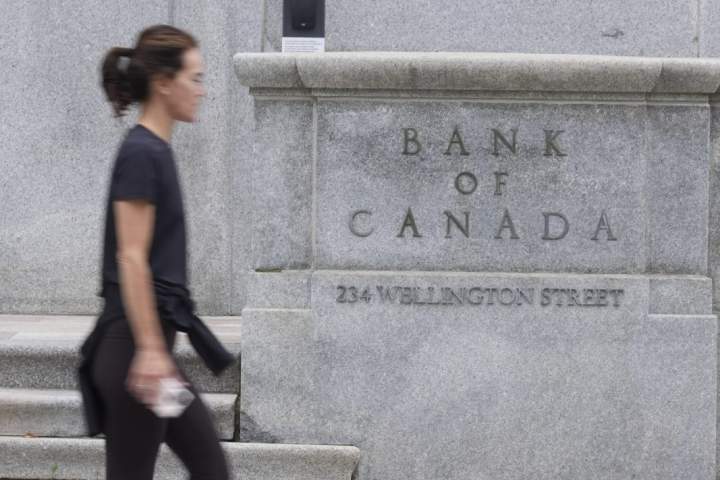
1:50 Bank of Canada hikes key interest rate, signals more increases on horizon WATCH: Bank of Canada hikes key interest rate, signals more increases on horizonThe Bank of Canada raised its benchmark interest rate for the first time in more than three years on Wednesday as it tries to get ahead of looming price hikes.
Already plagued by the rising costs of gas and groceries, consumers will feel the hit.
“A consumer who holds about $200,000 in a variable rate mortgage or a variable-rate home equity line of credit, they will feel about $500 worth of interest cost annually as relates to this,” Lara Stilin, chief financial officer at Your Neighbourhood Credit Union (YNCU), told Global News.
While Wednesday’s hike is less significant than the series of increases issued following the COVID-19 pandemic, experts say people who are already struggling to make ends meet with rising inflation will feel the burden first.
Inflation ticked up to 3.1 per cent in September, which the Bank of Canada has largely attributed to high gas prices.
The central bank now expects annual inflation will hit 3.5 per cent at the end of this year before gradually easing to around two per cent by mid-2028.
Food inflation is expected to average around four per cent in 2027, up about a half a percentage point from this year.
2:05 Business Matters: Inflation rate rises to 3.1% in September- Business Matters: Inflation rate rises to 3.1% in September
- Bank of Canada raises key interest rate to 2.5%, first hike since 2023
“I’m more worried about households that have already stopped eating out, put off big purchases and dipped into their savings, and are still coming up short. For them, another increase doesn’t mean finding one more thing to cut. It means deciding which bill gets paid this month and which one waits until next month,” Kristy Rachkowski, chief member experience officer at YNCU, said in a statement.
Get breaking National news
Get breaking Canada news delivered to your inbox as it happens so you won't miss a trending story. By providing your email address, you have read and agree to Global News' Terms and Conditions and Privacy Policy.Bank of Canada Governor Tiff Macklem said Wednesday inflation is likely to be “more persistent.”
“And I think when you look at it through that risk lens, that also tilted in favour of raising the policy rate now,” he said.
- Stelco owner hopes to recall laid-off steelworkers before Christmas
- Higher tariffs on Canadian imports would be ‘catastrophic,’ Honda exec says
- Stocks held steady after the Fed says it won’t raise interest rates
- Bank of Canada says its interest rate hike is ‘not going to feel good’
What experts say is more concerning for Canadians, is if they can expect more hikes to follow.
“Is this the first of many, or is this first of a few, or is this the first and last, which is still I’d say, unclear right now as the economic situation evolves,” Stilin said.
Macklem said the central bank will take its upcoming rate decisions “one meeting at a time” but also suggested future hikes are still in the cards.
“There could be a need to raise the policy rate further, but given the uncertainties, we will proceed carefully,” he said.
Charles St-Arnaud, chief economist at Servus Credit Union, said in a note to clients that he expects the central bank will deliver back-to-back hikes to end the year with a policy rate of 2.75 per cent.
He said only a weakening economy or softer than expected inflation will prevent a future hike.
Stilin said the majority of Canadians may not need to worry just yet, but said it is prime time to make sure you understand your own budget and the flux space you have within it.
“If you are already feeling the pinch with rising fuel prices, rising grocery prices, now is the time to act,” she said.
Add Global News as a Preferred Source on Google to see more of our stories in your search results.
Journalistic standards Report an error © 2026 Global News, a division of Corus Entertainment Inc.
