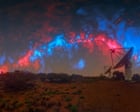
Light from nearly 4m galaxies measured as it twisted and travelled through intergalactic space
Get our breaking news email, free app or daily news podcast
A cosmic map of magnetic fields – the largest ever produced – could help scientists delve into one of the major and most mysterious forces in the universe.
A global team led by Australia’s national science agency, the CSIRO charted the magnetic fields by measuring light from nearly 4m galaxies as it twisted and travelled through intergalactic space.
Sign up for the Breaking News Australia emailDr Alec Thomson, a CSIRO astronomer and astrophysicist said the Earth, stars, galaxies – and the material between galaxies – all had magnetic fields, so the map would enable scientists to investigate fundamental questions about the physics of the universe, and the galaxy we live in.
“We still don’t actually know how magnetic fields started in the universe, or how they’ve changed across time since the big bang. And so this type of map helps us start to answer those questions and be able to look at the details of the magnetic universe.”
CSIRO’s ASKAP radio telescope at Inyarrimanha Ilgari Bundara, at Murchison Radio-astronomy Observatory. Photograph: CSIRO/Alex CherneyThe encyclopaedic chart, now published and named “SPICE_RACS” (Spectra and Polarisation In Cutouts of Extragalactic Sources from the Rapid ASKAP Continuum Survey), was made possible by the country’s most powerful radio telescope array, the Australian Square Kilometre Array Pathfinder – located at the Inyarrimanha Ilgari Bundara observatory in Western Australia. The instrument is capable of scanning immense areas of the sky and deep into the far reaches of distant galaxies.
Prof Naomi McClure-Griffiths, an author of the paper and chief scientist of the Square Kilometre Array observatory, said previous efforts to map magnetic fields didn’t even cover the southern sky.
The largest cosmic map of the universe ever produced“For the past 20 years we have been working with essentially the same dataset,” she said. “Now, we can finally answer some big questions with a much better picture of the universe’s magnetic structures.”
The dataset, which was five times larger and much more detailed than previous efforts, has been made available to scientists around the world, and published by the Astronomical Society of Australia.
Prof Lisa Harvey-Smith, an astrophysicist at the UNSW Sydney, who was not an author of the paper, said there were the two big forces that moved things in space – gravity and electromagnetism.
“We’re really familiar with gravity because it pulls us to the Earth. It keeps us on the planet. It makes the Earth orbit the Sun, it makes the moon orbit the Earth and so on,” she said.
Electromagnetic forces were the other major ingredient. Magnetic fields are a naturally occurring phenomenon, used in magnets and old-fashioned compasses for navigation, but also responsible for creating light and colour. A magnetic field is a physical property that could be created by the movement of charged particles or molten metals in the Earth’s core.
“The Earth is actually a magnet, it creates its own invisible magnetic field,” she said. “And that tells us which way is north and south, that’s really handy.
“If you extend that into space, we actually learn that other objects are magnets as well. Things like stars and galaxies create magnetic fields. And in fact, when you look throughout the emptiest, vastest regions of space we still see magnetic fields.”
Harvey-Smith said it was “wonderful” that the data was being made available as a “true open repository for any person to use”.
“The result of creating the map is not the end product – the end product will be over the next few years with scientists dipping in and doing their own studies of particular star-forming regions or particular galaxies. And there’ll be so many discoveries that flow on from this map.”
Explore more on these topicsShareReuse this contentTwenty-two years and 15,000km later: fluke discovery sets new record for humpback whale journey
19 May 2026‘Foolish’ CSIRO job cuts will mean Australia unable to provide climate projections to global reports, scientists warn
19 May 2026Signs of ‘feeding’ ritual at dingo burial site shed new light on bond between First Nations people and canines
18 May 2026Supermarket foods claiming to be ‘natural’ or ‘sustainable’ mostly just using marketing terms, researchers find
11 May 2026Poached: could a video of tree-climbing egg thieves help save Australia’s vulnerable honeyeaters?
29 Apr 2026…… commentsAustralia is the world’s fourth-largest black truffle producer. Now scientists may have unearthed why
26 Apr 2026‘A history of the Earth’: Twelve Apostles revealed to be as old as 14m years
23 Apr 2026Giant echidnas weighing 15kg roamed Victoria – and the evidence was hiding in plain sight
14 Apr 2026Humans are en route to the moon for the first time in 54 years – and Australia’s Dish is tracking them
2 Apr 2026Australia’s superb fairywren could be extinct within decades due to climate crisis, researchers say
31 Mar 2026