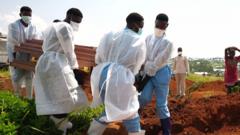
Nyamurongo cemetery in Bunia, a city in north-eastern Democratic Republic of Congo that is the epicentre of the current Ebola outbreak, is much busier than usual.
"Today is the sixth time I have come to the cemetery," says Joel Lonza Makumbu as he explains how the virus has devastated his family and community.
"Yesterday I buried my father. Today I have come to say goodbye to my mother."
As he fills the grave with soil, he says he has also lost three sisters and a brother-in-law to Ebola.
"I want to say for all people [to hear] that Ebola is true."
It is a message he is desperate to communicate as the authorities try to tackle misinformation around the disease which has so far killed almost 200 people in the last few months, mainly in the province of Ituri of which Bunia is the capital.
The current outbreak has been caused by a rare species of Ebola known as Bundibugyo, which kills about a quarter of those infected.
Ebola is transmitted through contact with infected bodily fluids, including blood, urine, vomit, semen and breast milk. Stringent protocols have to be followed to stop it spreading - and safe burials are vital.
One of several gravediggers hard at work at the cemetery tells me that 15 families were currently attending burials - but there is none of the usual crowds, ceremony, singing and other rituals.
One traditional practice that is now strongly discouraged is the washing of dead bodies by family members before burial.
Amensisa Ifa / BBCMany fresh graves can be seen at Nyamurongo cemeteryIt is a tricky and sensitive job to get grieving families to understand why these changes need to be made.
Julienne Anoko, an anthropologist with the UN's World Health Organization (WHO), says mourners would usually dress a dead body in smart clothes while funeral rites could last several days.
She explains that most communities in Ituri believe a dead person needs to look their best as they are "travelling from one world to the other world - to the world of the ancestors".
"Women are dressed in a wedding dress with make-up… They sing, they celebrate that person, because it's a journey, it's not the end of the life," she tells the BBC.
But in the case of someone who has died of Ebola, they must immediately be put in a leak-proof body bag for burial.
Maria Munoz-Bertrand, public health emergency co-ordinator for the International Federation of the Red Cross and Red Crescent (IFRC), says efforts are being made to accommodate the needs of families.
In Ituri this means that coffins are used - with the body bag placed inside. The coffin has a few transparent panels on the side to allow mourners to be able to see inside.
Another change has been to body bags, which now have clear film at the top so the face inside can be seen.
"We need to be very close to the communities and engage with them very closely and make sure that they understand what's going on, they're informed and they consent," says Munoz-Bertrand.
What is Ebola and why is stopping the latest outbreak so difficult?
Recovery of Ebola patients offers rare moments of joy at epicentre of outbreak
"If the family asks for something special to be included in the procedure, as long as it respects the infection prevention and control measures, and it doesn't put anyone at risk, we will try to accommodate the wishes of the family as much as possible, because we understand that it's a very difficult time for families.
"We want to be as supportive as possible, while at the same time protecting them, the community, and our volunteers."
I joined a team of IFRC volunteers as they went to an Ebola treatment centre at a hospital in Bunia to pick up a body for burial.
Family members sat by the roadside waiting to accompany their deceased kin to the cemetery.
One of the groups included a weeping mother who had lost her child.
A tent just outside the treatment centre acts as a temporary morgue or transit zone where we see health workers in full personal protective equipment (PPE) take a body bag and place and seal it inside a coffin.
Anne Soy visits Bunia cemetery: "I have never seen anything like this"They go back to the hospital, their path disinfected as they retreat. Then the IFRC team, made up of six people also in full protective gear, goes inside the tent from the opposite side to pick up the body and take it to a truck.
It contains the body of a 34-year-old mother of four, whose father and brother-in-law quietly observe the process from a distance.
"This is a big blow for us," says her father Simone Nyal.
"She was ill for just one week before she succumbed. She has left us her four children - I don't know how we will cope."
At the cemetery her mother and sister wait by the newly dug grave. In under 10 minutes, the burial is complete. The volunteers decontaminate once again before departing, leaving three gravediggers to cover it with soil.
Anoko, the WHO anthropologist, says it takes patience to help a community at a time like this. Her team listens, condoles with the families and tries to humanise the situation.
"We negotiate to make the family accept the unacceptable. Sometimes it may take three days, but we negotiate, and I use the knowledge of their culture," she says.
Amensisa Ifa / BBCThe volunteers wear full PPE to collect the coffin from the tent that acts as a mortuaryThe most challenging scenario, she tells me, has been negotiating the burial of pregnant women.
The community believes that a pregnant woman should not be buried with the foetus inside her - needing to "travel light" into the afterlife.
This means the foetus is often removed and either buried separately or in the same grave as the mother, she says.
But that would involve interaction with a lot of fluids, the very agent of transmission of Ebola, so Anoko reminds them how ancestors in their culture have foresight.
"I explain to them very clearly that our ancestors have already planned something to repair this type of thing," she says.
Anoko, who has worked through several Ebola outbreaks in DR Congo and West Africa, has been welcomed back by many families as a result of the bond she has built during their most vulnerable moments.
She has managed to bridge the gap between communities and healthcare workers - between science and culture.
But there is still a long way to go for all those involved in the current crisis.
Back at Nyamurongo cemetery, as Joel Lonza Makumbu finishes covering his mother's grave, he tells me he fears he may yet return for a seventh time.
"I have relatives who are in the treatment centres - two sisters in Rwampara and a cousin and another sister [at a different facility].
"I don't know if it will continue like that and I don't know the future. But I want everybody to know that Ebola is real."
More BBC stories on the Ebola outbreak:'Speed, money and compassion' - lessons from an Ebola survivor and other experts
How health workers in DR Congo are treating Ebola and staying safe
'Ebola has tortured us': Fear grips eastern DR Congo as deadly virus spreads
Getty Images/BBCGo to BBCAfrica.com for more news from the African continent.
Follow us on Twitter @BBCAfrica, on Facebook at BBC Africa or on Instagram at bbcafrica
BBC Africa podcastsFocus on Africa
This Is Africa
AfricaDemocratic Republic of CongoEbola virusDiseaseVirusesRelatedAfrican and Caribbean nations call for formal apology for transatlantic slavery
US to stop funding HIV programmes in South Africa
UK law enforcement destroyed my reputation and integrity, ex-Nigerian oil minister tells BBC
More from the BBC1 day agoSix-year-old Ebola patient taken from DR Congo hospital found and 'doing well'
1 day ago2 days agoThe designer behind DR Congo's World Cup suit: 'I wanted to change people's views on Africa'
2 days ago3 days agoSearch for six-year-old Ebola patient after armed men storm DR Congo hospital
3 days ago3 days agoAid donation of £50k for PPE to help combat Ebola
The grant is for health workers' personal protective equipment in the Democratic Republic of Congo.
3 days ago3 days agoBaby's condition is 'as rare as winning lottery'
Hull parents of boy with Krabbe Leukodystrophy determined to make his life as positive as possible.
3 days ago